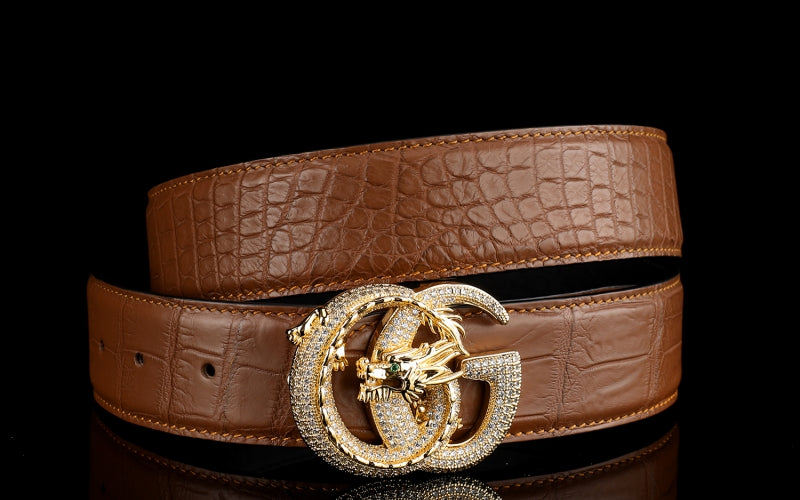
Can You Roll a Crocodile Belt for Travel? (Without Cracking It)
TL;DR:
- Yes, you can roll a crocodile belt for travel — but only in a loose coil with at least a 3-inch (7.5 cm) diameter.
- Never fold a crocodile belt. A fold creates a permanent crease that splits the scale pattern.
- Place the buckle at the center of the coil, wrap in a microfiber cloth or dust bag, and tuck inside your dopp kit edges.
- On arrival, unroll within 24 hours and hang the belt so the leather relaxes back to its natural shape.
Quick Facts
- Safe coil diameter: ≥ 3 inches / 7.5 cm
- Folding tolerance: zero — never fold an exotic belt
- Best wrap material: microfiber cloth or cotton dust bag
- Carry-on placement: dopp kit edges, not under shoes
- Recovery time after unrolling: 12–24 hours hanging
- TSA-friendly buckles: brass or stainless steel prong styles pass easily
I'm writing this from our workshop bench, where a customer's well-traveled crocodile belt just arrived for a check-up. He'd flown 14 hours with it folded in half inside a packing cube — and the fold-line crease across three scales is the kind of damage we can soften but never fully erase. So before your next trip, here's exactly how we pack the same belts we hand-finish in small batches, the ones that ship from our workshop in 2–3 days. Get this right and your belt will outlast the suitcase.

Packing Tonight? The 20-Second Version
Travel-rolling triage:
| Your situation | Go with |
|---|---|
| Suitcase, belt must come | Loose coil, 3-inch minimum diameter, buckle at the center, wrapped in the dust bag. |
| Tempted to fold it flat | Never — a fold creases croc permanently and splits the scale line. Coil or carry it worn. |
| Wearing it through security | Fine — buckles trip scanners sometimes; pull it off into the tray like a watch. |
| Just landed | Unroll within 24 hours and hang it — the leather relaxes back to true. |
Travel-worthy croc that springs back: BELTLEY's belts — and the care guide for the rest.
Can you actually roll a crocodile belt without damaging it?
Yes — a crocodile belt can be safely rolled for travel, but only as a loose coil with at least a 3-inch (7.5 cm) inner diameter. A tight roll or fold cracks the keratin scales along the bend line, leaving a permanent crease. Loose coiling distributes tension evenly across the hide.
Crocodile leather is structurally different from cowhide. The scales sit on top of a dermis layer in a tile-like pattern, and each scale boundary is a natural stress point. When you bend the belt around something smaller than your fist, you concentrate force on those boundaries. According to a Wikipedia overview of crocodile leather, the unique cellular pattern that makes the hide beautiful is also what makes it more bend-sensitive than smooth leathers.
Our rule on the bench is simple: if the inner curve of the coil can swallow a tennis ball, you're safe. If it can't, you're crushing scales.

The diameter rule: why 3 inches is the magic number
A 3-inch (7.5 cm) inner diameter keeps the bend radius wide enough that the scale boundaries flex rather than crack. Below that, you're entering fold territory.
Here's how to check without a ruler:
- Fist test: Make a loose fist — that's roughly 3 inches across. The coil should be at least that wide.
- Coffee mug test: A standard ceramic mug is about 3.5 inches in diameter. Coil your belt loosely around the outside of the mug, slide it off, and you've got a perfect travel coil.
If you want a deeper read on why exotic hides need this kind of handling year-round, our leather care guide breaks down the chemistry of why crocodile, alligator, and python all behave differently from cowhide.

How do I roll the belt step by step?
Lay the belt flat with the scaled side facing up. Place the buckle at one end and begin coiling toward it, keeping the coil loose. When the buckle reaches the center of the coil, you're done. The buckle should be cushioned by the surrounding leather, never touching the outer surface of the belt.
Step-by-step:
- Clean and condition first. Wipe the belt with a dry microfiber. If it's been a humid season, our conditioning routine protects the scales before they sit folded against fabric for hours.
- Lay flat, scales up. Smooth the strap on a clean surface.
- Start from the tip (not the buckle). Begin a loose coil at the leather tip, working toward the buckle.
- Buckle to center. End with the buckle sitting in the middle of the coil. This protects the scales from buckle prongs and keeps metal away from your other belongings.
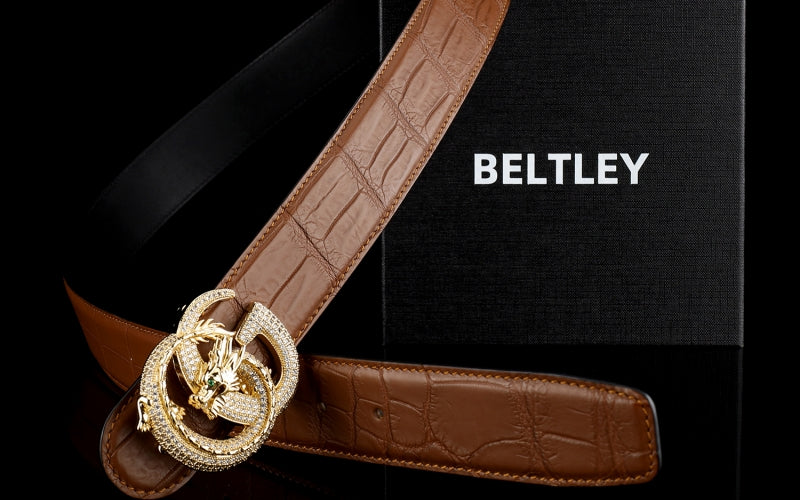
- Wrap in microfiber or a dust bag. A cotton dust bag (the kind that comes with every BELTLEY belt) prevents friction marks and absorbs ambient moisture.
- Secure with a soft hair tie — never a rubber band. Rubber bands leave indentations and can react chemically with leather finishes.

Why should the buckle go in the center?
Centering the buckle protects the scales from being scratched by the metal hardware and prevents the prong from puncturing the leather face. It also balances the weight of the coil so it doesn't unspool inside your luggage and snag on zippers, watch bands, or cufflinks.
We use stainless steel buckles on most BELTLEY belts, and while that grade is corrosion-resistant and gentle on skin, it's still harder than crocodile leather. A loose buckle bouncing against scales for 12 hours of flight time can leave hairline marks that look like cracks under store lighting. Center the buckle, wrap the bundle, and it can't move.
For TSA, prong-style brass and stainless steel buckles pass through security without issue. Large rhinestone, plaque, or sculpted animal-head buckles can sometimes trigger a secondary screen — not a problem, just slower. Consistent with general TSA carry-on guidance, keep statement hardware in carry-on so you can hand-inspect if asked.

Why you should never fold a crocodile belt
A fold puts the entire bending force on a single line of scales. Unlike a loose coil, which distributes flex across the whole length, a fold creates a 180-degree crease at one point. The result is what we call "the airline crease" — a permanent pale line across the scale pattern that no conditioner can remove.
Cowhide belts can sometimes recover from a fold after a few days of hanging. Crocodile, alligator, and elephant cannot. The scale boundaries lose their structural memory, and the leather underneath develops a flex point that gets worse with every wear.
If you're choosing between a small carry-on and folding the belt, the answer is to wear it on the plane.
Where should the rolled belt go inside your luggage?
Tuck the coiled belt along the inside edge of your dopp kit or inside a structured shoe bag — never under heavy items in the main compartment. Pressure from stacked shoes, books, or a packed laptop is what flattens the coil into a fold during transit.
Our recommended placements, in order of preference:
- Inside a hard-sided dopp kit. The walls protect the coil from compression.
- Inside a sunglasses case (for slim 1" or 1.18"/30 mm belts only). A perfect rigid home.
- Inside a shoe, on top. Counterintuitive, but a clean dress shoe is a structural cylinder. Just don't bury the shoe under others.
- In the carry-on, not checked. Cabin pressure and temperature swings in cargo holds can accelerate leather drying.
For a 7-day trip with two belts, we recommend coiling both and storing them in the same dust bag — one on each side, buckles tucked center, with a folded microfiber between them. This works perfectly for pairing a black crocodile dress belt with a casual full-grain everyday belt.
Key Takeaways (Mid-Post)
- Loose coil only, never fold, never tight roll.
- 3-inch / 7.5 cm minimum diameter for the inner curve.
- Buckle to center, scales protected from metal.
- Wrap in cotton or microfiber, secure with a soft tie.
- Carry-on placement in a dopp kit or rigid case — not under heavy items.
- Unroll within 24 hours of landing and hang to settle.
What should you do with the belt as soon as you land?
Within 24 hours of arrival, unroll the belt, hang it from a sturdy hanger or hook, and let gravity pull it back to its natural straight shape. Leaving it coiled for days after travel can set a curve into the leather memory, especially in humid climates.
Hanging works best on a wide wooden hanger — wire hangers create pressure points. If you're staying in a hotel, the closet rod itself is fine; loop the belt over so the buckle hangs free. After 12–24 hours, the leather will have relaxed, and a light buff with a microfiber will restore the surface gloss.
If the belt feels dry on arrival (common after flights into desert climates like Dubai, Las Vegas, or Phoenix), wait until it's hung overnight, then apply a pea-sized amount of reptile-safe conditioner. Our exotic leather care page lists what's safe and what to avoid — most cowhide conditioners are too aggressive for scaled hides.
Are crocodile belt buckles TSA-friendly?
Most BELTLEY buckles — prong, ratchet, and box-frame styles in brass or stainless steel — pass through TSA screening without issue. Larger sculpted plaque buckles, especially with rhinestones or animal-head designs, may trigger a manual inspection but are not prohibited.
A short pre-flight checklist:
- Belts you can leave on through screening: thin prong-style belts under 1.5" (38 mm) wide with a small buckle.
- Belts to remove and place in the bin: anything with a wide plaque, rhinestones, or heavy metal hardware.
- Belts to pack instead of wear: elaborate buckles with raised stones or carved details — packed, they can't be scratched by the bin.
Our men's belts collection and women's belts collection both list buckle weights and styles, so you can pick travel-friendly options before booking.
The Bottom Line
A crocodile belt can travel anywhere you go — as long as you respect the scales. Loose coil, buckle centered, wrapped in cloth, packed where nothing crushes it. Never fold, never tight-roll, and always unroll within a day of landing. At BELTLEY, we hand-finish every exotic belt in small batches and ship in 2–3 days, which means the belt that arrives at your door has been kept flat and conditioned right up to the moment it's boxed. Treat it the same way on the road, and a properly cared-for crocodile belt easily lasts 20+ years — which is why we back every one with a 10-year materials and construction warranty. Ready for one that earns its frequent-flyer miles? Browse the exotic leather belt collection or get sized first with our size guide.
Frequently Asked Questions
Q: Can I fold a crocodile belt if I'm only flying for a few hours?
No. Even a 90-minute flight is long enough for a fold to set a permanent crease into crocodile scales. The damage is mechanical, not time-based — a single 180-degree bend under any pressure is enough.
Q: Will a rolled crocodile belt fit inside a standard suit carrier?
Yes. A loosely coiled belt at 3-inch diameter is roughly the size of a small bagel and fits inside the accessory pouch of nearly every garment bag. Place it near the top so other items don't compress it.
Q: Should I store my crocodile belt rolled at home too?
No — store belts hanging on a wide hanger or laid flat in a drawer. Coiling is a travel-only technique. Long-term coiling can create a memory curve, especially in warm storage conditions.
Q: Can I check a crocodile belt in my main luggage?
You can, but we don't recommend it. Cargo holds experience temperature drops and pressure swings that accelerate leather drying. Carry-on placement keeps the belt in stable cabin conditions throughout the flight.
Q: How long does a properly traveled crocodile belt last?
With correct packing and our recommended care routine, a BELTLEY crocodile belt is built to last 20+ years of regular wear — and is backed by our 10-year warranty on materials and construction.
By the BELTLEY artisan team — handcrafting exotic leather belts since 1999.
Last updated: May 10, 2026.
%20diameter.%0A%0ANever%20fold%C2%A0a%20crocodile%20belt.%20A%20fold%20creates%20a%20permanent%20crease%20that%20s...)