How to Replace a Broken Belt Buckle — DIY Guide
Quick answer: To replace a broken belt buckle, first identify how it's attached — snap-button, screw, or sewn-in. Snap and screw buckles swap in 5 minutes with no tools or just a screwdriver. Sewn-in buckles require cutting the stitching, fitting a new buckle, and re-stitching or adding snaps. Always match the new buckle's bar width to your belt's strap width.
Last updated: June 2026 • By BELTLEY Editorial
TL;DR:
- Step one is identifying the attachment: snap, screw, or sewn-in — it decides everything.
- Snap and screw buckles are true 5-minute DIY jobs; sewn-in buckles need cutting and restitching.
- The new buckle's center-bar width must match your strap width or it won't fit.
- If the leather is also failing, replace the belt — a new buckle on a cracked strap is a short-term fix.
A broken belt buckle doesn't have to mean a dead belt. Most quality belts are built so the buckle can be swapped, and the whole job often takes less time than tying your shoes. The catch is that "broken buckle" covers everything from a bent or snapped prong to a cracked frame to a stripped snap — and the fix depends entirely on how your buckle attaches to the strap. A buckle has a few core parts (frame, bar, and prong), and knowing which part failed tells you whether to repair or replace. This guide walks through every attachment type, the tools you need, and the honest line where DIY stops making sense. For the styling side of swapping hardware, pair it with our types of belt buckles overview.
Broken Buckle Triage: Fix Path in 20 Seconds
Match your attachment, get your repair:
| Your situation | Go with |
|---|---|
| Snap-button attachment | Hand-swap in two minutes — buy a matching-width buckle and pop it on. |
| Chicago screws | Flat-head screwdriver, five minutes — the friendliest repair in leather goods. |
| Sewn-in construction | Cobbler territory ($15–$30) — or the moment to evaluate the whole belt. |
| Cheap belt, broken buckle | Replace the belt — a $15 repair on a $20 bonded strap is sentiment, not sense. Full-grain from $58. |
Belts whose buckles don't break: BELTLEY's collection — solid hardware, 10-year warranty.
How do you know if your belt buckle can be replaced?
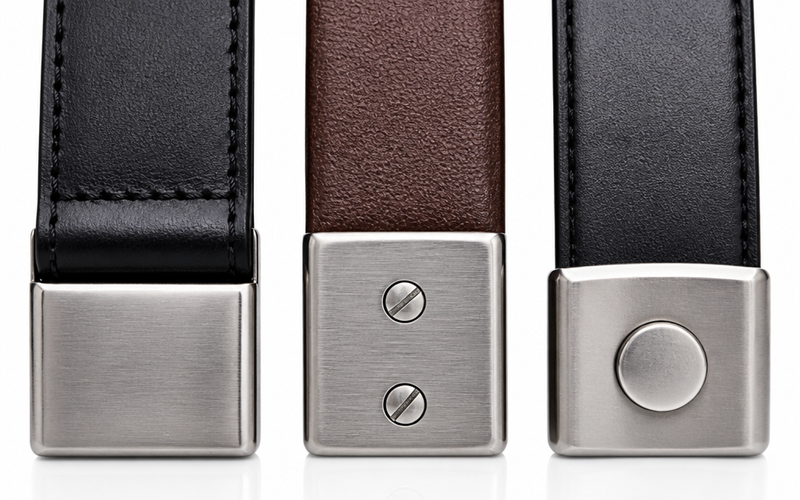
Look at where the buckle meets the strap. If you see metal snaps (small round studs) near the buckle, it's snap-on and removable by hand. If you see tiny screws (often Chicago screws), it's screw-back and removable with a screwdriver. If the leather wraps the buckle bar with stitching and no visible fasteners, it's sewn-in and harder to change.

This single check determines your whole approach. A buckle is held to the strap at the bar, and how that connection is made — snap, screw, or stitch — is the deciding factor, as covered in the reference on the buckle. Removable designs were made to be swapped; sewn-in designs were made to be permanent. Art of Manliness's complete guide to men's belts breaks down these buckle and attachment types in plain terms if you want the wider context first. Our deeper guide on whether you can put a buckle on any belt covers compatibility in detail — the short version is that strap width and attachment style must match.
How do you replace a snap-on belt buckle?
Unsnap the old buckle by pulling the strap end free of the snap studs, slide the buckle off the bar, slide your new buckle on, and re-snap the strap. It takes about two minutes and needs no tools. If the snaps feel loose afterward, a few light taps with a snap-setting tool tightens them.

Snap-on belts are the easiest to live with because the buckle is meant to come and go. This is the same mechanism behind interchangeable "ratchet" and Western belt systems. If your snaps are worn out rather than the buckle, replacement snap sets are cheap and easy to install. Browse removable-buckle options in the BELTLEY belt buckles collection to see how the system works.
How do you replace a screw-back belt buckle?
Unscrew the small fasteners (usually Chicago screws) holding the strap to the buckle bar with a flathead or Phillips screwdriver, lift off the old buckle, position the new one, and re-tighten the screws. A drop of thread-locker on the screws prevents them loosening with daily wear.

Screw-back buckles are the favorite of belt makers because they're secure and swappable. The only common issue is screws working loose over months of flexing — thread-locker or a periodic re-tighten solves it. Here's how the attachment types compare for a DIY swap:
| Attachment type | Tools needed | Difficulty | Time | Re-stitch? |
|---|---|---|---|---|
| Snap-on | None | Easy | ~2 min | No |
| Screw-back (Chicago screw) | Screwdriver | Easy | ~5 min | No |
| Sewn-in (stitched) | Seam ripper, needle/awl, thread or snap kit | Hard | 30–60 min | Yes |
| Riveted | Drill/rivet remover + rivet setter | Hard | 30+ min | No (re-rivet) |
How do you replace a sewn-in belt buckle?
Carefully cut the stitching that wraps the strap around the buckle bar with a seam ripper, remove the old buckle, wrap the leather around the new buckle's bar, and secure it — either by re-stitching with a needle and waxed thread, or by adding snap fasteners for easier future swaps. Match the buckle bar to your strap width first.

Key stat: A standard men's dress belt uses a 35mm (1.38") strap and a men's casual belt a 38mm (1.5") strap — so a buckle sized for one will sit loose or won't slide onto the other. Always confirm the bar width before buying a replacement.
This is the one job that crosses from "quick fix" into "small project." Many people convert a sewn-in belt to snaps during the repair so the next swap is effortless — our deep dive on sewn-in vs screw-back vs snap-button buckles compares all three attachment styles. If you'd rather not sew, a cobbler or leatherworker can do it in minutes. For sizing the replacement correctly, our standard belt width in mm guide lists every common width, and the size guide helps confirm overall fit.
When should you replace the whole belt instead?
Replace the belt when the leather itself is failing. If the strap is cracked, stretched thin, splitting at the holes, or peeling (a sign of bonded or genuine-leather construction), a new buckle won't save it. A premium buckle on worn-out leather is wasted money — and a cheap zinc buckle that shattered will likely do so again.

This is where buckle quality matters. A buckle that broke cleanly under normal use was probably die-cast zinc alloy, not solid brass or steel. BELTLEY's 3-Material Rule — full-grain leather + stainless or solid brass buckle + sealed edges — exists precisely to prevent both failure modes: leather that cracks and hardware that snaps. A belt built to that standard rarely needs either repair, and when something does go wrong, it's covered by the 10-year warranty.
The Bottom Line
Replacing a broken belt buckle is genuinely easy once you've identified the attachment type. Snap-on and screw-back buckles swap in minutes with little or no tooling, while sewn-in buckles take a seam ripper, a little patience, and a matching bar width. The judgment call is knowing when to stop: if the leather is cracked or the original buckle was flimsy cast metal, you're better off starting fresh with hardware built to last. At BELTLEY, every belt pairs full-grain leather with a solid brass or stainless buckle for exactly that reason. If your old belt is past saving, explore the full collection of belt buckles and belts and read up on the point of a buckle before you choose.
Frequently Asked Questions
Q: Can any buckle fit any belt?
No. The buckle's center-bar width must match your strap width, and the attachment style (snap, screw, sewn) has to be compatible. A 38mm buckle won't sit right on a 32mm strap. Always measure your strap width before buying a replacement buckle.
Q: What tools do I need to change a belt buckle?
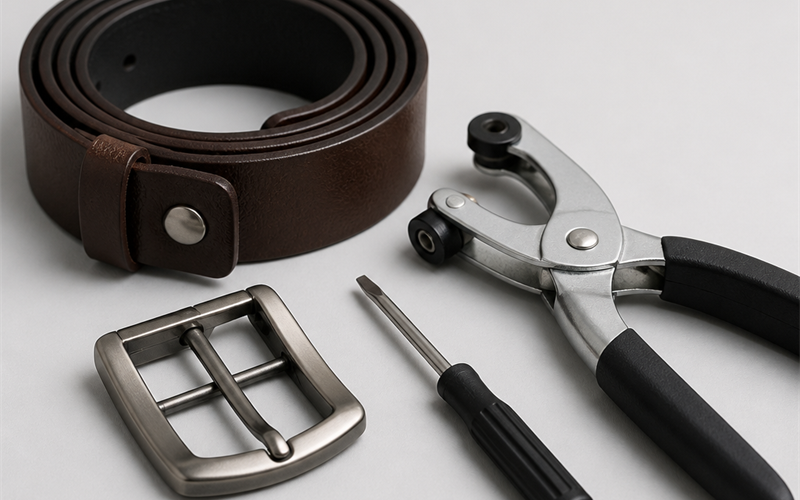
For snap-on buckles, none. For screw-back buckles, a small flathead or Phillips screwdriver. For sewn-in buckles, a seam ripper plus either a needle and waxed thread or a snap-fastener kit. Thread-locker is a useful extra for keeping screws tight.
Q: How do I remove a belt buckle that has no visible screws or snaps?
It's likely sewn-in or riveted. Look for stitching around the buckle bar — cut it with a seam ripper to free the buckle. If it's riveted, the rivets must be drilled or cut out and replaced. When in doubt, a cobbler can remove it without damaging the leather.
Q: Is it worth replacing a belt buckle or just buying a new belt?
If the leather is in good shape and you like the belt, replacing the buckle is cheap and worthwhile. If the leather is cracked, stretched, or peeling, buy a new belt — a good buckle on bad leather won't last.