How Much Should a Leather Belt Cost? The Unfiltered Truth
TL;DR: Quick Answer
- A good leather belt should cost between $75 and $150. This range gets you full-grain leather, solid hardware, and handcrafted construction that lasts 10+ years.
- Below $50, you're buying disposable leather — bonded or genuine-grade material that cracks and peels within 1-3 years. Above $200, you're mostly paying Brand Tax.
- The real metric is cost-per-year, not sticker price. A $100 belt lasting 10 years ($10/year) beats a $30 belt replaced every 18 months ($20/year) — and looks better the entire time.

You're standing in a store (or scrolling online) staring at leather belts priced anywhere from $18 to $600. They all look roughly similar. They all say "leather." So how much should a leather belt actually cost — and what are you really paying for at each price point?
The answer depends on what's inside the belt, not what's printed on the tag. Leather quality, hardware grade, construction method, and brand markup create a massive pricing spread for products that look deceptively alike on the surface. This guide breaks down exactly what you get at each price tier, where quality peaks before diminishing returns set in, and how to identify the sweet spot where your money goes furthest. For a deeper look at why leather belts are expensive at the material level, that companion guide covers tanning, sourcing, and labor costs in detail.

What Should You Expect to Pay for a Quality Leather Belt?
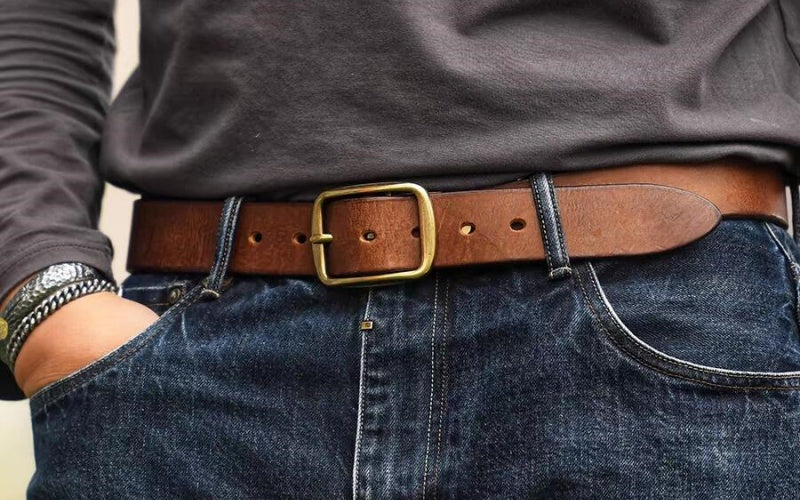
A quality leather belt — one made from full-grain leather with solid hardware and proper construction — should cost between $75 and $150. This range consistently delivers the best balance of material quality, durability, and long-term value without the inflated brand markups that dominate the $200+ tier.
According to Hoplok Leather's pricing analysis, the $80–$150 range represents the "Quality Sweet Spot" — full-grain leather capable of lasting over a decade, paired with brass or stainless steel buckles and hand-finished edges. Above $250, the correlation between price and quality breaks: you're no longer paying for better leather — you're paying for the ecosystem around it.
Szoneier Leather's cost guide confirms this range, noting that mid-range belts ($75–$150) offer "full-grain or top-grain leather, solid hardware, stitched edges, and better tanning/finish" with an expected lifespan of 3-7+ years of regular use. That lifespan extends to 10-20 years for well-maintained full-grain belts in this tier.

The Complete Leather Belt Price Breakdown
Here's what you're actually getting at each price point, based on industry material costs and construction methods:
| Price Tier | Leather Grade | Hardware | Construction | Expected Lifespan |
|---|---|---|---|---|
| Under $30 | Bonded or PU leather | Plated zinc alloy | Machine-glued edges | 6-18 months |
| $30–$50 | Genuine/split leather | Plated zinc or thin brass | Machine-stitched, painted edges | 1-3 years |
| $50–$80 | Top-grain leather | Basic brass or steel | Machine-stitched, basic burnishing | 3-5 years |
| $75–$150 | Full-grain leather | Solid brass or 316L stainless | Hand or lock-stitched, burnished edges | 10-20+ years |
| $150–$300 | Full-grain or exotic leather | Premium hardware | Artisan handcrafted | 15-25+ years |
| $300+ | Same as $150-$300 tier | Same or similar | Same or similar | Same — you're paying Brand Tax |
The jump from $50 to $100 represents the biggest quality leap in the entire spectrum — you move from top-grain to full-grain, from plated to solid hardware, and from machine assembly to hand-finished construction. The jump from $150 to $400 buys you a logo, not a better belt.

What Drives the Price of a Leather Belt?
Four factors determine a belt's real cost — and understanding them prevents you from overpaying for any of them.
1. Leather Grade and Sourcing
Raw full-grain leather costs $10–$15 per square foot, while top-grain runs $5–$8 and split/genuine grades cost $2–$4, according to Szoneier Leather's material breakdown. A single belt uses approximately 2-3 square feet of leather, so the hide itself represents $20–$45 of a full-grain belt's cost.
Exotic leathers — crocodile, alligator, elephant, python — command significantly higher raw material costs due to limited supply and specialized tanning. BELTLEY's exotic leather belt collection ranges from $128–$299, reflecting the genuine material premium rather than an inflated markup.
2. Hardware Quality
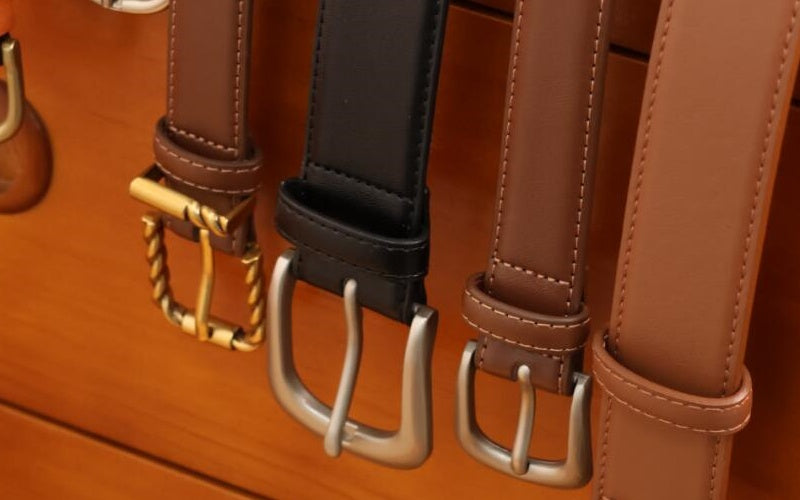
Buckle material creates a surprisingly large cost gap. Solid brass or 316L stainless steel buckles cost $5–$15 per unit to produce, while plated zinc alloy buckles cost $1–$3. The difference shows up within months: cheap zinc buckles lose their finish, corrode, and can snap under daily stress, while solid brass and stainless steel hold their appearance indefinitely.
At BELTLEY, we use 316L stainless steel exclusively — the same surgical-grade alloy used in high-end watches. It costs more per buckle, but it won't tarnish, corrode, or trigger skin reactions.

3. Construction Method
This is where the labor cost sits — and it's the factor most invisible to buyers.
Mass-produced belts ($30–$60) use automated edge painting (a spray-on coating), machine stitching, and minimal hand involvement. A single worker can produce dozens of belts per hour.
Handcrafted belts ($80–$200) involve manual edge burnishing — an artisan spending 20-30 minutes per belt repeatedly sanding and waxing each edge. Hand or lock stitching adds another 15-20 minutes. Leatherworker.net forum discussions among professional leatherworkers confirm that a properly hand-finished belt requires 45-90 minutes of skilled labor.
The result: burnished edges resist moisture and fraying for decades, while painted edges chip and peel within the first year.
4. Brand Markup (The Brand Tax)
This is the factor that distorts pricing the most. Luxury fashion houses typically use an 8x to 12x markup on production costs, while craft-focused DTC brands multiply by 2x–3x. That means a belt costing $40 to produce retails at $80–$120 from a DTC brand — or $400 from a designer label.
Where does the designer premium go? According to a McKinsey & Company report on luxury fashion spending, luxury brands spend 12–18% of revenue on marketing alone — more than double the cross-industry average. Add Fifth Avenue retail rent, celebrity partnerships, and glossy packaging, and you understand why a $400 designer belt often uses the same materials as a $120 DTC alternative.
For a full breakdown of designer pricing, our guide on why designer belts are so expensive covers all 12 cost factors in detail.

Is It Worth Buying an Expensive Leather Belt?
Yes — but only up to a point. The relationship between price and quality follows a curve, not a straight line. Quality rises steeply between $30 and $150, plateaus between $150 and $250, and flatlines above $250. Every dollar above that threshold buys brand prestige, not better leather.
The cost-per-year calculation makes this concrete:
| Belt | Price | Lifespan | Cost Per Year | Appearance Over Time |
|---|---|---|---|---|
| Bonded leather | $20 | 1 year | $20/year | Peels, delaminates |
| Genuine leather | $40 | 2 years | $20/year | Cracks, flakes |
| Full-grain (DTC) | $100 | 10+ years | $10/year | Develops rich patina |
| Full-grain (designer) | $400 | 10+ years | $40/year | Same patina, same leather |
The full-grain DTC belt costs one-quarter per year of the designer version while delivering identical material performance. For a deeper exploration, our guide on is it worth buying an expensive belt covers the value equation from every angle.

How to Avoid Overpaying for a Leather Belt
Five rules to protect your money:
1. Check the leather grade first. "Genuine leather" and "real leather" are marketing terms, not quality guarantees. Look specifically for "full-grain leather" on the product page. If the grade isn't listed, the brand is hiding it. Our full-grain vs. genuine leather comparison explains exactly why this distinction matters.
2. Examine the buckle material. Product descriptions should specify brass, stainless steel, or the exact alloy. "Metal buckle" or "alloy buckle" usually means plated zinc that will corrode.
3. Look at the edges. Burnished edges (smooth, slightly glossy, no visible coating layer) indicate hand-finishing. Painted edges (thick, opaque coating on the edge) indicate mass production.
4. Compare cost-per-year, not sticker price. A belt with a 10-year warranty signals that the manufacturer trusts their materials. A belt with no warranty — or a 90-day warranty — tells you the same thing.
5. Question the brand markup. If two belts use the same leather grade and hardware type but one costs 3x more because of a logo, you're buying marketing — not materials.

The Bottom Line
A leather belt should cost $75–$150 for full-grain leather with quality hardware and handcrafted construction. Below $50 buys disposable material. Above $200 buys a brand name. The sweet spot — where your dollar converts most efficiently into lasting quality — sits right in between.
When shopping, focus on four things: leather grade (full-grain), hardware material (solid brass or 316L stainless), construction quality (burnished edges, lock stitching), and warranty length (10+ years signals confidence in materials). Skip the logo, skip the designer markup, and invest in the belt itself.
Browse BELTLEY's full-grain leather belt collection — handcrafted belts starting at $58, every piece backed by a 10-year warranty, free worldwide shipping, and 30-day hassle-free returns.
Frequently Asked Questions

Q: Why are some leather belts so cheap?
Cheap leather belts ($15–$40) use bonded leather (leather dust glued to fabric) or genuine/split leather (the lowest usable hide grade). They're made with plated zinc buckles and machine-glued or painted edges. These materials degrade quickly — expect cracking, peeling, or buckle failure within 1-3 years.
Q: Are $400 designer belts worth it?
From a materials standpoint, rarely. A $400 designer belt typically uses the same full-grain or top-grain leather as a $100-$150 DTC belt. The extra $250+ covers retail overhead, marketing, and brand prestige — not better leather or hardware. See our full analysis of why designer belts are so expensive.
Q: How much does it cost to make a leather belt?
A full-grain leather belt costs roughly $35–$55 to produce — including leather ($20–$45), hardware ($5–$15), and 45-90 minutes of skilled labor. DTC brands typically retail at 2-3x production cost ($80–$150). Designer brands retail at 8-12x production cost ($300–$600).
Q: Is a $100 leather belt worth it?
Yes — $100 is the threshold where you consistently access full-grain leather, solid metal hardware, and hand-finished construction. A $100 full-grain belt lasts 10+ years (cost-per-year: $10), while a $30 genuine leather replacement cycle costs $20+ per year and looks worse from day one.
Q: How long should a leather belt last for the price?
At minimum: $30–$50 belts should last 1-3 years. $75–$150 belts should last 5-15 years. Belts over $100 in full-grain leather with solid hardware, like those in BELTLEY's full-grain collection, should last 10-20+ years with basic care.