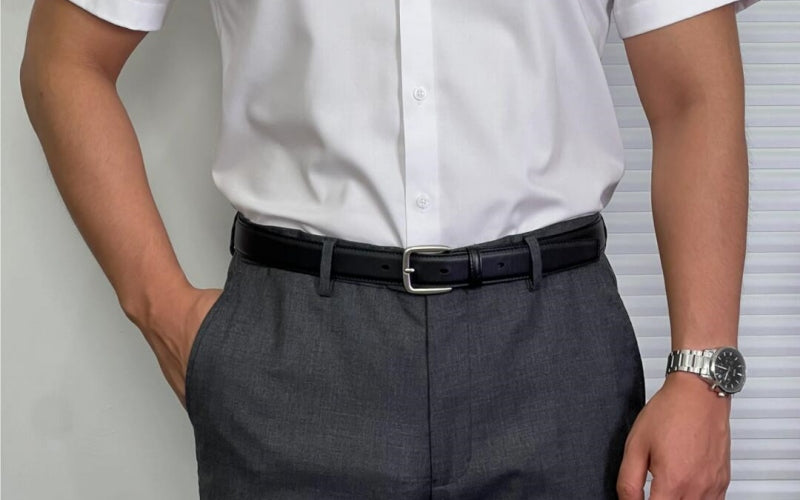
How Far Should a Belt Extend Past the Buckle?
TL;DR: Quick Answer and main takeaways
- Your belt should extend 2–4 inches past the buckle after fastening — this is the universally accepted rule.
- The tail should end between your first and second belt loop, ideally tucked through that first loop.
- Achieving the right tail length starts with buying the correct belt size, not with brute-forcing the buckle hole.

There's a simple answer here, and it's this: after buckling, the tail of your belt should extend 2–4 inches past the buckle. The tip of the belt should pass through — or land just past — your first belt loop on the left side. That's the clean, balanced look that says you bought the right size and put it on correctly.
What this post is really about is everything that goes wrong around that simple rule — and why so many belts end up flapping around with six inches of sad leather tail, or pulled so tight that the buckle sits at the hip. That's a sizing problem, not a style problem. Here's how to fix it.

The 2–4 Inch Rule: What It Means in Practice
After you buckle your belt, the excess strap past the buckle — called the belt tail — should measure between 2 and 4 inches. That tail should reach through your first belt loop comfortably, with a little length to spare, but it shouldn't be long enough to reach the second loop or dangle below it.
The practical target: 2 inches for formal outfits, 3–4 inches for casual wear. On a slim dress belt worn with a suit, a shorter tail looks cleaner and more intentional — there's less visual noise at the waist. On a wider leather belt worn with jeans, a slightly longer tail sits naturally and doesn't look trimmed to the point of awkwardness. Either way, the tail stays tucked into that first belt loop rather than sticking out like a pointer.
Elliot Rhodes, a custom beltmaker with decades in the trade, puts it plainly: a well-fitted belt should buckle at the middle hole — and the tail length lands correctly as a natural result of that. If you're at the first or last hole, the belt doesn't fit. That's the core of the whole thing.
Why the Middle Hole Is the Key to Correct Tail Length
Most leather belts come with five holes, spaced roughly 1 inch apart. The design assumption is that you'll buckle at hole three — the middle one — which gives you two holes' worth of adjustment room in either direction for weight fluctuations, different trousers, or whether or not you just had a large lunch.
When you buckle at the middle hole, the tail length works out to approximately 2–4 inches almost automatically, because standard belt sizing is built around this assumption. The reason people end up with too-long tails isn't bad posture or unusual belt loops — it's that they bought the wrong belt size.
Effortless Gent's belt sizing guide recommends buying a belt 1–2 inches larger than your actual trouser waist. So if your pants are a 32, buy a 34-inch belt. If your pants are a 36, buy a 38. This gets you to that middle hole for your normal waist measurement, with the correct tail length as a side effect. Size up by more than 2 inches and you'll be buckling at the first or second hole with too much tail. Size down and you're at hole five with barely any tail at all and a buckle that sits awkwardly off-center.
You can check BELTLEY's size guide for a complete breakdown of how to measure your waist correctly and which belt size to order — it takes about 60 seconds and saves the hassle of exchanges.

Does the Rule Change for Formal vs. Casual Wear?
The target window stays the same — 2–4 inches — but formality level affects where in that range you should aim.
For dress trousers and suits: Target the lower end of the range (2–2.5 inches). A shorter tail on a slim dress belt keeps the waistline clean and doesn't draw visual attention. Dress belts are narrower (1" to 1.25"), which means even a modest tail length is more visible in proportion to the strap width. Keep it short, keep it tucked, and let the buckle do the talking.
For jeans and casual trousers: 3–4 inches is a comfortable target. A wider full-grain leather belt at 1.5" has more visual weight, and a slightly longer tail looks natural rather than clipped. This is also the range where the Art of Manliness' belt guide suggests the first belt loop acts as the natural stop — the tail threads through it and stays put rather than moving around during the day.
The one absolute: a tail longer than 4–5 inches looks wrong in any context. It's not a hard-and-fast style rule handed down from fashion gods — it just looks like the belt doesn't fit. Same goes for a tail so short the tip doesn't make it through the first loop. Both signal the same thing: wrong size.

What to Do When Your Belt Tail Is Too Long
This is the practical question most style guides skip. You bought a belt, it buckles fine at the hole you use, but the tail hangs four inches past your first loop and it looks messy. Your options:
Tuck it more aggressively. Some dress trousers have a keeper loop specifically sized for excess tail. Use it. If your pants don't have one, you can thread the tail back behind the main strap — it sits flat against the waistband and stays invisible.
Have it trimmed. A leatherworker or cobbler can trim a leather belt tail and re-punch the tip hole for $10–$20. This is the cleanest long-term solution if the belt fits correctly at the hole you use but has consistently too much tail. It's worth doing on a quality belt you plan to keep.
Buy the correct size. If you're consistently on the first or second hole with a long tail, the belt is too big. That's not a tailoring problem — it's a sizing problem. Our post on how to choose a belt size for a man walks through the math simply.
What you should not do: fold the tail back through multiple loops, knot it, or cut it without re-finishing the edge. The first two look sloppy; the last one ruins the belt.

What to Do When Your Belt Tail Is Too Short
A too-short tail is less common but equally problematic. If the belt barely reaches the buckle hole you need, or the tip doesn't clear the first loop, the belt is undersized.
The practical fix here is only one: buy the right size. There's no workaround that makes a belt tail longer. A belt stretched to its last hole also signals that the belt is pulling under stress — and that's where cracking and premature wear tend to start, because the leather is under constant tension rather than sitting relaxed.
This is one of the reasons BELTLEY uses full-grain hides rather than corrected-grain or split leather. Full-grain leather holds its shape and flexibility under use — it doesn't compress or crack at the hole points when fitted correctly. Our men's belt collection is sized to standard US waist measurements with the +1 to +2 inch convention built in, so you can order your actual pant size and land where you should.
A Quick Reference Table
| Outfit Type | Target Tail Length | Buckle Hole Target |
|---|---|---|
| Formal / Business suit | 2–2.5 inches | Middle hole (3rd of 5) |
| Business casual / Chinos | 2.5–3.5 inches | Middle hole (3rd of 5) |
| Casual / Jeans | 3–4 inches | Middle hole (3rd of 5) |
| Too short (any context) | Under 1.5 inches | Last hole — wrong size |
| Too long (any context) | Over 5 inches | First hole — wrong size |

The Bottom Line
The correct belt tail length is 2–4 inches past the buckle — period. The tail ends between your first and second belt loop, ideally threaded through that first loop. A shorter tail works better on formal dress belts; a slightly longer one is natural on casual leather belts with jeans. Either way, the real fix starts with buying the right belt size to begin with: your trouser waist plus 1–2 inches gets you to the middle hole, and the tail takes care of itself.
If you're shopping for a new belt and want to get the sizing right from the start, BELTLEY's size guide takes 60 seconds, and our team handcrafts every belt to the listed length — no shrinkage, no stretch, no guessing. The full-grain leather belt collection covers every waist size with the same construction quality we've built since 1999: full-grain hides, 316L stainless hardware, and a 10-year warranty on materials and construction. If you order the wrong size, the 30-day return policy covers you — no questions, no hassle.
Frequently Asked Questions
Q: How far should a belt extend past the buckle?
The standard rule is 2–4 inches. After fastening, the belt tail should pass through or land just past your first belt loop. Formal belts look best at 2–2.5 inches; casual belts work well at 3–4 inches. Anything over 5 inches signals the belt is too large.
Q: What hole should a belt be on?
A properly sized belt should buckle at the middle hole — typically the third hole on a standard 5-hole belt. This gives you room to adjust one hole in either direction and leaves the correct tail length naturally. If you're consistently on the first or last hole, the belt is the wrong size.
Q: How do you fix a belt that's too long?
If the belt fits correctly at a specific hole but the tail is too long, have a leatherworker trim and re-punch the tip for $10–$20. If you're consistently using the first or second hole, the belt is the wrong size entirely and trimming won't fix the underlying problem — you need a smaller belt.
Q: What is the proper belt tail length for a suit?
For a suit or formal dress trousers, aim for 2–2.5 inches of tail past the buckle. Shorter is cleaner in formal contexts. The tail should be tucked through the first belt loop so it stays flat and doesn't move. Wide, long tails on dress belts look out of proportion with slim-cut trousers.
Q: Does it matter if the belt tail is slightly long?
Slightly long (4–5 inches) is manageable — tuck it firmly through your first belt loop and it'll stay. More than 5 inches becomes a practical problem: it sticks out, won't stay tucked, and looks like the belt doesn't fit. At that point, either trim the belt or buy a smaller size.