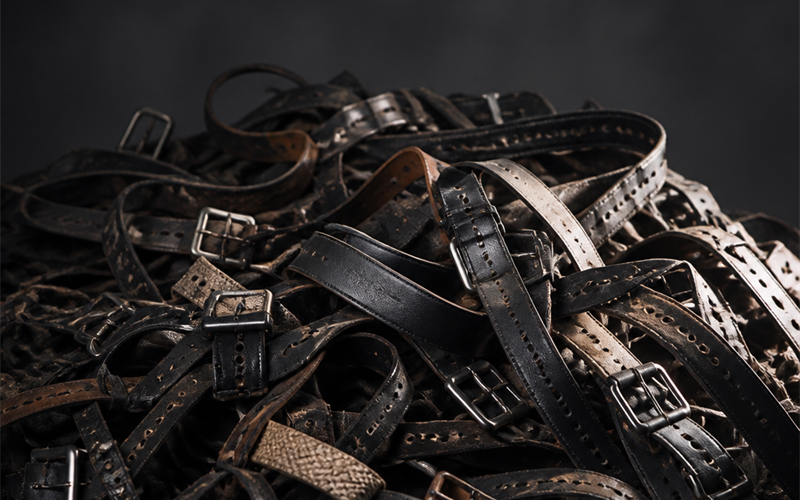
The Hidden Cost of Cheap Fast-Fashion Belts (Microplastics Edition)
Quick answer: A $20 fast-fashion belt looks like a bargain. It isn't. Most are bonded leather or PU plastic that sheds microplastics during wear, lasts under 12 months, and ends up in a landfill where it persists for centuries. The actual cost-per-year-of-use is higher than a $200 full-grain leather belt — and the environmental footprint is much worse.
Last updated: May 2026 • By BELTLEY Editorial
TL;DR:
- Cheap belts aren't cheap. They're expensive on a cost-per-year basis.
- Most fast-fashion belts are bonded leather or PU/PVC — both shed microplastics during wear.
- Lifespan: usually 6-18 months before peeling, cracking, or buckle failure.
- End-of-life: landfill for centuries (PU/PVC) or quick decay with chemical leaching (chrome-tanned bonded).
- Apply the BELTLEY 3-Material Rule: full-grain leather + stainless or solid brass + sealed edges. Anything less is a slow leak of money and microplastics.
You see a belt at a fast-fashion retailer. $20. Looks fine in the photo. You buy it. By the next summer the surface is peeling, the buckle has black flecks on it, and you don't know whether to keep wearing it or quietly retire it.
Multiply that by millions of belts a year. That's the fast-fashion belt economy. The story has a quieter chapter — the microplastics this churn dumps into the environment one waistband at a time.
Exit the $20-Belt Cycle: Your Route
Different starting points, same destination:
| Your situation | Go with |
|---|---|
| Third cheap belt died this year | Run the math: $20 × every 10 months loses to $58 once per decade — and stops the landfill drip. |
| Tight budget right now | One full-grain belt at $58 IS the budget move — it's the cheap belts that are expensive. |
| Microplastics specifically bother you | Bonded and PU belts shed throughout their life — natural veg-tan leather doesn't. |
| Checking a belt's honesty in-store | Cut-edge test: fibrous = leather; layered sandwich with foam core = plastic in costume. |
The exit ramp: BELTLEY's full-grain collection — 10-year warranty, zero shed.
What's wrong with fast-fashion belts?
Three things. First, most are bonded leather or PU plastic that fails within 12-18 months. Second, both materials shed microplastics during wear — the surface coating wears off in microscopic particles that end up in dust, soil, and waterways. Third, the end-of-life impact is dire: the belts don't biodegrade, and the volume of disposed belts globally is significant.

The bonded leather problem is worth understanding because the name is misleading. "Bonded" leather is shredded leather scrap glued to a fabric backing with polyurethane. It looks like leather. Chemically and behaviorally, it's mostly plastic.
For the basic distinction, see our is genuine leather real leather post.
Key stat: Per Wikipedia's microplastics research summary, a single garment load of laundry can release over 700,000 microplastic fibers. Belts don't get washed — but they shed similarly as the surface coating degrades through daily flex and friction.
Do leather belts shed microplastics?
Real animal leather doesn't shed microplastics — leather is animal protein, not petroleum-based. Bonded leather and PU/PVC vegan leather do shed microplastics as the surface coating wears, cracks, and flakes. The shedding is invisible at the individual particle scale but cumulatively significant across the global belt market.
The distinction matters. A full-grain cowhide belt is not a microplastic source. A bonded "leather" belt is.
Real leather vs fast-fashion belt — cost and impact comparison
| Belt type | Typical price | Real-world lifespan | Cost per year of use | Microplastic shedding | Biodegrades? |
|---|---|---|---|---|---|
| Full-grain leather (quality) | $150-$300 | 15-25 yr | $8-$20/yr | None | Yes |
| Crocodile / alligator | $400-$900 | 25-30+ yr | $15-$35/yr | None | Yes |
| Bonded leather fast-fashion | $15-$40 | 6-18 mo | $15-$60/yr | Yes (low) | Partially |
| PU vegan leather fast-fashion | $15-$40 | 12-24 mo | $10-$40/yr | Yes (high) | No |
| PVC vegan leather | $10-$30 | 12-36 mo | $10-$30/yr | Yes (highest) | No |
| Bonded leather + cheap plated buckle | $10-$25 | 3-12 mo | $20-$100/yr | Yes | No |
The math on a $20 belt that lasts 8 months: that's $30/year of use. Compare with a $200 belt at 20 years — $10/year of use. Cheap is more expensive.
What is bonded leather actually made of?
Bonded leather is leather fiber scrap (shredded leftover hides from genuine leather production) combined with polyurethane glue and pressed into sheets. The leather content typically ranges from 10% to 50%. The rest is plastic binder. A polyurethane coating is then applied to the surface to give it the look and feel of finished leather.

The end product looks like leather. It behaves like plastic. It sheds like plastic. And once the PU coating cracks (usually within 12 months of regular wear), the bonded core delaminates rapidly.
For deeper context, see our is genuine leather real leather post.
Why do fast-fashion belts fail so quickly?
Two failure points. The leather/plastic core fatigues under buckle-bend stress, especially in dry indoor heat. The plated buckle hardware (almost always zinc with thin chrome or nickel plating) pits and flakes within months of skin oil and sweat exposure. Combined, the belt looks tired by month 6 and visibly broken by month 18.
The construction is engineered for a price point, not a lifespan. The buyer is expected to replace it. Volume is the business model.
How much fast-fashion belt waste actually exists?
Global fashion produces over 100 billion garments per year, with accessory production (including belts) running a smaller but still substantial share. Belts are typically the first leather accessory category to be replaced because they fail visibly fast. The cumulative waste from fast-fashion belts globally runs into hundreds of millions of units annually — most ending up in landfills or low-grade textile recycling.

The Ellen MacArthur Foundation has published extensive data on fashion's circular economy gaps. Belts are a small slice of total fashion waste, but the per-unit lifespan is among the shortest in the industry.
What happens to a fast-fashion belt at end of life?
Three possible fates. Landfill — where bonded leather and PU/PVC belts persist essentially indefinitely. Incineration — which releases chemical byproducts, especially from PVC content. Textile recycling — which works poorly for belts because the layered construction (plastic + leather scrap + metal buckle + fabric backing) is hard to separate.
Most fast-fashion belts go to landfill or incineration. Recycling isn't really an option at scale yet.
Does buying expensive leather actually reduce waste?
Yes, on the per-year-of-use basis. A $200 full-grain leather belt worn for 20 years generates approximately 1/15th the waste, replacement cycles, and microplastic shedding of a $20 belt replaced every 12 months. Even accounting for higher production impact per unit, the long lifespan delivers net environmental gains.
See our deep-dive on why Tuscan belt leather is a better long-term investment for the underlying logic, which applies to environmental cost as well as financial cost.
Are LWG-certified belts immune to this?
Partially. LWG certifies tannery operations — water, energy, chemical use, traceability. It doesn't certify the finished belt's lifespan or microplastic shedding. A bonded leather product made from LWG-audited tannery scraps still behaves like bonded leather. Quality matters more than badge.

See our LWG-certified leather post for the certification limits.
What should you look for instead?
The BELTLEY 3-Material Rule applies cleanly here: full-grain leather + stainless or solid brass buckle + sealed (painted or burnished) edges. These three specs eliminate most fast-fashion failure modes simultaneously. Full-grain doesn't shed microplastics. Solid brass and stainless steel don't pit. Sealed edges don't fray.
Most belts that meet these three specs cost $150-$300 new. Compared to a $20 belt replaced every year for 20 years, that's $200 once vs $400 cumulative — with a much better belt at the end.
Are there exceptions — some cheap belts that actually last?
Yes, occasionally. A few small-batch artisan brands sell genuine full-grain belts in the $40-$80 range by skipping marketing, retail, and brand markup. They exist but they're rare and require digging. Mainstream fast-fashion retailers almost never offer real full-grain belts at fast-fashion prices.

If you find one, the test is simple: look for the actual leather grade (must say "full-grain"), check the buckle alloy (stainless or solid brass disclosed, not "metal"), and feel the edge (painted or burnished, not raw or shiny-lacquered).
The Bottom Line
Cheap belts aren't cheap. They cost more per year of use, shed microplastics into the environment, and pile up in landfills with disposal lifetimes measured in centuries. Applying the BELTLEY 3-Material Rule — full-grain leather + stainless or solid brass + sealed edges — eliminates the worst failure modes and shifts the math toward fewer, longer-lasting belts. That's the actual sustainable approach to belt ownership.
BELTLEY's belts are built for 15-25 year lifespans, full-grain Tuscan vegetable-tanned leather, stainless or solid brass hardware, and hand-finished edges. Browse the full-grain leather collection or the men's belt collection. Each belt costs more upfront — and replaces 10+ fast-fashion belts on per-year-of-use math.
Frequently Asked Questions
Q: Do leather belts shed microplastics?
Real animal leather (full-grain, top-grain, exotic) doesn't shed microplastics — it's animal protein. Bonded leather and synthetic vegan leather both shed plastic particles as the surface coating wears.
Q: How long does a fast-fashion belt actually last?
Most cheap bonded leather and PU belts visibly fail within 6-18 months of regular wear. PVC belts can last slightly longer but with worse environmental outcomes.
Q: Are $25 belts worth buying?
Rarely. The total cost over 5-10 years usually exceeds a single $150-$200 full-grain belt that lasts decades. See are leather belts expensive for the math.
Q: Can you recycle a fast-fashion belt?
Mostly no. The mixed construction (plastic coating + bonded fiber + fabric backing + metal hardware) makes belts hard to recycle at scale. Most end up in landfill.
Q: Are there cheap belts that don't shed microplastics?
Pure cotton or hemp canvas belts don't shed microplastics. They're a reasonable budget vegan alternative to PU vegan leather. See are canvas belts good for men.
Q: How can I tell if a belt is bonded leather?
Check the product spec for "full-grain leather" or "top-grain leather" explicitly. If the spec says only "leather," "genuine leather," or "bonded leather" — assume bonded. Look at the edge: bonded leather often has a layered, fibrous edge that's been lacquered to hide the cross-section.


