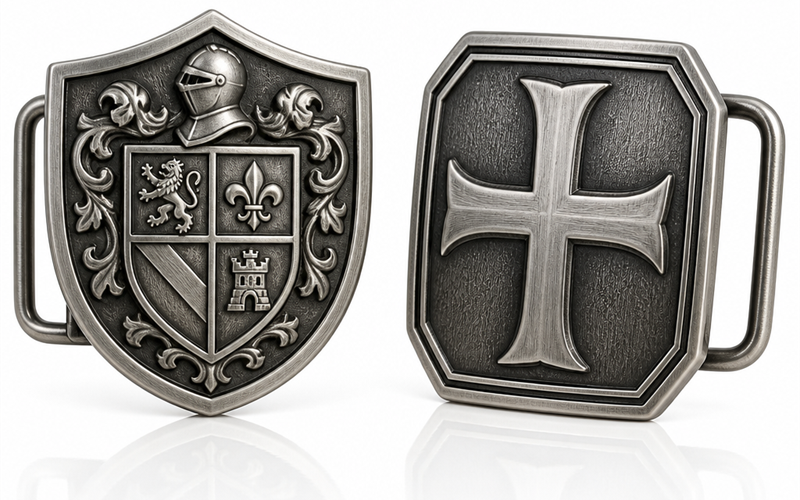
Heraldic and Religious Buckle Motifs Through History
Quick answer: Through history, belt buckles and fittings carried heraldic motifs (coats of arms, family crests, animal charges) to signal rank and lineage, and religious motifs (crosses, saints, pilgrim badges) to express faith and protection. From medieval nobles displaying their arms to pilgrims wearing devotional fittings, the buckle was a compact canvas for identity and belief — a tradition that echoes in today's symbolic and crest-style buckles.
Last updated: June 2026 • By BELTLEY Editorial
TL;DR:
- Heraldic buckles carried coats of arms, charges, and family crests to denote rank and lineage.
- Religious buckles bore crosses, saints, and devotional symbols for faith and protection.
- Medieval metalwork made the buckle a compact display of identity and belief.
- These traditions live on in modern crest-style and symbolic buckle designs.
Long before logos, the most meaningful symbols a person could wear at the waist were heraldic and religious. In the medieval and early-modern world, a belt buckle wasn't just a fastener — it was a small, portable statement of who you were and what you believed. Heraldry encoded family, rank, and allegiance; religious motifs declared faith and invoked protection. The craftsmanship lavished on these fittings reflected their importance. This guide explores how heraldic and religious motifs shaped buckle design through history, and why those traditions still resonate. It builds on our short history of the belt buckle.

What are heraldic buckle motifs?
They're designs drawn from heraldry — coats of arms, family crests, and symbolic "charges" like lions, eagles, and crosses — applied to belt buckles and fittings to denote rank, lineage, and allegiance. A noble or knight's buckle could display the arms that identified their house, turning hardware into a portable badge of identity and social standing.

Heraldry was a complete visual language, and the buckle was one of its surfaces. As the reference on heraldry explains, it functioned "to identify individuals and families [and] denote rank," using charges (animals, objects, geometric shapes) and tinctures (colors). Encyclopaedia Britannica describes it as the science and art of "hereditary symbols employed to distinguish individuals, armies, institutions", born so medieval knights could recognize one another in battle. Applying these to a buckle let the wearer carry their identity literally at their center. The finest examples were worked in bronze, brass, silver, and gold, and their quality signaled status as much as the design did — a link between craftsmanship and standing we still see in collectible buckles.
What religious motifs appeared on historical buckles?
Crosses, saints, sacred monograms, and devotional symbols. Throughout the Christian medieval era, belt fittings bore crosses and religious imagery to express faith and invoke divine protection, while pilgrims wore badges and fittings marking their journeys to holy sites. Across cultures, buckles carried the protective and devotional symbols of their faith traditions.

Key stat: The link between belts and identity is ancient — the Roman cingulum militare marked military status with metal fittings by the 1st century, establishing the belt as a surface for meaning long before heraldic and religious motifs flourished in the medieval era.
That ancient precedent, documented in the reference on the cingulum militare (worn "as a badge of military status"), set the stage. Medieval Christendom layered faith onto the same surface: a cross on a buckle was both adornment and a statement of belief, sometimes believed to offer protection. Pilgrim badges and devotional fittings let travelers display their piety and the holy sites they'd visited. Here's how the motifs functioned:
| Motif type | Examples | What it signaled |
|---|---|---|
| Heraldic | Coats of arms, lions, eagles, crests | Family, rank, allegiance |
| Religious | Crosses, saints, sacred monograms | Faith, protection, devotion |
| Pilgrim | Site badges, shells (St. James) | Completed pilgrimage, piety |
| Military-civic | Roman cingulum fittings | Status, service, office |
Why was the buckle a canvas for identity and belief?
Because it was visible, personal, and permanent. A buckle sits centrally on the body, is worn daily, and lasts for years, making it an ideal place to display the things that defined a person — their family and their faith. In eras when identity was tightly bound to lineage and religion, encoding those into one's hardware was natural and meaningful.

The buckle's qualities made it perfect for symbolism: small enough to be intimate, prominent enough to be seen, durable enough to endure. In a world without printed branding, hand-worked metal motifs were how you broadcast identity. This is also why such buckles were crafted with care — the motif's meaning deserved quality execution, and the quality itself signaled status. That fusion of meaning and craftsmanship is the through-line to the symbolic buckles people choose today, explored in our animal-motif symbolism guide.
How do these traditions live on in modern buckles?
In crest-style, emblem, and symbolic buckles. Modern buckles bearing family crests, religious symbols, animal motifs, or other meaningful emblems descend directly from the heraldic and religious tradition — the impulse to wear identity and belief at the waist. Even the designer logo buckle is a commercial heir to heraldry: a "house" emblem signaling allegiance, just to a brand rather than a bloodline.

The continuity is striking. A monogram buckle is, in a sense, modern heraldry — a crest for a fashion house. Symbolic and animal-motif buckles continue the older tradition of wearing meaning rather than branding. For those drawn to that meaningful, emblematic style — crests, animals, and symbols crafted in solid metal — BELTLEY's unique buckle belts carry the tradition forward with quality construction. Browse the full range of styles in our types of belt buckles guide.
The Bottom Line
For most of history, the most meaningful buckles weren't branded — they were heraldic and religious. Coats of arms, crests, and charges signaled family, rank, and allegiance; crosses, saints, and pilgrim badges declared faith and invoked protection. The buckle was the perfect canvas for these messages: visible, personal, durable, and crafted with care befitting its meaning. Those traditions endure in today's crest-style, emblem, and symbolic buckles — and even the designer logo is a commercial descendant of heraldry. For buckles that carry genuine symbolic character in solid, well-made metal, explore BELTLEY's unique buckle belts collection and the broader men's belts range.
Frequently Asked Questions
Q: What is a heraldic belt buckle?
A heraldic belt buckle bears designs from heraldry — coats of arms, family crests, or symbolic charges like lions and eagles — used historically to signal a wearer's family, rank, and allegiance. It turned the buckle into a portable badge of identity, often crafted in fine metal befitting the wearer's status.
Q: What did religious motifs on buckles mean?
Religious motifs such as crosses, saints, and sacred symbols expressed the wearer's faith and were sometimes believed to offer divine protection. Pilgrim badges marked completed journeys to holy sites. These motifs turned the buckle into a daily, visible declaration of belief and devotion.
Q: Are designer logos a form of modern heraldry?
In a sense, yes. A designer logo buckle functions like a heraldic crest — a "house" emblem signaling allegiance and identity, just to a fashion brand rather than a family bloodline. The impulse to wear an identifying emblem at the waist descends directly from heraldic tradition.
Q: Do people still wear symbolic belt buckles today?
Yes. Crest-style, animal-motif, religious, and other symbolic buckles remain popular, continuing the centuries-old tradition of wearing meaning at the waist. Unlike logo buckles, these emphasize personal significance — a family crest, a faith symbol, or a meaningful animal — crafted in solid metal.
%20to%20signal%20rank%20and%20lineage,%20and%20religious%20motifs%20(crosses,%20saints,%20p...)