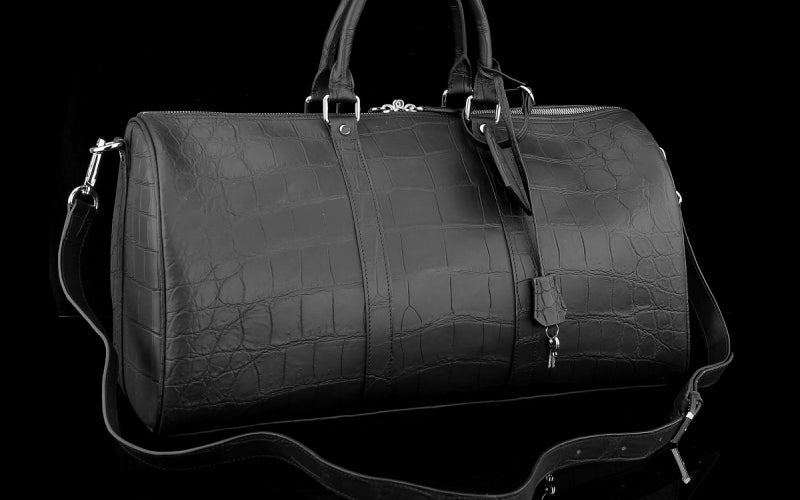
Crocodile Backpack Guide: The Modern Executive Alternative (2026)
TL;DR:
- A real crocodile backpack uses 4–6 crocodile hides — slightly more material than a briefcase due to the rounded silhouette and dual straps.
- Optimal size: 14–16 inches tall × 11–13 inches wide × 5–6 inches deep — fits a 14-15" laptop with daily essentials.
- Hardware critical points: stainless or brass strap-attachment plates, reinforced top handle, and YKK-grade main zipper.
- Price math: real one-piece-paneled crocodile backpack from a DTC brand starts at $1,200–$2,300. Designer houses charge $5,000–$15,000.
- The modern executive shift: tech, finance, and creative-industry executives have moved from briefcases to structured backpacks since 2020.
- Made-to-order: custom-color or out-of-stock backpacks ship in roughly 3 weeks.
Quick Facts
- Hides per real backpack: 4–6
- Optimal size: 15" × 12" × 5" (laptop-compatible)
- Fair DTC price: $1,200–$2,300
- Designer house price: $5,000–$15,000
- Hermès flagship crocodile backpack: Not currently produced
- Made-to-order timeline: 3 weeks
- Lifespan with proper care: 15–20 years

A crocodile backpack is the executive accessory of the post-2020 era. Where the briefcase signaled traditional authority for fifty years, the structured exotic-leather backpack signals contemporary authority — the executive who doesn't need to perform the briefcase ritual to be taken seriously. Tech founders, hedge fund partners, creative directors, and senior consultants have quietly converged on the format because it solves a real problem: carrying a laptop, a tablet, and a day's essentials without breaking shoulder posture or compromising on visible craft.
This guide covers what makes a real crocodile backpack different from a high-end cowhide alternative, how to choose size and hardware, and why the price math sits where it does. In our own workshop, the dual straps must be cut from the same hide section to maintain visible scale coherence — the constraint that defines whether a backpack is genuinely premium or just expensive.

Briefcase Refugee or Backpack Native?
The executive-backpack decision by starting point:
| Your situation | Go with |
|---|---|
| Switching from a briefcase | 14–16" structured croc backpack in black — keeps briefcase gravitas, frees both hands. |
| Bike or walk commute | The backpack wins outright — check strap-plate hardware (stainless or brass) before anything else. |
| Conservative client meetings | Carry it by the top handle into the room — backpack in transit, briefcase in posture. |
| Price-checking against fashion houses | BELTLEY's croc backpacks run $2,288–$2,588 made-to-order (~3 weeks) — a fraction of boutique pricing for the same hide count. |
Build yours: BELTLEY's crocodile collection.
Why Are Executives Switching from Briefcases to Crocodile Backpacks?
Modern executives are switching to crocodile backpacks for ergonomic and practical reasons: dual-strap weight distribution, hands-free mobility, and easier transit through airports and dense urban environments. The leather quality and structural construction of a real crocodile backpack signals the same expertise as a briefcase while solving the physical problems of single-shoulder carry.
The shift accelerated through 2020–2024 as remote work and travel patterns changed executive lifestyles. According to coverage from Business of Fashion, the executive backpack category has been one of the fastest-growing luxury accessory segments since 2020 — driven by tech and finance sector executives who treat the briefcase as a generation marker. Our crocodile briefcase guide covers the traditional alternative.
A practical comparison:
- Briefcase wins: traditional law/finance environments, formal client-facing meetings, oldest-school authority signaling
- Backpack wins: tech and creative industries, multi-modal transit, back/shoulder ergonomics, modern executive aesthetic
- Either works: consulting, modern finance, executive coaching, modern medicine

How Many Crocodiles Does It Take to Make One Backpack?
A standard crocodile backpack (14-16 inches tall) requires 4–6 crocodile belly hides for the main panels, gussets, base, top flap, dual straps, and trim. Larger backpacks can require 6–8 hides. The dual-strap construction adds material requirement compared to a similar-sized briefcase.
The hide math is unforgiving on backpacks because of the strap construction. A briefcase has one handle and one optional shoulder strap. A backpack has two structural straps that must match in scale pattern, color, and finish — which often means cutting from the same hide rather than two different hides. Pattern matching across the straps and main panels is what separates a true luxury backpack from a multi-piece construction.
Our how many crocodiles to make one belt and crocodile briefcase guides cover the underlying yield frameworks.

What Size Crocodile Backpack Should You Buy?
The optimal executive size is 14–16 inches tall × 11–13 inches wide × 5–6 inches deep. This sizing accommodates a 14" or 15" laptop, a tablet, files, charging accessories, and personal items. Smaller backpacks (under 13 inches) can't fit modern devices comfortably; larger (over 17 inches) cross into hiking-pack territory.
| Use case | Recommended size | Capacity |
|---|---|---|
| Daily executive carry | 15" × 12" × 5" | Laptop + tablet + files + accessories |
| Travel + executive carry | 16" × 13" × 6" | Laptop + 1-day clothing + tech |
| Minimalist daily | 13-14" × 11" × 4" | 13" laptop + minimal essentials |
| Statement / occasional | 14-15" × 12" × 5" | Versatile sizing for limited-use |
The 15-inch height is the sweet spot for most executives — large enough for modern devices, small enough to avoid the hiking-pack visual.
Key Takeaways
- 4–6 hides per backpack; dual straps require matched-hide cutting
- 15" laptop-compatible = optimal executive size
- $1,200–$2,300 fair DTC pricing (lowest Brand Tax in luxury bag categories)
- Modern industries (tech, venture, creative) have shifted backpack > briefcase
- Strap-attachment hardware is the highest failure point — verify reinforcement

What Hardware Should a Crocodile Backpack Have?
Choose stainless steel for strap-attachment plates, top handle reinforcement, and main zipper hardware. Brass works for traditional aesthetic with patina. Avoid plastic hardware on any luxury backpack — it dates the bag and signals lower-tier construction.
Five hardware checkpoints to verify before purchase:
- Strap attachment plates: solid metal, internally reinforced, sewn through the main panel
- Top handle base: reinforced with internal metal plate, not just stitched
- Main zipper: heavy-gauge metal teeth, smooth operation, ideally YKK or Riri grade
- Strap adjustment buckles: solid metal, not coated
- Optional lock or clip closure: useful for travel security but not essential
The metal-coherence rule we cover in the should your belt buckle match your watch guide applies to backpacks identically.

What Color Crocodile Backpack Is Most Versatile?
Matte black is the most versatile color for daily executive use, working with charcoal and navy suiting equally well. Burgundy, jade green, and cobalt blue are the modern statement colors increasingly chosen by tech and creative-industry executives. Hermès orange and bright reds work as deliberate signature pieces.
Color selection ties directly to industry expectations:
- Traditional finance / law / consulting → matte black or espresso brown
- Tech / venture / creative → matte black, burgundy, jade green, or cobalt blue
- Personal brand / public-facing → signature color (orange, red, viridian)
- Luxury hospitality / fashion → matte black or seasonal statement
Our glazed vs matte vs semi-matte crocodile guide covers the finish theory. Matte and semi-matte dominate the executive backpack category for the same wear-resilience and quiet-luxury reasons that drive the broader category.

How Much Should a Crocodile Backpack Cost?
A fair price for a real crocodile backpack from a DTC brand is $1,200–$2,300 depending on size, color, and finish details. Mid-luxury European brands run $3,500–$7,000. Designer houses charge $5,000–$15,000. Hermès does not currently produce a crocodile backpack as a flagship line.
| Tier | Price range | What you get |
|---|---|---|
| DTC artisan | $1,200–$2,300 | One-piece panels, stainless hardware, legally sourced |
| Mid-luxury European | $3,500–$7,000 | Same construction + brand boutique experience |
| Designer house | $5,000–$15,000 | Same construction + retail flagship + brand equity |
The $1,200–$2,300 DTC range is currently the strongest cost-per-use position in the entire luxury exotic leather market. Backpacks are newer to luxury than briefcases, so the Brand Tax has had less time to accumulate.

How Long Does It Take to Make a Custom Crocodile Backpack?
A custom-color or out-of-stock crocodile backpack takes roughly 3 weeks from order placement to finished piece. The timeline includes sourcing matched legally sourced Nile crocodile bellies, hand cutting all panels including the dual straps, panel assembly, hardware installation, and final finishing.
The strap-matching step is what makes backpack production slightly more time-intensive than briefcase production. The two straps must show coherent scale pattern, color saturation, and finish — which often requires cutting both straps from the same hide section.
The Bottom Line
A crocodile backpack is the strongest cost-per-use exotic leather purchase in the modern executive accessory category. The right size (14-16" tall), right color (matte black or modern statement), right hardware (stainless), and right construction (one-piece panels with matched straps) deliver a 15-20 year executive companion that signals contemporary authority across industries that have moved past the briefcase.
At BELTLEY, every crocodile backpack is hand-crafted from legally sourced Nile crocodile hides, with one-piece panel construction, matched straps, and stainless hardware. Made-to-order pieces ship in roughly 3 weeks. Three pieces worth knowing:
- The BELTLEY Explorer: Matte Black Crocodile Backpack ($2,288) — the executive default
- BELTLEY Explorer: Cobalt Blue French Patina ($2,588) — the modern statement piece
- BELTLEY Explorer: Matte Burgundy ($2,288) — the contemporary signature color
Browse the BELTLEY Crocodile Backpack Collection →
Frequently Asked Questions
Q: Is a crocodile backpack appropriate for business meetings?
Yes, in modern executive industries (tech, venture, creative, modern finance, consulting). For traditional law and oldest-school finance, the briefcase still signals more conventional authority. The choice depends on industry context, not the leather quality.
Q: How long does a crocodile backpack last?
15–20 years with proper care. The dual-strap construction means more potential wear zones than a briefcase, but the leather quality and reinforced hardware extend lifespan significantly.
Q: Can a crocodile backpack be carried as airline carry-on?
Yes. Standard 14-16" executive backpacks meet personal-item dimensions on most major U.S. and international airlines per TSA carry-on guidelines.
Q: How do you authenticate a crocodile backpack?
Apply the same seven authentication tests used for any crocodile good: visible pores, scale uniformity, edge inspection, smell, flex, CITES documentation, and price math. See our embossed cowhide vs real crocodile guide.
Q: Will the straps wear out before the body?
The strap attachment points are the highest-stress zones on any backpack. Quality construction reinforces these points with internal metal plates, which extends strap lifespan to match the body. Inspect strap attachment plates carefully before purchase.
Q: Should I match my crocodile backpack to my belt?
Color coherence helps but exact matching isn't required. A matte black crocodile backpack pairs cleanly with any black crocodile belt without needing to be from the same maker.
Q: Can I order a custom-color crocodile backpack?
Yes. Custom-color or made-to-order crocodile backpacks ship in roughly 3 weeks, including hide sourcing, hand cutting (including matched straps), and panel assembly.
By the BELTLEY artisan team — handcrafting exotic leather goods since 1999. Last updated: May 10, 2026.