Are Coach Belts Made in China? -Unraveling the Truth Behind Luxury Manufacturing
TL;DR: Quick Answer
Yes, most Coach belts are made in China. Some are also manufactured in Vietnam, India, Cambodia, and the Philippines. A very small number of limited-edition pieces have come out of Italy, and vintage Coach belts (pre-2000s) were mostly made in the USA. But if you buy a Coach belt today, there's roughly a 60% chance it was made in China.
Flip your belt over. There's a stamped label on the back that'll tell you exactly where yours came from.
Now, the real question you're probably asking isn't where it's made. It's whether that matters. Let's get into it.

Where Are Coach Belts Actually Made?
Coach is owned by Tapestry, Inc., a publicly traded company that also owns Kate Spade and Stuart Weitzman. According to Tapestry's SEC filings, manufacturing is spread across several countries:
- China — Still handles the bulk of Coach accessories, including most belts. Cities like Guangzhou and Dongguan are home to the factories.
- Vietnam — Has become Coach's largest production hub overall, especially for bags.
- India — Produces some belts, wallets, and smaller accessories.
- Cambodia & Philippines — Handle overflow and specific product lines.
- Italy & USA — Reserved for limited runs and legacy pieces. If you find one of these, hang onto it.
The shift happened gradually. Coach moved production out of the U.S. starting in the early 2000s, chasing lower labor costs and larger factory capacity. By 2010, almost everything was made overseas. This isn't unique to Coach — most designer belt brands followed the same playbook.

Does "Made in China" Mean Bad Quality?
This is where people get tripped up. The honest answer: it depends on the brand's standards, not the country.
China produces everything from dollar-store junk to the components inside your iPhone. The country has factories that can match European quality standards — and factories that absolutely cannot. What matters is the level of oversight the brand demands, the materials they specify, and the quality control they enforce.
Coach claims to maintain strict standards across all factories. They've committed to sourcing 90% of their leather from tanneries rated Silver or Gold by the Leather Working Group. That's a legit certification — it means the tanneries meet certain environmental and quality benchmarks.
But here's where things get a little less rosy.

What Leather Does Coach Actually Use?
Coach uses real leather — let's get that out of the way first. It's not faux or bonded. But real leather has a wide quality spectrum, and Coach sits somewhere in the middle.
Their belts typically feature:
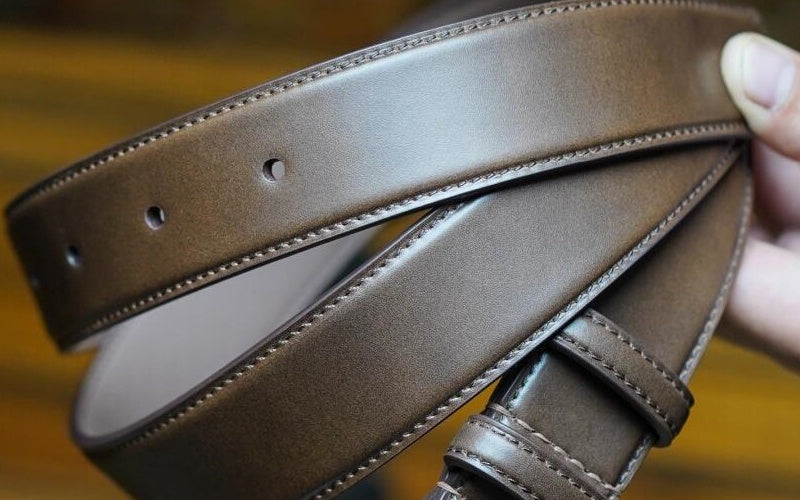
- Refined calf leather — smooth, thin, with a polished finish. Looks great out of the box, but it's corrected-grain (meaning the surface has been sanded and re-coated). That coating can crack or peel over time.
- Pebbled leather — their signature "Glovetanned Pebble." The texture is usually embossed rather than natural. Durable, hides scratches well, but doesn't develop the rich patina that full-grain leather is known for.
- Signature canvas — not leather at all. It's coated canvas with printed logos. If your Coach belt has the repeating "C" pattern, you're wearing fabric, not hide.
For a belt in the $50–$150 range, that's... fine. But it's not the same as a full-grain leather belt where you're getting the top layer of the hide with all its natural character intact. Coach's leather is more processed, more uniform, and more reliant on surface coatings to look polished.
And about those reversible Coach belts — some owners have reported that the two leather layers are glued together rather than stitched. After 6–12 months of daily wear, those layers can start separating. The glazed finish also tends to wear off around the edges, exposing the raw leather underneath. Not exactly what you'd expect from a designer belt at that price point.

The Real Question: Are You Paying for the Belt or the Logo?
This is where it gets uncomfortable for a lot of brands — not just Coach.
A Coach belt retails between $78 and $198. The materials? Corrected-grain cowhide, glued construction on some models, and plated (not solid) hardware. The same belt without the Coach name would probably sell for $25–$40.
That price gap is what we call the Brand Tax — the premium you pay for the name, the packaging, the retail experience, and the marketing budget. Coach spends hundreds of millions on advertising annually. That money comes from somewhere, and it's baked into every belt, bag, and wallet they sell.
None of this means Coach makes bad products. They make decent products at an inflated price point. And for a lot of buyers, the brand recognition alone is worth it. No judgment there.
But if you're the type who'd rather put your money into the actual leather and hardware — full-grain hide that ages beautifully, solid 316L stainless steel buckles that don't flake, and hand-finished construction — you can get more belt for less money by skipping the logo entirely.
At BELTLEY, we build our handmade belts from full-grain leather with a 10-year warranty. No Brand Tax. No plated hardware. Just the belt. And if it doesn't work for you, the 30-day return policy means you're not stuck with it.

How to Check Where Your Coach Belt Was Made
Quick how-to if you've already got a Coach belt and want to know its origin:
- Flip the belt over and look for a small leather patch or stamped text near the buckle end.
- Look for "Made in [Country]" — it's usually embossed or printed in small text.
- Check the creed patch (if it has one) — older Coach products have a leather label with a serial number and manufacturing location.
- No label? That's a red flag. Authentic Coach products always indicate the country of origin. If yours doesn't, it might be counterfeit. Check out our guide on how to tell if a designer belt is real for more tips.

The Bottom Line
Most Coach belts are made in China or Vietnam. That's been the reality since the early 2000s, and it's not changing anytime soon. The manufacturing location itself isn't the problem — plenty of excellent products come out of Chinese factories.
The real question is whether the materials and construction justify the price. With corrected-grain leather, glued layers on some reversible models, and plated buckles, Coach belts are solidly mid-tier accessories wearing a designer price tag.
If the Coach name matters to you, that's a perfectly valid reason to buy one. But if you care more about what's actually on your waist than what's stamped on the box, there are better options out there that'll last longer and cost less.
Frequently Asked Questions
Q: Are all Coach belts made in China?
No, but most are. Coach manufactures belts across China, Vietnam, India, and a few other countries. China handles roughly 60% of production. Check the stamped label on the back of your belt to see where yours was made.
Q: Are Coach belts real leather?
Yes, Coach belts use genuine cowhide leather — but it's typically corrected-grain or top-grain, not full-grain leather. The exception is their Signature canvas belts, which are coated fabric with leather trim, not full leather.
Q: Why did Coach move manufacturing out of the USA?
Cost reduction and scale. Moving production to China and Southeast Asia allowed Coach to lower manufacturing costs while increasing output. Most major fashion brands made the same shift between the late 1990s and early 2010s.
Q: Are Coach belts worth the money?
They're decent mid-range belts, but you're paying a significant premium for the brand name. The materials — corrected-grain leather and plated hardware — don't match what you'd get from a full-grain handmade belt at a similar or lower price. It depends on how much the logo matters to you.
Q: How can I tell if my Coach belt is fake?
Check for a country-of-origin stamp on the back, consistent stitching, a serial number or creed patch, and hardware with the Coach logo. Misspellings, uneven stitching, and peeling "leather" are dead giveaways. Our post on Coach belts made in China or the USA breaks this down in detail.
Q: Do Coach belts last long?
With careful use, a Coach belt can last 2–5 years. Heavy daily wear tends to reveal the limitations of corrected-grain leather and glued construction faster. By comparison, a well-made full-grain leather belt can last 10–20+ years and actually look better with age.