Why Does My Alligator Belt Have a Scale Lifting Up?
Quick answer: An alligator belt scale lifts up for one main reason: the leather dried out. As the tanning oils evaporate, the scale edges shrink, curl, and peel away from the surface. Brushing or wiping against the grain makes it worse. On a healthy belt this is fixable by conditioning; if the leather is cracked or brittle, the damage is permanent.
Last updated: June 2026 • By BELTLEY Editorial
TL;DR:
- The #1 cause is dried-out leather — when the oils tanners add evaporate, scale edges curl and lift.
- The #2 cause is rubbing against the grain — wiping "backward" physically pulls scales up.
- Most lifting scales settle back down after you recondition the belt with a reptile-safe product.
- A scale that fully sheds when rubbed ("scale slip") is a tannery defect, not your fault — check the warranty.
- If the leather is cracked, flaky, or brittle, it's dry-rot and usually beyond saving.
A single lifting scale on a genuine alligator belt looks alarming — like the whole thing is about to unravel. It usually isn't. Real alligator and crocodile leather is built from dense, interlocking collagen fibers under a layer of hard scales (technically scutes), and that structure is tough. The scale lifts because the thin layer holding its edge has lost moisture and contracted, not because the belt is falling apart. The same thing happens to a genuine alligator belt left in a hot car, a dry winter closet, or wiped down the wrong way. Below is exactly why it happens, how to fix it, and how to tell when a scale is gone for good.
What Should You Do About a Lifting Scale Right Now?
Match your belt's condition to the right move — don't condition a belt that actually needs returning.

| Your situation | Do this |
|---|---|
| Belt is brand new and a scale is already shedding | Stop. This is likely a tannery "scale slip" defect — contact the seller and use the warranty |
| Leather feels dry or stiff, scale edges are curling | Recondition it — most of these scales settle back down |
| Scale lifted after the belt got wet | Let it air-dry slowly away from heat, then condition — never blow-dry it |
| Leather is cracked, flaky, or brittle | This is dry-rot; the belt is usually beyond repair — replace it |
| One scale snagged or tore mechanically | A cobbler can spot-glue it; the rest of the belt is fine |
If your belt is simply thirsty, our leather care guide walks through the exact conditioning routine.
Why does my alligator belt have a scale lifting up?
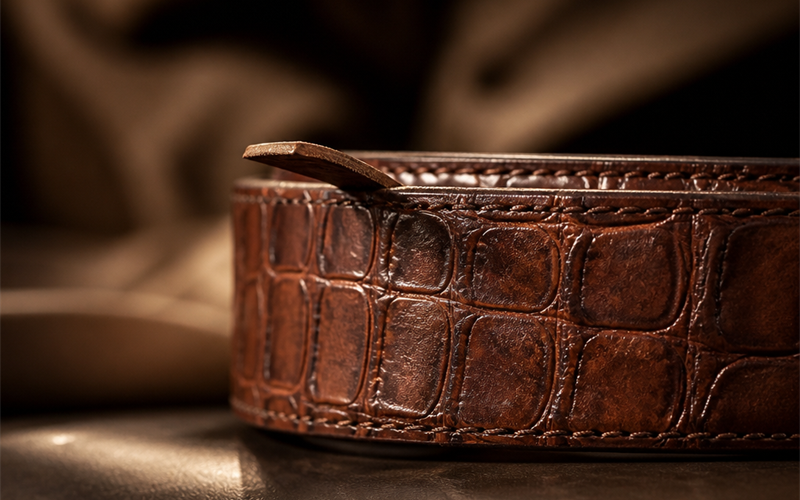
Your alligator belt has a scale lifting up because the leather lost its natural oils and the scale edge contracted as it dried. Tanners load exotic skins with oils during processing; over months those oils evaporate, the thin border under each scale shrinks, and the edge curls away from the belt.
This is the same chemistry behind every dried-out leather good. As one materials reference on leather conditioner puts it plainly: "The oils are volatile and evaporate over time. This causes the leather to shrink and stiffen, and sometimes to crack." On a smooth cowhide belt that shrinkage shows up as cracks. On a scaled alligator belt it shows up first at the scale edges, because those raised borders have the most exposed surface area and the least support underneath.
Is a brushing habit making it worse?
Yes — wiping or brushing an exotic belt against the grain physically lifts the scales. Alligator scales overlap slightly, like roof shingles, so they have a "with the grain" direction. Stroke toward the free edges and you pry them upward; stroke with them and they lie flat.

Always wipe from the buckle end toward the tip, following the way the scales naturally lie. If you rub the wrong way with a dry cloth, you create the exact flaking, lifted look you're trying to avoid. This matters even more once the belt is dry, because brittle scale edges are far easier to catch. The fix and the prevention are the same gentle motion — which is why most lifting is reversible if the leather underneath is still supple.
How do you fix a lifting scale on an alligator belt?
Fix a lifting alligator scale by reconditioning the leather so the curled edge relaxes and lies flat again. Clean the belt, apply a small amount of reptile-safe conditioner, gently press the scale down in its natural direction, and let it absorb. Healthy scales usually settle within a day.
Here's the step-by-step:
- Wipe the belt clean with a soft, dry cloth — moving with the grain, buckle to tip.
- Apply a pea-sized amount of conditioner made for exotic or reptile leather (never mink oil or harsh cleaners, which can darken or over-soften scales).
- Work it in with your fingertips, pressing the lifted scale gently back into place along the grain.
- Let it rest flat for 12–24 hours so the oils penetrate and the edge re-relaxes.
- Buff lightly and repeat once if the edge is still proud.
Not sure how often to condition? Our guide on whether you should condition your leather belt covers frequency. For exotic skins, two to four light treatments a year is plenty — over-conditioning is its own problem.
Key stat: Reptile leather can lose enough of its tanning oils to start curling in as little as 6–12 months of dry storage — yet just 2–4 light conditioning sessions a year keep most exotic belts supple for a decade or more.
Can you glue a lifted alligator scale back down?
You can, but only as a last resort for a scale that won't relax with conditioning. Use a tiny dab of flexible leather cement on the underside of the edge, press for 30 seconds, and wipe any squeeze-out immediately. Glue fixes mechanical lifting; it does nothing for the underlying dryness.

Think of glue as a patch, not a cure. If the whole belt is dry, gluing one scale just moves the problem to the next one. Recondition first, glue second, and for a valuable belt let a cobbler who handles exotics do it — the wrong adhesive can stain the scale permanently. If several scales are lifting at once, the leather itself is the issue, not the individual scales.
How do you stop scales from lifting in the first place?
Stop scales from lifting by keeping the leather conditioned and stored away from heat and dry air. Condition two to four times a year, hang the belt rolled or flat rather than crammed in a drawer, and keep it out of direct sun, radiators, and hot cars. Dryness is the enemy — humidity swings do the damage.

This is also where belt quality shows. A well-made exotic belt follows what we call the 3-Material Rule at BELTLEY: a genuine exotic face, a solid brass or stainless steel buckle that won't corrode against the leather, and sealed, hand-finished edges that lock moisture into the strap instead of letting it wick out the sides. Sealed edges slow the drying that lifts scales in the first place. Storage matters too — see our notes on the best way to store leather belts. Done right, a real alligator belt is genuinely durable, as we cover in are alligator leather belts durable.
When is a lifting scale beyond repair?
A lifting scale is beyond repair when the leather has dry-rotted — gone cracked, flaky, or brittle — or when scales shed completely at the slightest rub. At that point the oils and structure that held the scale are gone, and no conditioner can rebuild them.
There's an important distinction here. Normal lifting is a care issue. But "scale slip" is a tannery defect: the scales detach because the raw skin was poorly cured or stored before tanning. The United Nations FAO's reference on crocodile skin defects describes it exactly — "The scales will slough off when rubbed with the fingers… Scale-slip usually begins in small patches and can be arrested if found in time," but the lost scales never come back. If a new belt does this, it's not your care — it's the leather. That's what a real warranty is for.
The Comparison: Why Scales Lift and What Fixes Them
| Cause | What you'll see | Fixable? | Prevention |
|---|---|---|---|
| Dried-out leather | Scale edges curling, stiff feel | Yes — condition | Condition 2–4×/year |
| Rubbing against the grain | Flaky, lifted, "ruffled" look | Yes — smooth with grain | Wipe buckle-to-tip only |
| Water then heat-drying | Stiff, warped scales | Sometimes | Air-dry slowly, then condition |
| Dry-rot | Cracks, brittleness, flaking | No — replace | Never let it fully dry out |
| Scale slip (tannery defect) | Scales shed when rubbed, often new | No — warranty claim | Buy from a maker who cures skins right |
The Bottom Line
A lifting scale almost never means your alligator belt is ruined — it means it's thirsty. The scutes lift because the tanning oils evaporated and the edges contracted, and on healthy leather a light conditioning and a smooth, with-the-grain press usually settles them right back down. The two things that turn a fixable scale into a permanent one are letting the belt dry-rot and buying skins that were poorly cured to begin with. At BELTLEY, we work only with properly cured exotic hides and seal every edge by hand, because a $118–$288.88 belt should outlast the trend, not flake apart in a season — backed by a 10-year warranty. Keep it conditioned, store it smart, and browse the exotic leather belt collection when you're ready for one built to last.

Frequently Asked Questions
Q: Why is the scale on my alligator belt lifting up?
The scale is lifting because the leather dried out and the scale edge contracted, or because the belt was wiped against the grain. Both pull the edge away from the surface. Reconditioning the leather usually relaxes a healthy scale back into place.
Q: Can a lifted alligator scale be fixed?
Yes, in most cases. Condition the belt with a reptile-safe product, press the scale flat along its natural grain, and let it rest for a day. Only scales on cracked, dry-rotted leather, or those that fully detach, can't be saved.
Q: Does a lifting scale mean my alligator belt is fake?
Not necessarily. Real exotic leather lifts when it dries out, while embossed cowhide tends to crack instead of lift individual scales. A brand-new belt shedding scales when rubbed, though, points to a tannery defect called scale slip — worth a warranty claim.
Q: How do I keep my alligator belt scales from lifting?
Condition it two to four times a year, always wipe with the grain from buckle to tip, and store it away from heat, sun, and dry air. Dryness is what makes scales curl, so keeping the leather supple is the whole game. See our leather care page.
Q: Is alligator or crocodile leather more prone to lifting scales?
Both behave the same way — they lift when they dry out — since the structure is nearly identical. The difference is mostly cosmetic, which we break down in alligator vs crocodile belts. Care, not species, decides whether scales stay flat.