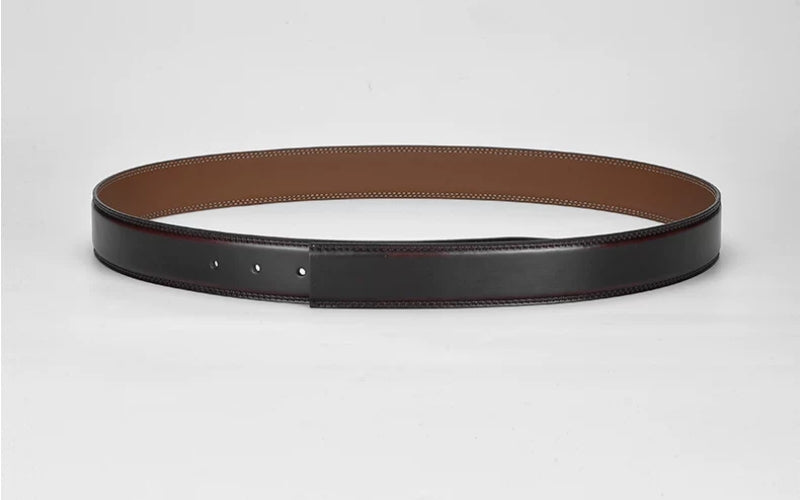
The 1.18" (30mm) Calfskin Dress Belt: Why Thin Is Elegant
TL;DR:
- 30mm (1.18") is the slimmest standard dress belt width — narrower than the 32mm everyday dress belt and far narrower than casual 35–40mm belts.
- Thin belts read as more formal because they preserve the vertical silhouette of tailored clothing.
- Best for: slim-cut suits, formal occasions, traditional European tailoring, evening wear with belt loops.
- Skip 30mm for: jeans, chinos, casual wear, anything wider than a slim trouser cut.
- Calfskin's tight fiber density is what makes 30mm structurally possible — coarser leathers go floppy at this width.
In menswear, "elegant" and "loud" are opposites. A wide belt with a big buckle announces itself. A thin belt with a low-profile buckle disappears — which is exactly why it looks more refined. The 30mm calfskin dress belt is the quietest, most formal belt width in regular production, and it's the one Italian tailors and traditional European brands have been quietly recommending for a century.
This guide explains why thin reads as elegant, when 30mm is the right call, and when it's actually the wrong tool for the job. If you already own a 32mm everyday dress belt and want to understand whether you need to go thinner, this is the answer.
Why is a thin belt considered more elegant than a wide one?
A thin belt is considered more elegant because it preserves the vertical line of tailored clothing. Wide belts create a visible horizontal break at the waist that draws the eye sideways, away from the suit's silhouette. Thin belts almost disappear into the trouser line, letting the suit's shape do the talking. The rule is older than menswear photography: less waistline visual = more refined outfit.

This isn't aesthetic guesswork. The classic Italian and English tailoring traditions both teach that the suit's silhouette is built on long vertical lines — bow tie or tie cascading down the shirt, jacket lapels pointing down, trouser break — and anything that breaks those lines weakens the look. The belt is one of the few horizontal elements in tailoring, which is why traditional formalwear hides it under a cummerbund or skips it entirely.
Gentleman's Gazette and Permanent Style have both written extensively about this principle — the more a dress belt resembles "trim work" rather than "feature hardware," the more formal it reads. We covered the broader version of this in our calfskin belt with a suit guide, but width specifically is the single biggest lever you have.
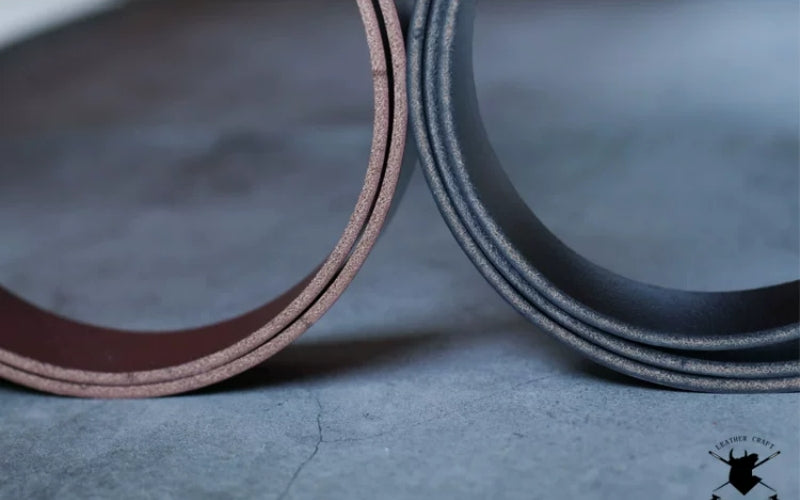
Britannica's leather entry notes that finer leathers — calfskin among them — were historically used for narrower dress belts precisely because their tight fiber density holds structure at slim widths without flexing or curling. Coarser cowhide can't pull this off; it goes wavy and loses shape at 30mm.
What outfits demand a 30mm calfskin dress belt?
The outfits that demand 30mm width are the most formal end of business and dress wear: slim-cut suits, classic European tailoring, evening wear with belt loops, and dress codes where elegance is the primary signal. A 30mm calfskin belt in polished black is the right answer for board meetings, weddings, opera, fine dining, and any occasion where you want the belt to be invisible rather than functional-looking.

Outfit-by-outfit:
| Occasion | Width Recommendation |
|---|---|
| Wedding (guest) | 30mm |
| Job interview (formal industry) | 30mm or 32mm |
| Black-tie optional | 30mm (slim is dressier) |
| Slim-cut Italian suit | 30mm |
| Traditional English suit | 30–32mm |
| Business suit (everyday) | 32mm |
| Sport coat + chinos | 32–35mm |
| Business-casual office | 32–35mm |
| Smart-casual / jeans + loafers | 35mm |
| Casual / weekend jeans | 35–38mm |
The pattern: the more formal the dress code, the thinner the belt. By the time you reach white-tie (no belt at all) and traditional black-tie (suspenders only), the belt has disappeared entirely. A 30mm dress belt is the closest thing to "absent belt" while still actually being there.
Is a 30mm belt too thin for normal everyday wear?
For most modern wardrobes, yes. A 30mm belt looks slightly under-scaled with standard-cut business suits, sport coats, chinos, and anything casual. The 32mm width is the better everyday default because it holds its proportional weight against a wider range of trouser cuts. Reserve 30mm for slim trousers, formal events, and outfits where you want to push the elegance dial as high as it goes.
Two questions to ask yourself before going 30mm:
- Are my trousers slim or classic cut? 30mm pairs naturally with slim. With classic-cut tailoring or pleated trousers, 32mm reads as more proportionally correct.
- Is this belt for one occasion (formal) or daily wear? Daily wear, default to 32mm. Specific formal occasions, 30mm earns its place.
The proportion logic: a slim belt looks balanced against slim hardware (low-profile buckle, narrow trouser cuts, fine leather shoes) and visually undersized against bulky hardware. Pair a 30mm belt with a 40mm chunky buckle and the look collapses immediately.
What buckle works with a 30mm calfskin belt?
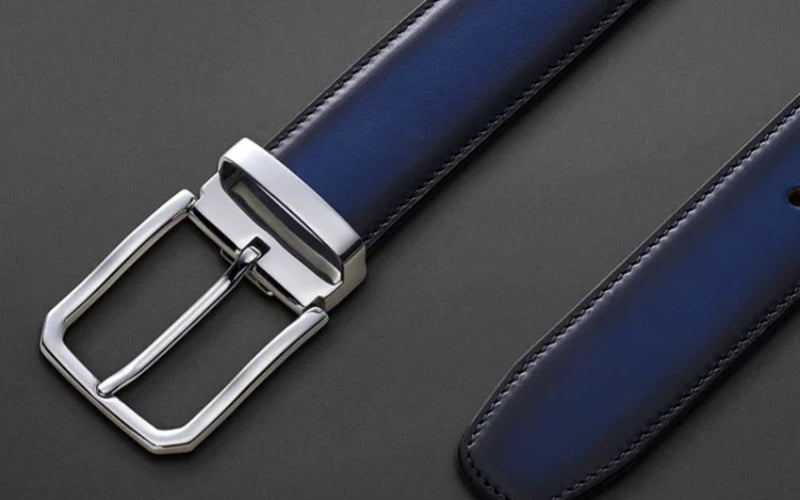
The buckle for a 30mm dress belt should be a low-profile single-prong frame or box-and-prong, scaled to match the strap width — 30mm buckle face for a 30mm strap. Anything wider overhangs the strap edges and looks unbalanced. Polished silver-tone (stainless steel or polished chrome) is the most formal pairing. Heavy brass or oversized buckles defeat the entire point of going slim.

What pairs well:
- Polished stainless single-prong frame buckle — formal, neutral, BELTLEY's default
- Polished chrome single-prong — slightly more reflective, great for black-tie-optional
- Slim box-and-prong — modern formal alternative, clean architectural look
- Low-profile minimal frame — almost decorative, very European tailoring
What to avoid:
- Plaque buckles (too casual, scale wrong)
- Oversized buckles wider than 30mm
- Warm brass with cool dress fabrics (visually mismatched)
- Logos or branded faceplates (kills the elegance signal entirely)
We covered the buckle hierarchy in detail in our calfskin dress belt buckle guide — for 30mm specifically, you want the minimalist end of the frame buckle spectrum.
Why does calfskin work at 30mm where other leathers fail?
Calfskin works at 30mm because of its fiber density. Calf hides have a tighter, finer fiber structure than adult cowhide or other coarser leathers, which lets the strap hold its shape at narrow widths without curling, waving, or developing a "floppy" feel. A 30mm strap cut from full-grain calfskin behaves like a properly engineered piece of equipment — a 30mm strap cut from average cowhide tends to twist over time.

The fiber-density math:
- Calfskin: 0.6–1.2mm typical hide thickness, papillary and reticular layers tightly aligned, fiber bundles small and dense
- Adult cowhide: 2–5mm thickness, coarser fiber bundles, more variable density across the hide
- Bridle / harness leather: Designed for thicker straps; tends to feel overbuilt at 30mm
- Split leather: Lacks the natural fiber structure; goes floppy at any narrow width
Carl Friedrik's leather education content talks about how fiber density — not thickness — is the real predictor of how a strap holds its shape over years. We unpacked this in detail in our calfskin hide anatomy post. The short version: a quality 30mm calfskin dress belt feels structured and substantial despite being slim, because the leather underneath is doing more with less.
This is also why cheap "thin dress belts" feel cheap. They're often made from split leather or low-density top grain, which can't hold shape at 30mm without feeling like a strap of cardboard. The leather is doing the work, not the width.
How long should a 30mm calfskin dress belt be?
Length sizing for a 30mm belt follows the same rule as any dress belt: order 2 inches longer than your pants waist size. So a 34" waist gets a 36" belt (measured tip-to-buckle-edge), which puts the buckle pin in the middle "true size" hole with one hole's slack on each side. This works for nearly every brand using standard 5-hole spacing.

The reason length matters more with slim belts: a 30mm dress belt's strap tail is the most visible part of the belt after threading. Too long and it dangles awkwardly past the first belt loop. Too short and the buckle ends up on the wrong side of your waist with the keeper loops fighting for space. Slim hardware amplifies fit problems that wider belts can absorb.
Our size guide page walks through measurement in detail — the short version is "your jeans size is rarely your belt size, measure twice, buy once."
The Bottom Line
The 30mm calfskin dress belt isn't a fashion choice. It's a proportions choice — the slimmest standard width that still reads as a real belt, engineered to disappear into tailored clothing rather than compete with it. If your wardrobe leans formal, slim-cut, and European-influenced, 30mm is the right specification. For everyday business and business-casual, 32mm remains the better default.
At BELTLEY, our 30mm calfskin dress belts are cut from full-grain calf, paired with low-profile stainless or polished chrome single-prong buckles, and built to the same 10-year warranty as the rest of the range. The reason we make a 30mm option at all is the same reason traditional Italian belt makers do: some occasions demand a belt that's barely there.
If your wardrobe has a slim-cut suit, a wedding on the calendar, or a formal event where the details matter, browse our calfskin dress belt collection and look for the 30mm width.
Frequently Asked Questions
Q: Is a 30mm belt too thin to be practical?
No — it holds your trousers up just as effectively as a wider belt. The "thin = impractical" assumption comes from cheap thin belts made of low-density leather. A 30mm full-grain calfskin belt is structurally sound and lasts as long as any wider dress belt.
Q: What's the difference between 30mm and 32mm dress belts?
Visually small but functionally important. 32mm is the everyday business dress standard — works with most suits and dress trousers. 30mm is slimmer and dressier — best for slim-cut suits, formal occasions, and European-influenced tailoring. The 2mm difference is roughly the gap between "office" and "wedding."
Q: Can I wear a 30mm belt with jeans?
No, and it'll look obviously wrong. 30mm is dress belt territory. With jeans, you want 35–38mm. We cover the casual belt rules in our calfskin belt with jeans post.
Q: Is 30mm the same as 1.18 inches?
Yes. 30mm converts to 1.18 inches. Manufacturers in the US sometimes label these as 1.18" or 1.2", but they refer to the same standard slim dress width.
Q: Why don't more brands make 30mm belts?
Because they're harder to make. 30mm demands higher-quality leather (calfskin, not cheaper cowhide) and tighter manufacturing tolerances to avoid the strap warping. Mass-market brands stick to 35–40mm widths because cheaper leathers can absorb the slack. Quality calfskin makers offer slim options because the leather supports it.
%20is%20the%20slimmest%20standard%20dress%20belt%20width%20%E2%80%94%20narrower%20than%20the%2032mm%20everyday%20dress%20belt%20and%20far%20narrower%20than%20casual%2035%E2%80%9340mm%20belts.%0AThin%20belts%20read%20as%20more%20formal%20because%20they%20p...)