Why LV Belt Edges Crack First (Edge Paint Explained)
Quick answer: LV belt edges crack first because they're sealed with edge paint — a separate, plastic-like coating applied on top of the cut leather. The leather flexes and reacts to humidity, but the paint layer doesn't move with it, so the edges chip, flake, and crack long before the face of the belt shows wear. Heat makes it worse, and once it starts, re-painting only resets the clock.
Last updated: June 2026 • By BELTLEY
TL;DR:
- LV belt edges are sealed with edge paint (glazing) — a coating that sits on top of the leather.
- The leather flexes and swells with humidity; the paint doesn't move with it, so it cracks.
- The edge is the most-flexed, thinnest-coated part of the belt — so it fails first.
- Heat (hot cars, hairdryers) softens the glazing and speeds up peeling.
- Burnished edges — compressed into the leather instead of painted on — don't peel; they just fade.
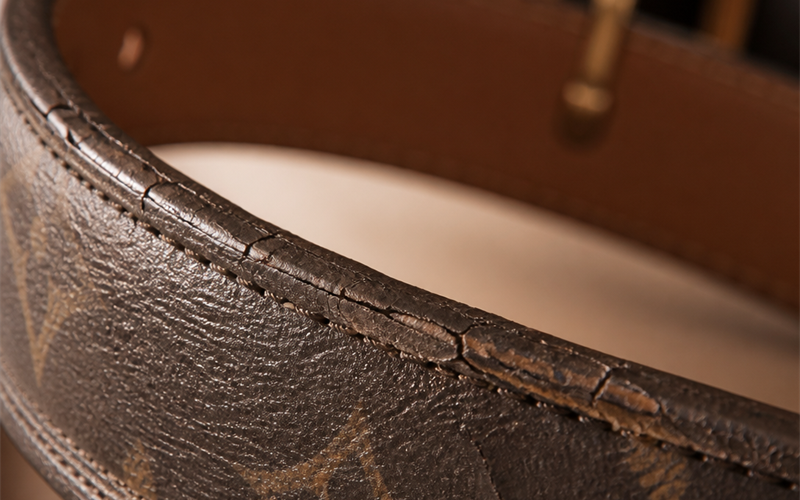
It always starts at the edge. The face of a Louis Vuitton belt can look fine while the rim is chipping, flaking, or going tacky. That's not bad luck or a fake — it's the predictable behavior of edge paint, the glossy sealant brands use to finish a cut leather edge. Because it's a layer on top rather than part of the leather, the edge becomes the belt's weakest point. Understanding why tells you exactly how to slow it and what to choose next time. For the bigger picture on what these belts are built from, see what Louis Vuitton belts are made of.
What to Do About Cracking LV Belt Edges
Match the state of your belt's edges to the right move.

| Your situation | Do this |
|---|---|
| Edges flaking, leather/canvas still intact | Re-glaze at LV or have a cobbler re-paint the edges |
| Edges soft or tacky from heat | Get it away from heat; store cool and dry |
| Cracking keeps coming back after repair | It will — consider a burnished-edge belt instead |
| Edge and the leather body both cracked | Bigger repair; reglazing alone won't fix it |
| You want edges that never peel | Choose a belt with burnished, sealed-in edges |
If the whole belt is drying out, not just the edges, our guide on how to keep leather belts from cracking covers the full routine.
Why do LV belt edges crack before the rest of the belt?
LV belt edges crack first because edge paint is a coating on top of the leather, and the edge is the part that flexes most. As the leather bends and swells with humidity, the rigid paint layer can't keep up, so it separates, chips, and cracks along the rim while the flatter, less-stressed face stays intact longer.

It comes down to where the stress concentrates. Every time you buckle, sit, or bend, the edges curve more sharply than the face. Pile a surface coating onto the most-flexed area and it's the first to fail. As one leather-finishing breakdown explains, edge paint is "a separate layer of material applied on top of the leather... a flexible, plastic-like coating," and the problem is that "leather expands, contracts, and flexes... the paint layer doesn't always move at the same rate." That mismatch is the crack.
What exactly is edge paint, and why does LV use it?
Edge paint is a specialized sealant brushed onto the cut edge of leather to create a smooth, uniform, glossy finish. Brands like Louis Vuitton use it because it's fast, consistent, and gives a crisp factory look across thousands of units — far quicker than hand-burnishing each edge.

The appeal is production speed and a flawless, color-matched line. The downside is durability: a painted edge looks perfect on day one and is the first thing to age. On Louis Vuitton specifically, this shows up as the classic glazing failure — as an LV repair specialist describes, the glossy painted edge "can soften, get tacky in heat, then chip or flake". It's the same glazing LV uses on bag handles, and it ages the same way on a belt.
Key stat: Edge paint is essentially a thin plastic-like skin on the rim — so heat, humidity, and constant flexing make the edge the first part of an LV belt to fail, often while the rest of the strap still looks new. Re-glazing restores it, but the coating will eventually peel again.
Edge paint vs. burnished edges: which lasts longer?
Burnished edges last longer than painted edges because they're compressed into the leather itself rather than coated on top. Burnishing uses friction and heat to seal the leather's own fibers, so there's no separate layer to peel — burnished edges fade and dull with age instead of cracking and flaking. The leather type matters too — vegetable-tanned leather burnishes especially well.

Here's the trade-off in plain terms:
| Feature | Edge paint (glazing) | Burnished edge |
|---|---|---|
| How it's made | Coating applied on top of the cut edge | Leather fibers compressed and sealed by friction |
| How it fails | Chips, cracks, flakes, gets tacky in heat | Slowly fades and dulls |
| Look when new | Crisp, glossy, uniform color | Natural, rounded, slightly matte |
| Long-term durability | Lower — surface layer separates | Higher — nothing to peel |
| Best for | Fast factory production | Belts built to last |
Neither is "fake," but they age very differently. A painted edge is built for the showroom; a burnished edge is built for the decade. It's the kind of construction detail that separates belts more than the logo does — a theme we dig into in Gucci vs Louis Vuitton belts.
How do I fix and prevent cracking LV belt edges?
Fix flaking edges by having Louis Vuitton re-glaze them or a cobbler re-paint them — possible as long as the leather underneath is sound. Prevent it by keeping the belt away from heat, conditioning the leather, and storing it cool and dry. Heat is the main accelerator.

Practical steps:
- Stop the heat exposure — no hot cars, radiators, or hairdryers; warmth softens glazing and speeds peeling.
- Re-glaze or re-paint the edges professionally; LV can do it if the leather/canvas hasn't cracked.
- Condition the leather body so it stays supple and flexes less harshly at the edge — see our leather care guide.
- Store it flat or rolled in a cool, dry spot, not crushed in a hot drawer.
- Accept the cycle — re-glazing resets the look but the coating will peel again over time.
If you're tired of babying an edge, the durable answer is construction, not maintenance. A full-grain belt with burnished, sealed-in edges sidesteps the whole problem.
The Bottom Line
LV belt edges crack first because edge paint is a coating on top of the leather, and the rim is the part that flexes and reacts to humidity the most — so the rigid paint separates and chips while the face still looks fine. Heat accelerates it, and while Louis Vuitton can re-glaze a sound belt, the paint will eventually peel again. The lasting fix isn't a better touch-up; it's a better edge. A genuine full-grain leather belt with burnished, sealed edges has no surface coating to lose, so it fades gracefully instead of cracking. Keep your LV out of the heat, re-glaze when needed, and buy your next belt for how its edges are built — not just the initials on the buckle.
Frequently Asked Questions
Q: Why do my Louis Vuitton belt edges crack and peel?
Because the edges are sealed with edge paint — a coating applied on top of the leather. The leather flexes and swells with humidity while the paint stays rigid, so the edges crack and flake first. Heat makes the glazing soften and peel faster.
Q: Can Louis Vuitton fix peeling belt edges?
Yes, LV can re-glaze the edges as long as the leather or canvas underneath hasn't cracked. A cobbler can also re-paint them. Just know that re-glazing restores the look temporarily — the coating will eventually peel again.
Q: What's the difference between edge paint and burnished edges?
Edge paint is a sealant layer applied on top of the cut edge, while burnishing compresses the leather's own fibers to seal them. Painted edges crack and flake; burnished edges fade and dull. Burnished edges last longer because there's no surface coating to peel.
Q: Does heat damage LV belt edges?
Yes. Heat softens the glazed edge paint, making it tacky and far more likely to chip and peel. Keep the belt out of hot cars, away from radiators, and never use a hairdryer on it. Cool, dry storage slows the cracking.
Q: How do I stop my belt edges from cracking for good?
Choose a belt with burnished, sealed-in edges rather than painted ones, since there's no coating to separate. Keep the leather conditioned and out of heat. On a painted-edge belt, cracking is a matter of when, not if — burnished construction avoids it.