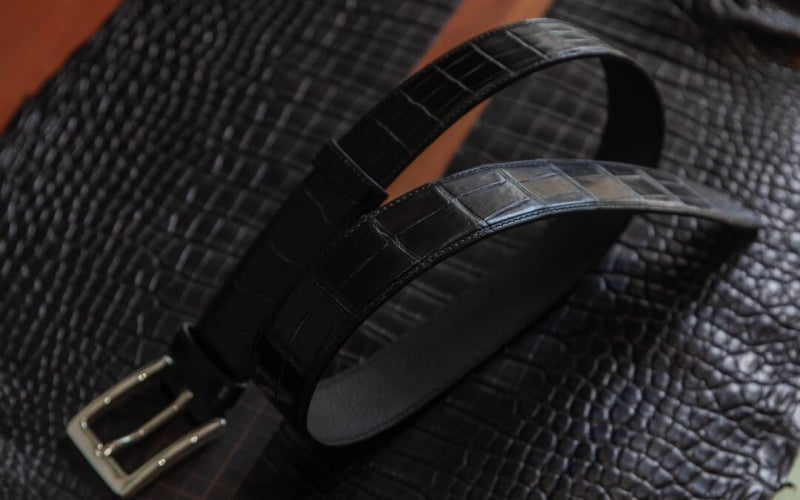
Why Is Alligator Leather So Expensive? The Real Cost
TL;DR: Quick Answer
- Alligator leather is expensive because of compounding scarcity at every stage: limited harvest (~500,000/year vs. 100 million cattle), carnivore feeding costs, 8-12 month tanning, and up to 50% waste from grading
- Finished alligator leather costs $350-$1,000+ per square foot — roughly 30-70x more than cowhide
- Much of what you pay at luxury houses is Brand Tax, not material cost — the same hide goes into a $250 DTC belt and a $2,500 designer belt

A genuine alligator leather belt costs $150-$400 from a DTC brand and $1,200-$5,000+ from a luxury house. Either way, that's significantly more than cowhide. The question isn't whether alligator leather is expensive — it obviously is.
The question is where the money actually goes and how much of it reflects genuine material and labor costs versus brand markup.
Here's the full cost chain, from Louisiana swamp to finished buckle.

How Much Does Alligator Leather Cost Per Square Foot?
Finished alligator leather ranges from $350 to over $1,000 per square foot, depending on grade, finish, and color. By comparison, finished cowhide costs $5-$15 per square foot — making alligator roughly 30-70x more expensive as a raw material.
Here's how pricing breaks down at each stage of the supply chain:
| Stage | Price | Unit |
|---|---|---|
| Raw belly skin (small) | ~$22 | per linear foot |
| Raw belly skin (large, 12'+) | ~$38.50 | per linear foot |
| Raw hornback skin | $33-$44+ | per linear foot |
| Finished leather (standard grade) | $50-$200 | per square foot |
| Finished leather (premium Grade 1-2) | $350-$800 | per square foot |
| Finished leather (top grade, custom color) | $500-$1,000+ | per square foot |
| Custom color surcharge | ~$400 | per belly skin |
These figures come from AMTAN (American Tanning and Leather) and industry pricing guides from Pan American Leathers. A single alligator belt requires a 40-45cm skin to cut a one-piece strap — there's no way to piece together offcuts without sacrificing structural integrity.

The Farming Stage: $80 Per Animal
It costs approximately $80 to raise a single alligator to harvest size in a controlled farming environment — covering feed, heated water, electricity, labor, and barn depreciation. That's cheap relative to the final product, but the volume limitations are what drive cost.
According to the Louisiana Department of Wildlife and Fisheries, Louisiana's alligator industry — the world's largest — harvests roughly 400,000 farm-raised alligators annually. The global total across all species and countries is around 500,000-750,000 skins per year. Compare that to roughly 100 million cattle slaughtered annually for leather, and the scarcity picture becomes clear: alligator skins represent just 0.2% of global leather production.
The farming process itself is demanding. Alligators are obligate carnivores, so their feed is meat-based — significantly more expensive than the grain-based diets of cattle. Water and air temperatures must be maintained at 85-90°F year-round to ensure growth rates. Farm-raised alligators reach harvest size (3-5 feet) in 12-18 months, while wild alligators take 3-4 years. As LSU AgCenter's industry research documents, Louisiana's program also requires farmers to return approximately 17% of hatchlings to the wild — a conservation mandate that further constrains supply.

Why Does Tanning Take 8-12 Months?
Exotic leather tanning takes 8-12 months because the process requires slow, multi-stage chemical treatment to preserve the natural scale pattern without distortion, cracking, or color irregularity. Standard cowhide chrome tanning can be completed in a single day.
Here's what makes exotic tanning so much longer and more expensive:
- Salting and preservation — the raw skin must be stabilized immediately after harvest to prevent decay
- Soaking and rehydration — carefully controlled to avoid scale damage
- Scale preparation — unlike cowhide's uniform surface, alligator scales require individualized treatment to retain their three-dimensional structure
- Degreasing — alligator hides contain natural oils that must be removed slowly and evenly; rushing this step causes blotching
- Tanning — vegetable tanning is preferred for luxury applications because it produces richer color and better aging characteristics, but it takes weeks versus days for chrome tanning
- Dyeing and finishing — each skin absorbs dye differently based on its scale pattern; achieving uniform color requires skilled hand-finishing
- Quality inspection — final grading determines the skin's commercial value
According to AMTAN's tanning guide, hornback skins take 12+ months due to the additional bone structures that must be processed. Custom color finishes add approximately $400 per belly skin on top of standard tanning costs. This is why a matte black belt and a hand-patinated French blue belt from the same hide can be priced very differently.

The Grading Tax: Up to 50% Material Waste
Alligator leather grading eliminates a significant percentage of each skin from premium use, and the losses compound costs for finished products. Less than 5% of wild-caught skins qualify as Grade 1 — flawless belly with zero scarring.
| Grade | Belly Condition | Usable Area | Typical Use |
|---|---|---|---|
| Grade 1 | Flawless | ~100% | Single-piece luxury belts, handbags |
| Grade 2 | Minor edge defects | ~75% | Belts, wallets, watch straps |
| Grade 3 | Center belly defects | ~50% | Small goods, accent pieces |
| Grade 4-5 | Multiple defect clusters | <50% | Industrial, heavily processed goods |
According to Panam Leathers' grading standards, farm-raised alligators produce higher percentages of Grade 1-2 skins than wild-caught because controlled environments minimize scarring from fights and habitat debris. But even on farms, a significant portion of skins grade below premium levels.
This is the hidden multiplier in alligator leather pricing. When a tannery processes 100 skins and only 40-50 yield enough clean belly leather for a premium belt, the cost of those 40-50 belts must effectively absorb the investment in all 100 skins. For more on how grading affects the finished product, see our guide on alligator leather quality.

How Much Is Actual Material vs. Brand Tax?
For a luxury house selling a crocodile belt at $2,500, the raw material, tanning, and artisan labor account for roughly $200-$260. The remaining $2,000+ is retail markup, marketing, and Brand Tax.
Here's the approximate cost breakdown:
| Component | DTC Brand ($250 belt) | Luxury House ($2,500 belt) |
|---|---|---|
| Raw hide | $100-$125 | $100-$125 |
| Tanning and finishing | $40-$50 | $40-$50 |
| Artisan labor (8-18 hours) | $40-$60 | $40-$60 |
| Hardware (buckle, keeper) | $15-$25 | $15-$25 |
| Total production cost | $195-$260 | $195-$260 |
| Retail markup | $0-$55 | $2,000-$2,240 |
The production costs are nearly identical. The Gentleman's Gazette confirms that the exotic leather supply chain is relatively standardized — the same Louisiana and African tanneries supply both DTC brands and luxury houses. What changes is what happens after the belt leaves the workshop: retail rent, celebrity endorsements, packaging, and brand premium.
This is the core of BELTLEY's model. We work directly with certified tanneries, handcraft each belt in small batches with 316L stainless steel buckles, and sell DTC — cutting the Brand Tax entirely. The result: a genuine crocodile belt at $150-$299 that uses the same grade of hide as a $2,500 department store equivalent. Compare how designer brands price their belts for more context on where the markup goes.

The Cost-Per-Year Reality Check
When you amortize alligator leather's price over its 20-30 year lifespan, it often costs less per year than cowhide alternatives that need replacing every few years.
| Belt Type | Price | Lifespan | Cost Per Year | Total Spend Over 25 Years |
|---|---|---|---|---|
| DTC alligator | $250 | 25 years | $10 | $250 |
| Full-grain cowhide | $80 | 6 years | $13 | $320 (4 belts) |
| Fast-fashion leather | $35 | 1.5 years | $23 | $583 (17 belts) |
The math tilts further in alligator's favor when you factor in that genuine exotic leather develops a richer patina with age — it actually looks better at year 15 than year one. Cowhide typically looks its best the day you buy it. For a full value analysis, see our guide on whether alligator belts are worth it.

The Bottom Line
Alligator leather is expensive for real, structural reasons: limited annual harvest, carnivore farming costs, 8-12 months of specialized tanning, and up to 50% material waste from grading.
Those costs are fixed and legitimate — they apply equally to every brand using genuine alligator. What isn't fixed is the markup. A luxury house charging $2,500 for a crocodile belt is spending $200 on production and $2,300 on brand infrastructure.
A DTC brand spending the same $200 on production and selling at $250 is giving you the same material and craftsmanship without the Brand Tax. At BELTLEY, every belt is handcrafted from certified Nile crocodile, paired with 316L stainless steel hardware, and backed by a 10-year warranty.
The leather is worth every penny — the logo shouldn't cost extra. Browse the full crocodile and alligator collection and see where your money actually goes.
Frequently Asked Questions
Q: Is alligator leather more expensive than crocodile leather?
Generally yes. American alligator tends to command a slight premium over Nile crocodile due to its more uniform scale pattern and higher demand in the U.S. market. However, the price difference is modest — typically 10-20% — and both fall in the same overall pricing tier.
Q: How much is a whole alligator skin worth?
A whole finished alligator skin ranges from roughly $450 to $840+ depending on size, grade, and finish. Premium Grade 1 skins in popular sizes (40-50cm width) command the highest prices. Custom color finishes add approximately $400 per skin.
Q: What is the most expensive exotic leather?
Alligator and crocodile consistently rank among the most expensive at $350-$1,000+ per square foot finished. Stingray and elephant leather are comparably priced in some markets. The single most expensive leather product ever sold was a Hermès Himalaya crocodile Birkin bag at over $400,000 at auction.
Q: How many alligators are harvested each year?
Approximately 400,000 farm-raised alligators are harvested in Louisiana annually, with the global total across all crocodilian species reaching roughly 500,000-750,000 skins per year. By comparison, about 100 million cattle are processed for leather annually — making alligator skins just 0.2% of global leather supply.
Q: Why does exotic leather tanning take so long?
Alligator tanning requires 8-12 months because each stage — degreasing, scale preservation, dyeing, and finishing — must proceed slowly to avoid damaging the three-dimensional scale structure. Rushing any step causes cracking, blotching, or distortion. Standard cowhide can be chrome-tanned in a single day because its uniform surface doesn't require the same precision.
Q: Is alligator leather a good investment?
Yes, from a cost-per-year perspective. A $250 DTC alligator belt lasting 25 years costs $10/year. CITES-certified pieces in pristine condition also retain an estimated 50-70% of retail value on the secondary market — a resale floor that cowhide products don't offer. See our full analysis of crocodile belt pricing.
,%20carnivore%20feeding%20costs,%208-12%20month%20...)