
Why Do Some Belts Have Layered Construction?
TL;DR:
- Layered belts combine two (or more) materials for specific functional or aesthetic reasons — a main leather layer + a liner layer is the most common construction
- Quality reason to layer: add structure, comfort, or a premium interior material (soft calfskin, Nappa) while maintaining a specific exterior leather
- Cheap reason to layer: disguise thin or low-grade leather by gluing it to a stiff backing to fake thickness and rigidity
- How to tell the difference: the edge cross-section and the liner material quality
Imagine a good winter coat. It has an outer shell (weatherproof), a mid-layer (insulation), and a lining (comfort against skin). Three materials, each doing something the others can't. That's smart construction.
Now imagine a cheap version: a thin outer shell glued to a low-quality lining to make it feel substantial in the store. Same number of layers, completely different purpose.
Belt construction works the same way. Here's how to tell which one you're looking at.
What Is Layered Belt Construction?
A layered belt is one made from more than one piece of material bonded together. The most common configuration is:

- Outer layer (face): The visible leather — full-grain cowhide, crocodile, alligator, or other exotic leather
- Inner layer (liner/backing): A secondary material bonded to the inside — typically a softer leather (Nappa calfskin, vegetable-tanned leather) or occasionally a structured material for shape
Some belts have a middle structural layer too — a thin strip of vegetable-tanned leather sandwiched between the face and liner for rigidity. This is the three-layer or "sandwich" construction used in premium dress belts and some exotic leather work.
What Are the Legitimate Reasons to Build a Belt in Layers?
1. Material efficiency for exotic leather Crocodile and alligator leather is expensive, and the skin is relatively thin on its own. A full-grain cowhide layer backing provides the structural thickness and rigidity a belt needs, while the exotic skin provides the visible face. This is standard practice in quality exotic leather goods — it's not a shortcut, it's intelligent material use.

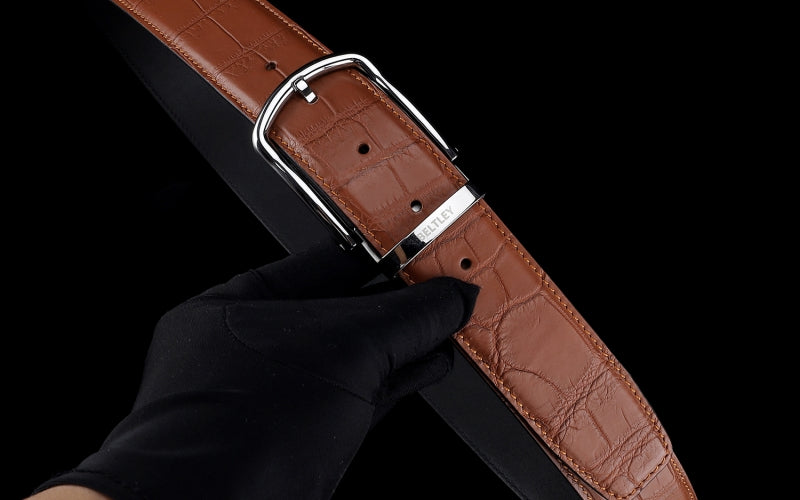
BELTLEY's exotic leather belts use this construction: genuine exotic leather face, full-grain cowhide structural layer, premium Nappa lining. Exotic leather belts — three materials doing three different jobs. Every one is covered by a 10-year warranty on materials and construction.

2. Comfort lining The back of a belt sits against your waistband and sometimes against your skin if worn without a shirt. A smooth, soft Nappa calfskin lining is noticeably more comfortable than raw leather. Some dress belts include a lining specifically for this reason — nothing structural, just comfort.
3. Achieving specific thickness A 3.5mm full-grain strap achieves its thickness naturally. But for a thin exotic skin that measures 1.5mm, adding a 2mm structural backing reaches the same specification through layering. The result is correct — the method is different.
According to Sourcify's manufacturing guide for leather belts, double-layer construction is the standard in premium belt manufacturing whenever the face material isn't structurally sufficient on its own — which covers most exotic leather work.
When Is Layered Construction a Quality Shortcut?
Here's where it gets important. Layering can also be used to disguise quality problems:

Thin genuine leather + non-leather backing: A 1.5mm genuine leather face bonded to a 2.5mm polyurethane, cardboard, or fabric backing. Measures 4mm — looks substantial in-store. But the backing provides no leather properties: no patina, no aging, no strength. As the glue bond degrades over time (which it will under daily flex), the layers separate. You see bubbling or delamination starting from the holes and edges.
Split leather face + cheap lining: Combines the worst of both worlds — a face that will peel with a backing that adds no compensating quality.
How to identify it:
- Look at the edge cross-section: Quality layering shows leather (with visible fiber structure) throughout both layers. Cheap layering shows a thin top skin over a clearly different substrate — often plasticky, fabric-textured, or foam-like.
- The delamination test: Carefully try to separate the layers at the tip end. In quality construction with proper leather adhesive, layers won't separate under gentle pressure. In cheap construction, they often will with minimal force.
- Weight: Quality leather is dense. A belt that looks substantial but feels surprisingly light is usually faking its weight with non-leather backing.
What About Single-Layer Belts?
Single-layer full-grain leather belts are the simplest construction and often the most honest one. One piece of leather, properly thick (3.5–4.5mm), with well-finished edges. No layers to separate, no glue to degrade, no liner to add or subtract quality.

This is the traditional construction for workwear belts, Western belts, and heritage casual leather goods. BELTLEY's full-grain leather collection includes both single-layer and double-layer constructions, clearly built from genuine full-grain leather throughout.
The limitation of single-layer for exotic leather is practical: a crocodile skin or alligator hide is too thin to function as a 4mm belt on its own. Layering isn't optional in that application — it's structural necessity. Double layer belt collection — built with full-grain leather on both layers, not shortcuts.
The Bottom Line
Layered construction is a legitimate engineering solution when each layer contributes something real: exotic leather for appearance, structural leather for rigidity, Nappa for comfort. It's a quality shortcut when the layers are thin genuine leather over non-leather backing. The edge cross-section doesn't lie — look at it before you buy. For a deeper look at how different construction methods affect longevity, see our guide to what is the most durable leather belt. And for the full story on leather grades across the layers, the full-grain leather vs. genuine leather comparison covers every tier.
Frequently Asked Questions
Q: Why do some leather belts have multiple layers?
Multiple layers serve specific purposes: exotic leather faces need structural backing for rigidity and thickness; comfort liners add a soft interior; middle layers can add stiffness to a dress belt. Quality layering uses genuine leather throughout each layer. Cheap layering uses thin leather glued to non-leather backing to fake substance.
Q: How can I tell if a belt's layers are quality construction?
Look at the edge cross-section — quality layering shows leather fiber structure throughout. Cheap layering shows a thin top skin over a different substrate (plasticky, fabric-textured, or foam-like). Also test the layer bond at the strap tip — quality adhesion won't separate under gentle pressure.
Q: Is a single-layer belt better than a layered belt?
Not necessarily — context determines the right construction. Single-layer full-grain leather is appropriate for casual everyday belts. Multi-layer construction is required for exotic leather belts (where the skin is too thin to function alone) and desirable for dress belts with comfort liners. The key is that each layer should be genuine leather doing a real job.
%20materials%20for%20specific%20functional%20or%20aesthetic%20reasons%20%E2%80%94%20a%20main%20leather%20layer%20+%20a%20liner%20layer%20is%20the%20most%20common%20construction%0A%0AQuality%20reason%20to%20layer:%20a...)