Why Do Cowboys Wear Such Large Belt Buckles?
TL;DR:
- Cowboys wear large belt buckles primarily as rodeo trophies — symbols of championship achievement, not just decoration
- The tradition only started in the 1920s; most cowboys didn't wear belt buckles at all before 1920
- Hollywood amplified the oversized buckle into a cultural icon, turning a trophy into a universal Western identity marker
Walk into any rodeo, country music venue, or Western wear store and the oversized belt buckle is impossible to miss. Some are the size of a small plate, engraved with steers, eagles, or a rider's event and year. They sit at the center of the outfit like a statement of personal history. But the tradition behind the large cowboy belt buckle is more specific — and more recent — than most people realize. Here's the full story.
Why Do Cowboys Wear Such Large Belt Buckles?
Cowboys wear large belt buckles because the oversized buckle originated as a rodeo championship trophy — a wearable award given to competition winners in place of a conventional trophy. The larger and more elaborately engraved the buckle, the higher the achievement it represents. Over time, the trophy buckle became the defining symbol of Western identity and heritage for cowboys and non-competitors alike.

The logic is straightforward: a silver trophy sits on a shelf. A championship buckle rides with you every day, visible to everyone in the room. According to the Buffalo Bill Center of the West, the buckle became the preferred rodeo award specifically because it merged achievement with daily life — a trophy that worked as clothing. For a broader history of what belt buckles represent, see What Is the Point of a Belt Buckle?
Did Cowboys Always Wear Big Belt Buckles?
No. Most cowboys did not wear belt buckles at all before 1920, and oversized decorative buckles didn't become common until the mid-20th century. Belt loops didn't even exist on denim jeans until 1922, when Levi Strauss & Co. added them to the 501 Jean — before that, cowboys used suspenders and cinch-back straps to hold up their trousers.

The pre-1922 cowboy wardrobe relied on the cinch-back: a strip of fabric at the rear waistband that could be tightened with a buckle or tie. Belts as we understand them — a leather strap threaded through loops — were simply not part of the standard working cowboy kit. True West Magazine's research on belt loop history confirms that the transition from suspenders to belts in Western wear happened gradually through the 1920s and 1930s, driven by both Levi's design changes and shifting fashion.
The large decorative buckle came after the loop — not before.
The Rodeo Trophy Buckle: How a Sport Changed Fashion
Rodeo competitions in the early 20th century initially awarded conventional prizes — cash, trophies, saddles. But as professional rodeo grew during the 1920s and 1930s, organizers wanted awards that felt distinctly Western and could be worn rather than stored. A Cut Above Buckles' documented history of rodeo awards traces the first formal trophy buckle awards to this era, when silversmiths began crafting oversized, engraved buckles specifically as competition prizes.
The prestige escalated quickly. By the 1950s, major rodeo associations were commissioning silver and gold buckles of significant value. Levi Strauss & Co. famously awarded a gold and silver championship buckle to Jim Shoulders of Henryetta, Oklahoma — the 1956 Rodeo Cowboy Association All-Around Champion — along with a $1,500 prize check. Shoulders won 16 world championships in total and wore his buckles as public proof.
The engraving mattered. A trophy buckle would typically feature the event (bull riding, barrel racing, team roping), the year, the competition name, and often the rider's name or initials. Reading a champion's buckle was like reading their résumé — every detail was deliberate. Explore the unique buckle belts collection for modern examples of how buckle craftsmanship carries forward this tradition.
How Big Is a Typical Cowboy Belt Buckle?
A standard dress belt buckle measures roughly 1.5 to 2 inches wide. A typical cowboy or Western belt buckle runs 3 to 4 inches wide. Championship rodeo trophy buckles can reach 5 to 6 inches wide and 4 to 5 inches tall — large enough to serve as a centerpiece of any outfit and impossible to miss across a crowded arena.

The size is functional in the original trophy context: a larger buckle means more engraving space, which means more detail about the achievement it represents. Championship buckles often weigh several ounces of sterling silver and may be set with gemstones, gold plating, or colored enamel. According to Belt Buckle History, the oversized format became a deliberate aesthetic choice once Hollywood adopted it — bigger communicated more authority, more presence, more story.
The contrast with a modern dress belt buckle is sharp. A plaque buckle belt designed for business or formal wear might be 40mm wide and 3-4mm thick — almost invisible by design. A Western trophy buckle is the exact opposite: designed to be the first thing anyone notices.
Hollywood's Role in Making the Buckle Iconic
Rodeos created the trophy buckle tradition, but Hollywood turned it into a universal symbol. From the 1920s through the 1950s, Western films defined the visual vocabulary of American masculinity for a global audience. Conejo Western Wear's documented history of Western belts notes that film costumers deliberately exaggerated the size and ornamentation of cowboy buckles to read clearly on camera — and audiences adopted the aesthetic as authentic.
Gene Autry, Roy Rogers, and later John Wayne wore buckles that were often custom-made for screen presence. Real working cowboys, seeing these films, began seeking similar buckles for their own belts. The feedback loop between Hollywood performance and lived Western identity compressed within a generation: by the 1950s, the large silver buckle was simply what a cowboy wore, regardless of whether they had won one.
Country music amplified this further. Artists performing in the 1960s and 1970s wore buckles as centerpieces of stage costumes — they were jewelry-scale objects that caught stage lighting. For a deeper look at how belt symbolism evolved across cultures, see What Does a Leather Belt Symbolize?
What Do the Engravings and Symbols on a Cowboy Buckle Mean?
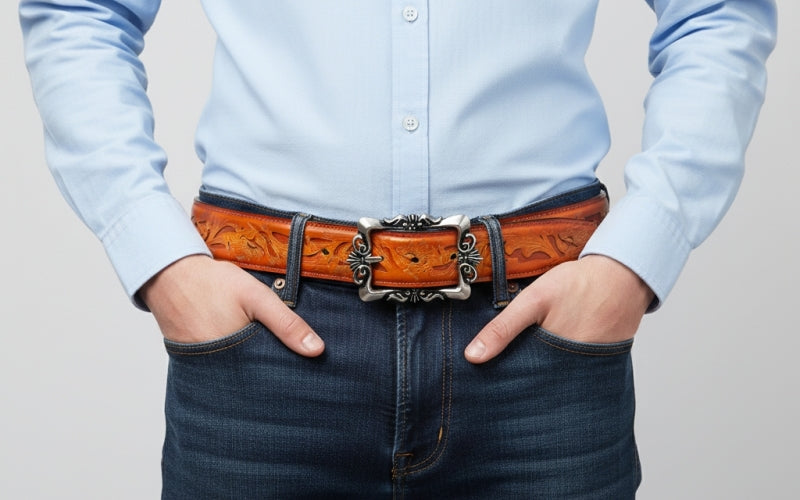
Rodeo trophy buckle engravings record the specific achievement: event type (bull riding, barrel racing, calf roping), competition name, year, and often the winner's name or brand. Decorative Western buckles use symbolic imagery — longhorns (ranching heritage), eagles (American identity), horses (freedom and working tradition), and floral scrollwork (silversmithing craft origin in Mexican vaquero tradition).

The longhorn and eagle combination is the most common in Texas and Oklahoma rodeo culture. Floral scroll engraving in the Sheridan style — named after Sheridan, Wyoming, where the technique was developed in the 1920s — is the dominant decorative language of premium Western buckles. Each motif carries regional and personal meaning, functioning as a visual signature for the wearer's background and achievements.
According to the Legacy of Championship Rodeo Belt Buckles research, some buckles are passed down through families as heirlooms, functioning like military medals — earned objects that belong to a lineage, not just an individual.
Can Anyone Wear a Large Western Buckle?
Yes. The large cowboy belt buckle long ago crossed from rodeo trophy to general fashion item. Non-competitors wear oversized Western buckles as an expression of regional identity, cultural heritage, or personal style. Country music fans, Western wear enthusiasts, and fashion designers have all adopted the buckle as an aesthetic choice entirely separate from its rodeo origins.
The unspoken rule is context: a large engraved Western buckle reads clearly in country, Western, and casual settings. It looks out of place with a business suit or formal wear. Understanding types of belt buckles helps clarify which buckle weight and style belongs in which setting.
At BELTLEY, our handmade belt collection includes buckle designs that carry the weight and craft heritage of the Western tradition — built with the same commitment to hardware quality, just scaled for modern professional and smart-casual wear.
The Bottom Line
Cowboys wear large belt buckles because the tradition began as a trophy system — a wearable championship award designed to be seen, read, and remembered. What started as a rodeo prize in the 1920s became the defining visual symbol of Western identity by the 1950s, largely because Hollywood made it so. Today the large buckle carries the same core meaning it always did: this person has a story, and they're wearing it.
The broader principle holds whether the buckle is a five-inch silver rodeo trophy or a 40mm stainless steel plaque buckle on a full-grain dress belt: the buckle is always the statement. Explore BELTLEY's belt buckles collection for hardware built to make that statement last.
Frequently Asked Questions
Q: Why are cowboy belt buckles so big?
Cowboy belt buckles are large because they originated as rodeo trophies, where size meant more engraving space and greater visual impact. The bigger the buckle, the more detail about the achievement it records. Hollywood then adopted and exaggerated the scale, making the oversized buckle a universal Western identity symbol.

Q: When did cowboys start wearing belt buckles?
Cowboys did not widely wear belt buckles before the 1920s. Belt loops weren't added to Levi's jeans until 1922. Rodeo trophy buckles emerged as championship awards in the 1920s and became mainstream Western fashion by the 1940s and 1950s, partly driven by Hollywood Westerns.
Q: What do cowboy belt buckle engravings mean?
Rodeo trophy buckle engravings typically record the competition name, event type, year, and winner's name. Decorative Western buckles use symbolic imagery — longhorns, eagles, horses, and floral scrollwork — each representing ranching heritage, regional identity, or personal history.
Q: How heavy is a rodeo trophy belt buckle?
Championship rodeo belt buckles are typically made from sterling silver, sometimes with gold plating, and can weigh 4 to 8 ounces. High-end competition buckles may be set with gemstones or colored enamel and are essentially pieces of wearable fine jewelry scaled to belt hardware.
Q: Is it disrespectful to wear a rodeo buckle you didn't earn?
No. The large Western buckle has long since become a general fashion item available to anyone. Wearing a decorative Western buckle without rodeo credentials is standard practice in country music culture, Western fashion, and everyday wear in many American regions.