What Is the Best Way to Store Leather Belts? ( Not Tossed in a Junk Drawer)
Quick answer for busy readers
- The best way to store leather belts is hanging them by the buckle on a dedicated belt rack inside a closet — it prevents creases, allows airflow, and keeps the leather straight.
- Rolling loosely (grain side out) in a drawer organizer is the best alternative for limited closet space or travel.
- Never fold belts, store them in plastic bags, or leave them in direct sunlight — all three cause cracking, warping, or mold.

A $200 belt stored wrong will crack faster than a $50 belt stored right. Storage is the easiest part of leather care to get correct, and the most common part people get wrong. Leaving belts threaded through pant loops in a dark closet, tossing them in a pile on a dresser, or coiling them tight inside a suitcase — each one quietly damages the leather.
The best way to store leather belts depends on your space, your collection size, and the type of leather. Here are five proven methods, ranked by effectiveness, plus the environmental conditions that keep leather healthy for years. If you're also looking for care tips beyond storage, start with our leather care guide.

Should You Hang or Roll Leather Belts?
Hanging is the superior storage method for everyday use. A belt hung by its buckle hangs straight under its own weight, which prevents creases, allows air to circulate around the full surface, and keeps the leather in its natural resting shape. Rolling is the best alternative when closet space is limited or for travel.
Both methods work well — the key difference is convenience versus space efficiency.
Hanging works best when you have closet wall space or door-back space. According to professional organizers at Homes & Gardens, a wall-mounted or door-mounted belt rack is the most recommended storage solution because it keeps belts visible, accessible, and damage-free.
Rolling works best for drawer storage, travel, or large collections. Roll each belt loosely from the buckle end to the tip, grain side out, with a radius no tighter than 4 inches. Tight coils create stress creases that become permanent crack lines over time. Use a drawer divider or compartmentalized organizer to keep rolled belts from uncoiling and pressing against each other.
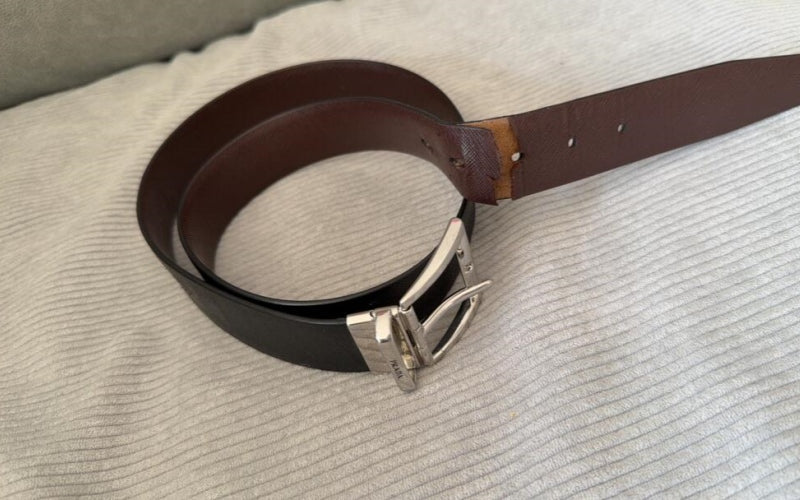
Never fold a belt in half. Folding creates a sharp crease at the midpoint that compresses the grain fibers unevenly. Over time, this fold becomes a weak point where cracking starts — the same damage mechanism that causes belts to break at the buckle fold.

5 Belt Storage Methods Ranked
Here's a comparison of the five most common storage approaches, ranked by leather preservation effectiveness:
| Method | Best For | Cracking Risk | Space Needed | Cost |
|---|---|---|---|---|
| 1. Belt rack (wall/door-mounted) | Daily-wear collections | Very low | Closet wall or door back | $15–$40 |
| 2. Pull-out sliding rack | Built-in closet systems | Very low | Closet interior panel | $25–$60 |
| 3. Drawer with dividers | Small collections, rolled storage | Low | One dresser drawer | $10–$25 |
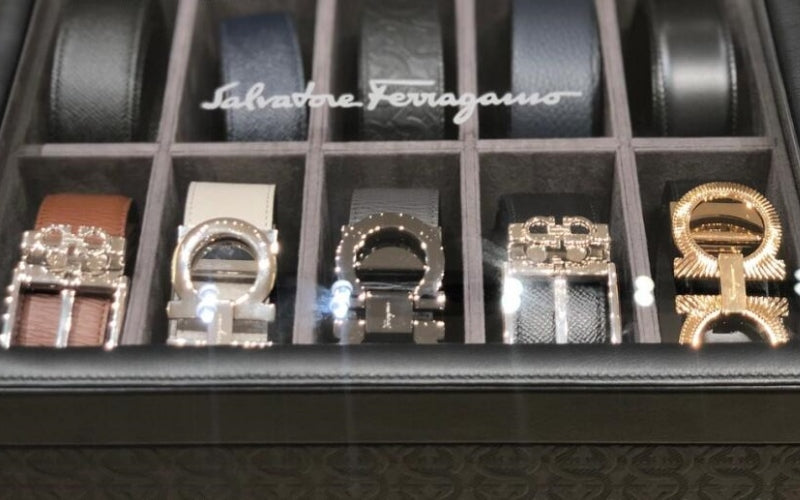
| 4. Belt storage box | Display/collector pieces | Low-medium (watch for UV if glass lid) | Dresser or shelf top | $30–$80 |
| 5. Hooks on closet rod | Quick/budget solution | Low | Existing closet rod | $5–$10 |
As The Modest Man's storage guide notes, the most effective solutions are the ones you'll actually use consistently. A $15 door-mounted rack that you hang belts on daily beats a $60 display box that sits empty while your belts pile up on a shelf.

What Temperature and Humidity Is Best for Leather Belt Storage?
Leather belts should be stored at 68°F–73°F (20°C–23°C) with relative humidity between 40% and 50%. These ranges keep the collagen fibers hydrated without promoting mold growth — the two risks that sit at opposite ends of the moisture spectrum.
Outside this range, problems develop:
- Below 30% humidity: Leather loses bound moisture, collagen fibers stiffen, and micro-cracks form at stress points. This is common in homes with forced-air heating during winter.
- Above 60% humidity: Mold spores colonize leather surfaces, especially in stitching channels and fold creases. Leather storage experts at Tanner Bates recommend silica gel packets inside storage drawers or boxes to regulate moisture in humid climates.
- Temperature swings: Rapid changes cause leather to expand and contract, loosening stitching and creating surface tension that leads to cracking.
Avoid these storage locations:
- Bathrooms (humidity spikes during showers)
- Attics (extreme heat in summer, cold in winter)
- Basements (often humid and poorly ventilated)
- Near radiators, heating vents, or air conditioners
- Windowsills or open shelving exposed to sunlight
A standard bedroom closet with a closed door meets the ideal conditions for most climates. If you're in an exceptionally dry or humid region, a small hygrometer ($8–$15 at any hardware store) lets you monitor conditions and adjust with a humidifier or silica gel packs.

How Should You Store Exotic Leather Belts?
Exotic leather belts — crocodile, alligator, python, elephant — require the same general storage principles as cowhide but with two additional precautions: avoid prolonged hanging and use breathable wraps.
Exotic skins are thinner and more texturally delicate than full-grain cowhide. A heavy crocodile belt hung from its buckle for months can develop elongation at the buckle hole due to its own weight. Exotic leather care specialists at Panam Leathers recommend alternating between hanging and flat storage, and rotating belts into use regularly rather than leaving them stored for extended periods.
Best practices for exotic leather storage:
- Wrap in a breathable cotton dust bag — never plastic, which traps moisture and prevents airflow
- Store flat or rolled loosely with a minimum radius of 4 inches — the textured surface of crocodile and alligator leather is more susceptible to crease damage than smooth cowhide
- Condition with exotic-specific products before long-term storage — standard leather conditioners can darken or stain scaled skins
- Rotate usage every 2-3 weeks to prevent permanent set in one position
At BELTLEY, every crocodile belt and exotic leather belt ships with care instructions specific to the skin type. Exotic leather is an investment — storing it correctly is what separates a belt that ages beautifully from one that dries out in a drawer.

Common Storage Mistakes That Ruin Belts
Even expensive, well-made belts degrade quickly under bad storage conditions. Here are the five most common mistakes:
1. Leaving belts in pant loops. The belt stays curved in a tight radius, pressing against the same fabric and absorbing body oils, sweat residue, and lint. Over weeks, the leather dries unevenly and the shape becomes permanently curved.
2. Storing in plastic bags or airtight containers. Plastic traps moisture against the leather surface, preventing the natural evaporation cycle that keeps leather healthy. According to ostrich leather storage research by Ostrich2Love, non-breathable materials are the #1 cause of mold damage in stored leather goods.
3. Piling belts on top of each other. Buckles scratch adjacent leather surfaces. Metal hardware pressed against leather for extended periods can leave oxidation marks — especially brass buckles, which naturally patinate and can transfer green residue to light-colored leather.
4. Storing in direct sunlight. UV rays fade dye, break down collagen bonds, and dry out fatliquors. Even a belt stored on an open shelf near a window receives enough UV to visibly fade within a few months. For a full breakdown of UV damage mechanics, read our guide on how to keep leather belts from cracking.
5. Ignoring seasonal conditioning before storage. If you're putting a belt away for the season, apply a thin coat of leather conditioner first. The conditioner acts as a moisture barrier during storage, keeping the fibers lubricated even in dry conditions. See our guide on whether you should condition your leather belt.

The Bottom Line
The best way to store leather belts is hanging them by the buckle on a rack inside a closed closet — or rolling them loosely in a drawer with dividers. Keep temperature between 68°F and 73°F, humidity between 40% and 50%, and the leather away from sunlight, heat sources, and plastic. Condition before seasonal storage. Rotate exotic skins. Never fold.
If your current belts are already showing storage damage — cracking, fading, permanent creases — it might be time for a fresh start with leather that's built to last. Browse BELTLEY's full-grain leather belts or our handmade collection, each backed by a 10-year warranty, free worldwide shipping, and 30-day hassle-free returns.

Frequently Asked Questions
Q: Can I store leather belts in a cedar closet?
Yes — cedar closets are excellent for leather storage. Cedar naturally repels moisture-loving insects and helps regulate humidity. Just avoid direct contact between raw cedar and leather, as cedar oils can stain light-colored hides. Line the shelf or drawer with a cotton cloth as a buffer.
Q: How many belts can I hang on one belt rack?
Most wall-mounted belt racks hold 8-12 belts comfortably. Avoid overcrowding — belts pressed tightly together don't get airflow, and buckles scratch neighboring straps. Leave at least a finger's width of space between each belt. For larger collections, read our guide on how many belts a man should have.
Q: Should I remove the buckle before storing a belt?
Only if the belt has a detachable buckle designed for removal (like some designer reversible belts). For belts with permanently attached buckles — which includes most standard leather belts — removing the buckle can damage the screw posts or stitching. Store the belt as-is, with the buckle hanging freely.
Q: Is it bad to leave belts in a suitcase between trips?
Yes. Suitcases are poorly ventilated, and leather stored in a closed suitcase for weeks absorbs odors and doesn't breathe. If you need to store belts temporarily during travel, roll them loosely and place them in a breathable cotton bag inside the suitcase. Unpack and hang them as soon as you arrive.
Q: How do I store leather belts long-term (6+ months)?
Clean the belt with a damp cloth, let it air-dry completely, then apply a thin coat of leather conditioner. Wrap in a breathable cotton dust bag or acid-free tissue paper. Store flat or loosely rolled in a cool, dry place. Check every 2-3 months for mold or drying, and recondition if needed. For full care instructions, visit our leather care page.