What Are Edge Painting Belts? (And Why Your Wardrobe Is Begging for One)
TL;DR: Quick Answer
- Edge painting is a leather finishing technique where paint is applied in multiple layers to the exposed edges of a belt. It creates a clean, uniform border.
- It's the fastest way to make belt edges look polished. It's also the first thing to crack and peel on a cheap belt. Quality of execution matters enormously.
- Burnished edges (friction-sealed, no paint) are more durable. Painted edges are more uniform. Raw edges are more rugged. Different belts need different finishes.
- The edge is where the truth about a belt lives. Flip it sideways. If the edge looks messy, nothing else matters.

Nobody buys a belt and immediately inspects the edges. You try it on. You check the buckle. You see if it matches your shoes. The edges? Invisible. Until they start peeling. Then they're the only thing you see.
Edge painting is one of three main techniques for finishing the exposed sides of a leather belt. It's popular. It's effective. And when done poorly, it's the number one reason "luxury" belts fall apart in 18 months.
Understanding edge finishing is the fastest way to separate a well-made belt from a marketing illusion. For a broader quality checklist, our guide on how to choose a good leather belt covers every sign of quality — including edges.

What Is Edge Painting on a Belt?
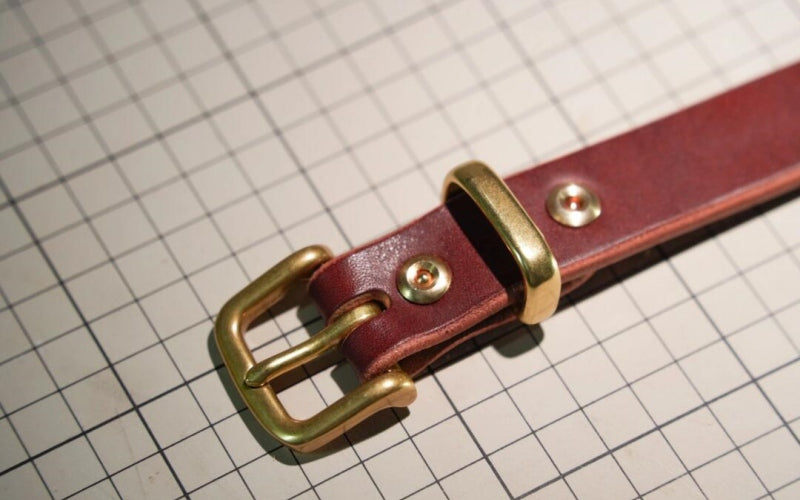
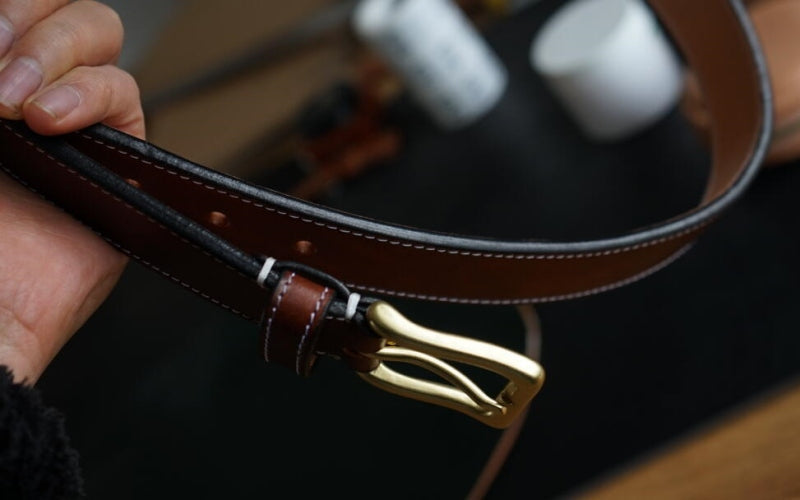
Edge painting is a leather finishing technique where specialized paint is applied in multiple thin layers to the raw, exposed edges of a belt to create a smooth, sealed, uniform border. The paint sits on top of the leather fibers rather than penetrating them, forming a protective coating that gives the edge a clean, polished appearance.
According to Tanner Bates' edge finishing guide, painted edges are "a popular option amongst many luxury brands" because they achieve "pristine looking edges" quickly and can even add a contrasting color. Old Town Leather Goods' finishing guide notes that edge paint "creates a smooth, uniform border that signals precision and sophistication."
The process isn't as simple as brushing on a coat of paint and calling it done. Good edge painting involves:
- Sanding the raw edge smooth (usually down to 600+ grit)
- Applying a thin first coat to fill leather fibers
- Drying completely between coats
- Sanding lightly between layers
- Repeating for 3-5 coats total
- Buffing the final layer for a smooth, even finish
Each layer builds on the last. Skip steps and you get bubbling, cracking, and peeling within months. Do it right and the edge stays clean for years.

Why Do Brands Use Edge Painting?
Two reasons: versatility and speed. Edge painting works on virtually any leather type — including chrome-tanned leather and exotics that can't be burnished. It's also faster than traditional burnishing, which matters when you're producing thousands of belts.
According to Sailrite's edge finishing guide, painted edges are "best suited for leathers that are thin, supple, pliable and generally do not burnish well — like chrome tan, bonded or exotic leathers." Ivan Leathercraft's finishing tutorial confirms that edge paint is the go-to method when the leather itself won't cooperate with burnishing.
Here's the honest breakdown of why brands choose edge paint:
Legitimate reasons:
- The leather type requires it (chrome-tan, exotic, bonded)
- Color matching — painted edges can match any belt color precisely
- Contrast design — some belts intentionally use different-colored edges as a style feature
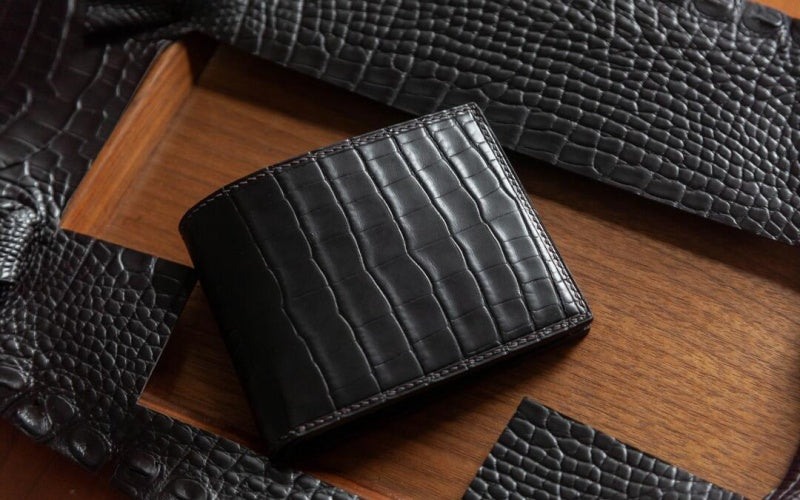
- Exotic leather belts like crocodile belts often need paint because exotic skins don't burnish traditionally
Less legitimate reasons:
- It's cheaper and faster than burnishing
- It hides low-quality leather edges that would look rough otherwise
- It creates the appearance of a premium finish on a budget product
The technique itself isn't the problem. The execution is. A Hermès belt with edge paint and seven layers of precision work is art. A $15 belt with one sloppy coat of paint is a countdown timer to peeling.
 Burnished edges
How Does Edge Painting Compare to Burnishing?
Burnished edges are more durable and authentic. Painted edges are more versatile and uniform. Both are valid — for different belts and different leathers. They're solving the same problem (raw, exposed leather looks unfinished) with completely different approaches.
According to Hoplok Leather's edge paint vs burnishing guide, burnishing uses friction to heat and compress raw leather fibers, sealing them naturally — while edge paint coats the surface with a protective layer. Tandy Leather's edge guide adds that burnishing "work-hardens the surface, which naturally seals the leather and helps it resist fraying and moisture damage over time."
| Feature | Edge Painting | Burnishing | Raw Edge |
|---|---|---|---|
| What it is | Paint layers applied to edges | Friction-sealed, compressed fibers | Untreated cut edge |
| Durability | Moderate — can peel over time | High — sealed into the leather itself | Low — frays without treatment |
| Appearance | Smooth, uniform, clean lines | Glossy, natural, shows leather character | Rugged, casual, deliberate |
| Leather compatibility | All types (chrome-tan, exotic, bonded) | Vegetable-tanned only | All types |
| Speed to produce | Fast (machine-applicable) | Slow (often hand-done) | None (it's literally doing nothing) |
| Repair | Requires repainting — visible if mismatched | Re-burnish with friction and wax | Not applicable |
| Cost | Low to moderate | High (labor-intensive) | Free (nature's finishing) |
| Common on | Designer belts, dress belts, exotics | Artisan belts, full-grain leather | Vintage belts, distressed styles |
According to The Leathercraft Masterclass, hand burnishing is "probably the most time consuming procedure in making leather goods, with no short cuts." It's a mark of genuine craftsmanship. Edge paint can be too — but only when applied with the same care.
At BELTLEY, our handmade belts use the edge finishing method best suited to each leather type — burnished edges on full-grain vegetable-tanned leather, and precision-painted edges on our exotic leather pieces where burnishing isn't possible.
 Burnished edges
How Can You Tell if Edge Painting Is Done Well?
Good edge painting is invisible. Bad edge painting is the first thing you notice — usually when it starts flaking onto your pants. Five signs separate quality edge painting from the cheap stuff.
1. Smooth, even surface. Run your finger along the edge. Quality paint feels glass-smooth with no bumps, ridges, or rough spots. That smoothness comes from multiple coats with sanding between each one. According to British Leather Supplies' edge guide, proper edge painting requires "several layers, with sanding between the layers resulting in a thick, smooth surface."
2. Consistent color. No thin spots. No visible brush marks. No areas where the leather shows through. The color should be completely uniform from end to end.
3. No cracking at the bend. Bend the belt gently. If the edge paint cracks or shows stress lines, it's either too thick, too brittle, or applied on poor-quality leather. Good paint flexes with the belt.
4. Clean transition. Where the paint meets the leather surface, the line should be crisp. No bleeding. No overlap. No smudges. This is where craftsmanship shows — or doesn't.
5. Adhesion under stress. After a few months of wear, check the edges near the buckle where bending is constant. Quality paint stays bonded. Cheap paint peels away like a bad sunburn. For long-term belt care, our leather care page covers edge maintenance.
 Burnished edges
When Does Edge Painting Fail?
Here's the uncomfortable truth. Edge paint is a coating. Coatings can fail. And on belts specifically — where constant bending, sweat, and friction concentrate at the edges — failure is common on cheap products.
According to Tanner Bates, "if you've ever owned a leather wallet or card holder and over time the edge peels off, you'll appreciate that this is not a durable solution to finishing a cut edge." Leathersmith Designs' finishing guide adds that paint adhesion depends heavily on surface preparation — skip the sanding and the paint has nothing to grip.
Edge paint fails when:
- The leather edge wasn't properly sanded before painting
- Only one or two coats were applied (needs 3-5 minimum)
- Cheap paint was used (low-flexibility formula)
- The belt bends repeatedly at the same point (near the buckle)
- Moisture weakens the bond over time
Edge paint lasts when:
- Proper prep and multi-coat application
- High-quality flexible edge paint formulas
- The belt is stored flat or hanging (not coiled tight)
- Occasional gentle cleaning keeps debris from grinding into the coating
This is why the same technique looks flawless on a $300 belt and disastrous on a $20 one. The materials are the same concept. The execution isn't even close. For belts built to handle daily wear without edge failure, our full-grain leather belts are constructed with edge finishing matched to each leather type.
 Burnished edges
Which Edge Finish Should You Look For?
Depends on the belt style and what you value most.
| If You Want... | Choose | Why |
|---|---|---|
| Maximum durability | Burnished edges | Sealed into the leather, won't peel |
| Cleanest, most uniform look | Painted edges (quality) | Precision finish, color-matched |
| Rugged, casual character | Raw edges | Intentionally unfinished, ages naturally |
| Exotic leather belt | Painted edges | Exotics can't be burnished traditionally |
| Heirloom quality | Burnished edges | Ages with the leather, improves over time |
According to Sterling Buckle's edge guide, the best approach is matching the edge technique to the leather and the belt's purpose. A dress belt benefits from painted edges' clean precision. A casual belt benefits from burnished edges' natural warmth. A vintage belt benefits from raw edges' honest character.
 Burnished edges
The Bottom Line
Edge painting belts use a multi-layer paint technique to seal and finish the exposed edges of leather, creating a smooth, uniform border. It's the most versatile finishing method — works on all leather types, allows color matching, and produces a clean modern look. The catch: paint sits on the surface, not in the leather, so poor application means peeling and cracking within months.
Quality edge painting (3-5 layers, sanding between coats, flexible paint formula) lasts years. Cheap edge painting lasts until you regret the purchase. The edge is where belt quality either proves itself or falls apart — literally.
At BELTLEY, we match edge finishing to each belt's leather type: burnished edges on full-grain vegetable-tanned pieces, precision-painted edges on exotics. Every belt handcrafted, 316L stainless steel hardware, 10-year warranty, free worldwide shipping. Browse the men's collection or women's collection and see the edges for yourself.
 Burnished edges
Frequently Asked Questions
Q: What is edge painting on a belt?
Edge painting is a leather finishing technique where specialized paint is applied in multiple thin layers to the raw, cut edges of a belt. The paint creates a smooth, sealed border that protects the exposed leather fibers and gives the belt a polished appearance. Quality edge painting requires 3-5 coats with sanding between each layer.
Q: Is edge painting better than burnishing for belts?
Neither is universally better — they serve different purposes. Burnishing is more durable and authentic, sealing fibers through friction. Edge painting is more versatile, working on all leather types including exotics that can't be burnished. Burnished edges are preferred for full-grain leather belts. Painted edges are standard for exotic leather and dress belts.
Q: Why does edge paint peel on belts?
Edge paint peels when it's poorly applied — insufficient sanding, too few coats, low-quality paint, or cheap leather underneath. Constant bending near the buckle accelerates peeling. Quality edge painting with proper prep, 3-5 layers, and flexible paint formulas resists peeling for years. Cheap belts often use only one coat, which fails quickly.
Q: How can I tell if a belt has quality edge finishing?
Run your finger along the edge. Quality finishing feels glass-smooth with no bumps or rough spots. The color should be uniform with no thin spots or brush marks. Bend the belt gently — the edge shouldn't crack or show stress lines. Where paint meets leather, the transition line should be crisp with no bleeding.
Q: Do luxury brands use edge painting?
Yes. Most luxury brands — including Hermès, Gucci, and Louis Vuitton — use edge painting on many of their belt products. The difference is execution: luxury brands apply multiple precision layers with sanding between each coat, using high-quality flexible paint formulas. The technique itself is not a quality indicator — the execution is.
Q: Can you repair peeling edge paint on a belt?
Minor peeling can be touched up with matching leather edge paint (available from leathercraft suppliers). Sand the damaged area lightly, apply thin layers, and let each dry completely. However, widespread peeling usually indicates poor original application — touching up won't solve the underlying adhesion problem. At that point, replacement is more practical than repair.