The Truth About Leather Belt Durability: What Lasts and What Doesn't
TL;DR: Quick Answer
- Full-grain vegetable-tanned leather belts last 10–25+ years with proper care. Bonded leather belts fail within 6–12 months.
- Leather grade matters most, but construction quality — stitching, edge finishing, and buckle hardware — determines whether a belt reaches its full potential lifespan.
- Exotic leathers like crocodile and elephant are the most durable belt materials available, routinely lasting 20–30 years.

Most belt shoppers focus on color, width, and price. Almost nobody asks the question that actually determines value: how long will this belt last?
The answer varies wildly — from six months to three decades — depending on leather grade, tanning method, construction, and care.
This guide covers the real data behind leather belt durability, backed by industry testing standards and material science, so you can stop replacing belts every year and start buying ones that last.

How Long Does a Leather Belt Last?
A leather belt's lifespan depends almost entirely on its leather grade. Full-grain vegetable-tanned leather lasts 10–25+ years with regular conditioning and rotation. Bonded leather — the lowest grade — typically fails within 6–12 months regardless of care. Everything else falls between those two extremes.
Here's the breakdown based on daily wear with moderate care:
| Leather Grade | Lifespan (Daily Use) | With Proper Care + Rotation |
|---|---|---|
| Full-grain (veg-tanned) | 10–15 years | 15–25+ years |
| Full-grain (chrome-tanned) | 7–10 years | 10–15 years |
| Top-grain | 5–7 years | 7–10 years |
| Genuine leather | 1–3 years | 2–5 years |
| Bonded leather | 6–12 months | 1–2 years max |
These numbers come from industry durability benchmarks and are consistent with what we see at BELTLEY from customer feedback over 25+ years. The gap between grades isn't small — it's a 10x difference between the best and worst. A full-grain leather belt at $120 that lasts 15 years costs $8 per year. A $25 bonded leather belt that lasts 8 months costs $37.50 per year. The cheap belt is nearly five times more expensive on a per-year basis.

What Makes a Leather Belt Durable?
Five factors determine whether a belt reaches its potential lifespan or fails prematurely:
1. Leather Grade and Thickness
Full-grain leather retains the complete, unaltered surface of the hide — including the outermost fiber layer, which is the densest and strongest part. Top-grain leather has this layer sanded off, removing the most durable fibers. Genuine leather is cut from the weaker inner layers, and bonded leather is ground-up scraps glued to a polyurethane sheet.
Thickness matters too. A belt strap at 4.0–5.0 mm (roughly 10–12 oz leather weight) provides structural integrity for years of daily bending and tension. Thinner straps (under 3.0 mm) flex more easily but fatigue faster. According to tensile strength testing data from Hoplok Leather, thick full-grain belt leather withstands tensile forces exceeding 25 MPa — strong enough to support well over 100 kg before failure.
2. Tanning Method
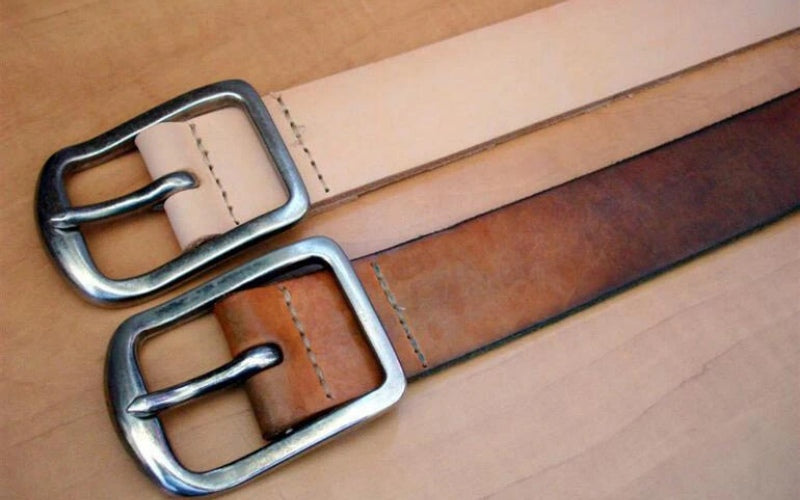
The tanning process transforms raw hide into stable leather, and the method used has a direct impact on long-term durability. Vegetable tanning uses plant-based tannins (oak bark, chestnut, mimosa) and takes several weeks. It produces denser, stiffer leather that resists stretching and develops a rich patina over years of wear.
Chrome tanning uses chromium salts and finishes in hours. It produces softer, more pliable leather — but that softness comes at a cost. Chrome-tanned leather stretches out under repeated stress, loses shape faster, and doesn't develop patina. For belts specifically, vegetable-tanned leather is the superior choice for durability.

3. Stitching Quality
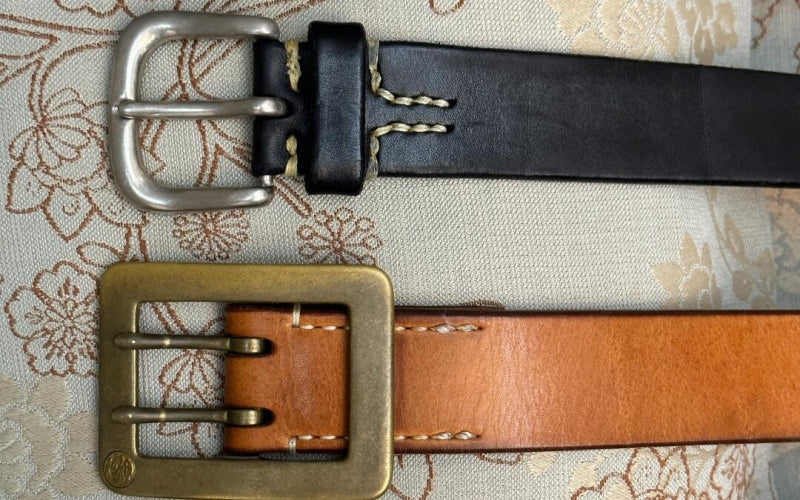
Belts rarely snap in the middle of the strap. They fail at stress points — buckle attachment holes, keeper loops, and stitch lines. Saddle stitching (two needles, one thread, hand-sewn) is the strongest method because if one stitch breaks, the adjacent stitches hold independently. Machine lock-stitching unravels if a single thread breaks.
Stitch density also matters. Professional-grade belts use 10–12 stitches per inch (SPI) with waxed polyester or linen thread. Budget belts often drop to 6–8 SPI with thinner thread, reducing tear resistance by 30–40% at stress points. The ASTM D4705 standard specifically measures stitch tear strength — how much force it takes to rip a stitch through leather.
4. Edge Finishing
Raw, unfinished edges absorb moisture, fray, and delaminate over time. Properly burnished edges — heated and polished with wax or resin — create a sealed barrier that prevents moisture intrusion and fiber separation. This is a detail most buyers never notice, but it's one of the clearest indicators of construction quality. A belt with raw, rough edges will deteriorate from the outside in.
5. Buckle Hardware
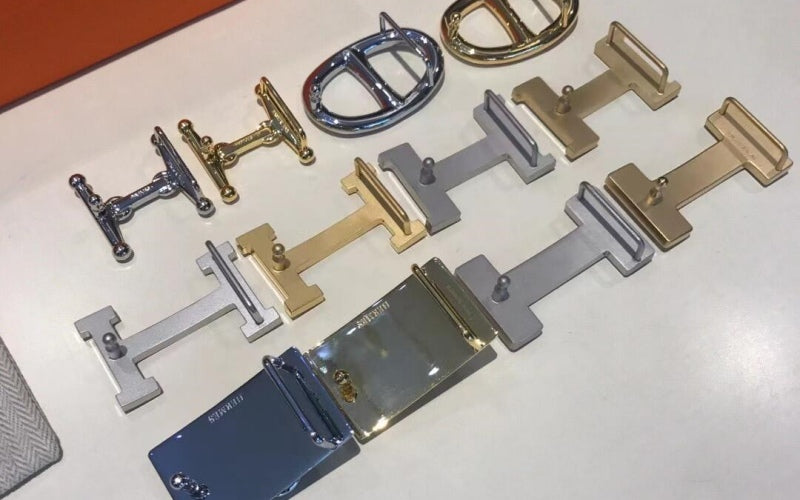
The buckle is a mechanical component under constant load. Solid brass and 316L stainless steel resist corrosion, maintain their shape under stress, and don't bend or deform over years of daily use. Hollow zinc-alloy buckles with chrome plating — standard on budget belts — act as levers under repeated tension and eventually crack, bend, or lose their plating. At BELTLEY, we use 316L stainless steel (the same grade used in surgical instruments and marine hardware) because it's the most corrosion-resistant alloy available for belt hardware.

How Durable Are Exotic Leather Belts?
Exotic leathers are significantly more durable than cowhide — sometimes by a factor of two or three. Their unique fiber structures, evolved to protect reptiles and large mammals, translate directly into superior wear resistance.
| Exotic Leather | Key Durability Traits | Lifespan with Care |
|---|---|---|
| Crocodile | High tensile and fatigue resistance; naturally water-resistant; scratch-resistant scales | 20–25+ years |
| Alligator | Slightly higher abrasion resistance than crocodile; dense, uniform scale pattern | 20–25+ years |
| Elephant | Nearly impossible to scuff; extremely thick and resilient hide; heaviest texture | 20–30+ years |
| Ostrich | Softer and more flexible; distinctive quill follicle pattern; moderate durability | 15–20 years |
| Python | Lightweight with unique scale pattern; thinner than croc/gator; requires careful handling | 10–15 years |
Crocodile and alligator leather have the highest combined tensile and fatigue resistance among exotic hides. Their interlocking scale structures distribute stress more evenly than the parallel fiber arrangement in cowhide. Elephant leather is arguably the most physically resilient belt material on the planet — Panam Leathers' exotic leather comparison rates it as nearly indestructible under normal wear conditions.
The trade-off with exotics is maintenance. Crocodile hides contain calcium deposits that require specialty conditioning to maintain flexibility. Standard leather conditioners can clog scale patterns and alter sheen. But with proper exotic-specific care every 3–4 months, these leathers outlast even the best full-grain cowhide by a wide margin. Browse our exotic leather belt collection to see the range of hides we work with.

Why Do Leather Belts Crack and Break?
Understanding failure modes helps you prevent them. Here are the most common reasons leather belts fail before their time:
- Low-quality material. Bonded and split leather crack because their fiber structure is fundamentally weak. No amount of care fixes a material problem.
- Moisture loss. Leather loses natural oils through heat, UV exposure, and friction. Without periodic conditioning, collagen fibers dry out and become brittle.
- Same-hole fatigue. Buckling at the same hole every day creates a permanent flex point. The leather fatigues at that exact spot, developing cracks that spread outward. Rotating between 2–3 belts eliminates this problem.
- Buckle-point failure. The area where the buckle pin meets the leather is the highest-stress zone on any belt. Sweat, friction, and constant bending concentrate here. Belts with reinforced buckle attachments (double-layer leather or riveted construction) last significantly longer at this critical junction.
- UV degradation. Prolonged sun exposure photodegrades leather fibers, causing fading, brittleness, and surface cracking. Store belts away from direct sunlight when not in use.
- Sweat and body oils. The acidic compounds in perspiration accelerate leather breakdown at contact points — particularly along the inner surface and around buckle holes.

How to Maximize Your Belt's Lifespan
You don't need an elaborate maintenance routine. Four habits cover 90% of what determines a belt's longevity:
- Buy the right leather. Full-grain vegetable-tanned is the baseline for any belt you expect to last more than a few years. Check for how to tell if a belt is full-grain before purchasing.
- Condition every 3–6 months. A thin coat of lanolin, beeswax, or mink oil-based conditioner keeps collagen fibers supple and prevents cracking. Our leather care guide covers the full process.
- Rotate your belts. Wearing two or three belts in rotation gives each one recovery time between wearings. This alone can double a belt's effective lifespan.
- Store properly. Hang belts from the buckle on a hook — never fold them. Keep them in a climate-controlled space away from sunlight and heat sources.

The Bottom Line
Leather belt durability is not a mystery — it's a function of material grade, tanning method, construction quality, and basic maintenance. Full-grain vegetable-tanned leather with solid hardware and proper stitching lasts 10–25 years.
Exotic leathers push that to 20–30+. Bonded leather fails in months. The difference between a belt that lasts and one that doesn't comes down to what the manufacturer chose to put into it, and what you do to maintain it afterward.
Every BELTLEY belt is built from full-grain or exotic leather, assembled with 316L stainless steel buckles and hand-finished edges, and backed by a 10-year warranty — because durability shouldn't be a gamble.

Frequently Asked Questions
Q: How long should a good leather belt last?
A quality full-grain leather belt should last 10–15 years with regular wear and basic conditioning every 3–6 months. With rotation and optimal care, 20+ years is realistic. The key variable is leather grade — full-grain vastly outlasts genuine or bonded leather.
Q: What is the most durable leather for a belt?
Elephant leather is the most physically durable belt material, lasting 20–30+ years. Among more widely available options, full-grain vegetable-tanned cowhide is the gold standard, offering 10–25 years of service. Crocodile and alligator fall between the two at 20–25+ years.
Q: Why do leather belts crack at the holes?
Belts crack at buckle holes because that's where stress concentrates. The buckle pin creates a pivot point, sweat weakens the leather locally, and repeated bending at the same spot causes fatigue cracking. Rotating between holes and conditioning regularly prevents this type of failure.
Q: Is genuine leather durable for belts?
"Genuine leather" is one of the lowest quality grades — it's cut from the weaker inner layers of the hide after the top surface has been removed. Genuine leather belts typically last only 1–3 years before cracking, peeling, or losing shape. For durability, look for full-grain leather specifically.
Q: Does vegetable-tanned leather last longer than chrome-tanned?
Yes. Vegetable-tanned leather has higher fiber density, better tensile strength, and resists stretching more effectively than chrome-tanned leather. It also develops patina rather than degrading, making it the preferred tanning method for belts that need to hold up under daily wear for a decade or more.
Q: How can I tell if my leather belt is good quality?
Check five things: the leather grain (full-grain has a natural, slightly irregular surface), edge finishing (burnished and sealed vs. raw and rough), stitching density (10+ stitches per inch), buckle weight (solid metal feels heavy, not hollow), and flexibility (quality leather bends without cracking). Our guide on how to tell if a belt is full-grain leather covers this in detail.