Stocking Stuffer Belts vs Splurge Belts: Where to Spend
Quick answer: Spend on the belt the person wears most. A cheap stocking-stuffer belt makes sense for a novelty, a kid, or a backup, but it cracks and peels within a year or two. For a primary daily belt, a splurge on full-grain leather wins on cost-per-wear — it lasts a decade-plus, so the price per year is actually lower.
Last updated: May 2026 • By BELTLEY Editorial
TL;DR:
- Stocking stuffer ($10–30): fine for novelty, kids, or a spare — but usually bonded leather that fails fast.
- Splurge ($60–200+): full-grain leather that lasts 10+ years — lower cost-per-wear.
- Cheap belts crack because they're bonded/genuine leather scraps, not full hides.
- Best gift strategy: one splurge belt they'll wear daily beats five cheap ones they won't.
Every gift budget faces the same fork: spread it thin across fun little gifts, or concentrate it on one thing that lasts. With belts, that choice has a clear answer once you understand what separates a $20 belt from a $200 one — and it's not the brand name. It's the leather. Below we break down when a cheap belt is the smart call, when it's a false economy, and the cost-per-wear math that reframes "expensive" entirely. If you want the deeper pricing picture, pair this with our guide on how much a leather belt should cost.

Spend Map: Stocking or Splurge?
Where each dollar belongs:
| Your situation | Go with |
|---|---|
| Gift for their primary daily belt | Splurge tier — full-grain (from $58) wins cost-per-wear inside two years. |
| Novelty, kid's belt, or backup | Stocking tier is honest here — just know its 1–2 year clock. |
| $50–$100 to spend well | That IS the splurge tier at DTC pricing — full-grain with a 10-year warranty fits a stocking fine. |
| Maximum-impression gift | Crocodile ($118–$289) — the stocking stuffer nobody forgets. |
Both tiers honestly priced: BELTLEY's collection — free shipping helps the math.
Stocking stuffer or splurge — where should you spend?
Spend on the belt that gets daily use. A splurge belt is worth it for someone's primary, everyday belt because quality leather lasts years and looks better doing it. A stocking-stuffer belt is fine for a novelty, a child, a costume, or a travel spare — low-stakes uses where longevity doesn't matter.

Match the spend to the role. For the belt someone reaches for every morning, quality pays off daily. For a fun extra or a backup, cheap is perfectly sensible. The mistake is buying a cheap belt for a primary role — it'll crack, peel, and get replaced within a year or two. A well-made full-grain leather belt flips that math, which is why it's our top leather gift for him.
Why do cheap belts crack and peel so fast?
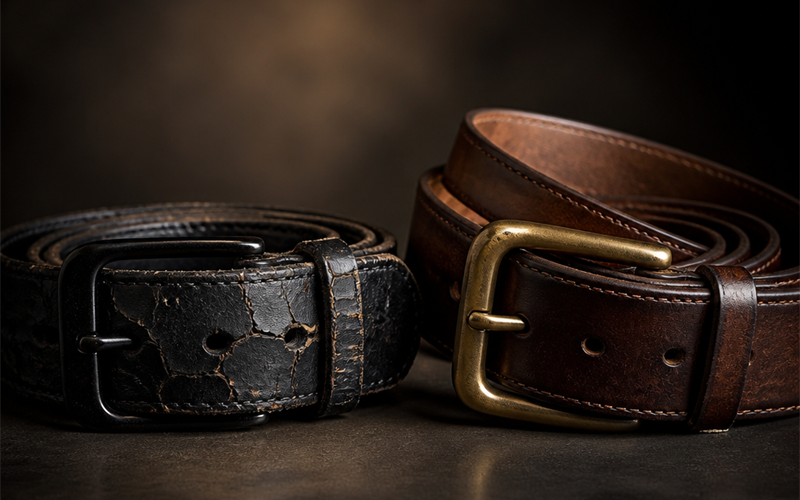
Because they're not made from solid leather. Most cheap belts use bonded or "genuine" leather — shredded leather scraps glued together or a thin split coated in plastic. That coating cracks and the bonded layer crumbles within months to a couple of years of daily flexing.

The material is the whole story. Cheap belts are built from leather byproducts, not full hides, so they physically can't age well. By contrast, full-grain leather is the top, intact layer of the hide — the strongest, most durable part — which is part of why quality leather belts cost more. It's the same logic that separates durable goods from fast fashion, the low-cost, low-durability model that prioritizes price over lifespan. A belt you replace yearly isn't cheap — it's expensive on a schedule.
Key stat: A $20 bonded-leather belt replaced every year for 10 years costs $200 — the same as one full-grain belt that lasts the entire decade, minus the annual hassle and the worse look in between.
Does a splurge belt actually save money?
Yes, on cost-per-wear. Divide the price by the years of use: a $150 belt worn for 12 years costs about $12.50 a year, while a $25 belt replaced every 18 months costs roughly $17 a year — and looks worse the whole time. The expensive belt is the cheaper belt over its life.

Cost-per-wear reframes everything. Quality leather doesn't just last longer; it improves with age, developing a patina that cheap coated leather can never achieve. So you pay less per year and get a better-looking belt every one of those years. This is the core of the BELTLEY 3-Material Rule — full-grain leather + a solid stainless or brass buckle + sealed (burnished or painted) edges. Those three things are what let a belt survive a decade, and they're exactly what cheap belts skip. It's why so many buyers conclude an expensive belt is worth it.
Cheap vs. splurge: the real cost
| Factor | Stocking stuffer ($25) | Splurge ($150) |
|---|---|---|
| Leather | Bonded / coated split | Full-grain hide |
| Lifespan | ~1–2 years | 10+ years |
| Cost per year | ~$15–17 | ~$12–15 |
| Ages by | Cracking, peeling | Developing patina |
| Best role | Novelty, spare, kids | Daily primary belt |
How do you choose the right belt to gift on a budget?
Buy one good belt, not several cheap ones. If the budget is tight, concentrate it on a single quality belt the person will actually wear, rather than spreading it across novelty belts that won't last. One full-grain belt in a versatile color beats a drawer of disposable ones.

Focus beats volume. A single well-chosen belt in black or brown covers most outfits and lasts for years, while a pile of cheap belts just becomes clutter to throw out. If you're building someone's collection over time, our guide on how many belts a man should have helps prioritize. And thanks to fair DTC pricing, a genuinely premium belt doesn't have to mean a designer price tag.
The Bottom Line
The stocking-stuffer-versus-splurge question really comes down to the belt's job. For a novelty, a costume, a kid, or a travel backup, a cheap belt is the right, sensible call. For the belt someone actually wears every day, spending more is the frugal choice — full-grain leather lasts a decade-plus and costs less per year than the cheap belt you keep rebuying. At BELTLEY, our entire model exists to break the false choice between quality and price: we cut the brand tax so a splurge-worthy belt costs what a fair price should be. Buy the good one once. Ready to give a belt that outlasts the wrapping paper by ten years? Browse our gift collection.
Frequently Asked Questions
Q: Is an expensive belt really worth it over a cheap one?
For a daily-wear belt, yes. Quality full-grain leather lasts 10+ years and develops a patina, so its cost-per-year is often lower than a cheap belt you replace every year or two. Cheap belts make sense only for novelty or backup use.
Q: Why do cheap belts fall apart so quickly?
Most are made from bonded or coated "genuine" leather — leather scraps glued together or a thin split with a plastic finish. That construction cracks and peels within months to a couple of years of regular flexing.
Q: What makes a belt last a long time?
Three things: full-grain leather (the strongest part of the hide), a solid metal buckle (stainless steel or brass, not plated pot metal), and sealed or burnished edges. Belts with all three can last a decade or more.
Q: Should I buy one nice belt or several cheap ones as a gift?
One nice belt. A single full-grain belt in a versatile color gets worn for years, while several cheap belts become clutter and wear out fast. Concentrating the budget gives a better, longer-lasting gift.