Should Your Belt Be the Same Size as Your Pants? ( Probably Not—Here’s Why)
TL;DR:Quick Answer and main takeaways
- No — your belt should not be the same size as your pants.
- The standard rule: belt size = pants size + 2 inches.
- A correctly sized belt fastens on the middle hole — not the first, not the last.
- Vanity sizing in pants makes the +2" rule more important than ever.
Most people order a belt in their pants size and wonder why it fits wrong. The answer is simple — and once you understand it, you'll never size a belt incorrectly again.
Belt size and pants size are measured completely differently. A size 34 pair of jeans is not 34 inches at the waist. A size 34 belt often is. That gap between the two is where most belt-buying mistakes live. Check BELTLEY's size guide for exact belt measurements before ordering.

The Fix for Your Exact Situation
No — and here's what to do instead, wherever you're starting:
| Your situation | What to do |
|---|---|
| Ordering a new belt | Pants size + 2 inches. A 34" pant takes a 36" belt |
| Checking a belt you own | It should fasten on the middle hole — first or last hole means wrong size |
| Your pants are vanity-sized | Measure an existing belt instead — the +2" rule assumes honest pants labels |
| Between sizes | Go up — punching an extra hole is easy; adding leather isn't |
BELTLEY's size guide has the conversion chart. Why the two numbers measure different things:
Should Your Belt Be the Same Size as Your Pants?
No. Your belt should be 2 inches larger than your pants size. If you wear size 34 pants, order a size 36 belt. This accounts for how belts are measured (tip-to-middle-hole) versus how pants are measured (labeled waist size, which is often smaller than the actual waistband).
This is the rule Nordstrom uses in their official belt sizing documentation: select a belt at least 2 inches larger than your pant size. It's a standard across the menswear industry for good reason — the two sizing systems simply don't align.
The +2" rule isn't arbitrary. It's the result of:
- How belt length is measured (from the buckle pin to the center hole)
- How pants sizes are labeled (often 1–2" smaller than the actual waistband due to vanity sizing)
- Where a belt actually sits on your body (over pants fabric and often a waistband, adding circumference)

Why Doesn't Belt Size Match Pants Size?
Two separate reasons: measurement method and vanity sizing. Belt size is measured from the buckle end to the center hole. Pants size is a labeled number that frequently understates the actual waistband measurement — sometimes by 1 to 2 inches. Together, these add up to a reliable 2-inch gap.
Measurement method: A size 34 belt measures 34 inches from the buckle attachment point to the middle of its five holes. That's the reference point. Pants, however, are measured at the cut — the fabric cut at the waist — not accounting for how the waistband stretches or where the belt will actually sit.
Vanity sizing: Research published in the International Journal of Fashion Design, Technology and Education documents systematic vanity sizing in menswear — labeled pant sizes regularly run 1–2 inches smaller than actual measurements. A "size 34" jean often has an actual waistband of 35–36 inches. Your belt needs to wrap that actual measurement, not the label.
Put both together and the math is clear: belt size should be pants size + 2 inches, consistently.

Belt Size Conversion Chart: Pants to Belt
Use this table to find your belt size from your labeled pants size. When in doubt, go up one size — a belt that's slightly long is easy to trim or tuck. A belt that's too short has no fix.
| Pants Size (labeled) | Belt Size to Order | Actual Waist Measurement |
|---|---|---|
| 28 | 30 | ~29–30" |
| 30 | 32 | ~31–32" |
| 32 | 34 | ~33–34" |
| 34 | 36 | ~35–36" |
| 36 | 38 | ~37–38" |
| 38 | 40 | ~39–40" |
| 40 | 42 | ~41–42" |
| 42 | 44 | ~43–44" |
| 44 | 46 | ~45–46" |
For women: Sizing logic is the same, but pants vanity sizing tends to run even more aggressively. Measure your actual waist or hips (wherever the belt will sit) and add 2 inches to find your belt size. See the full breakdown: How to Size a Belt for a Woman
How Should a Belt Fit When It's the Right Size?
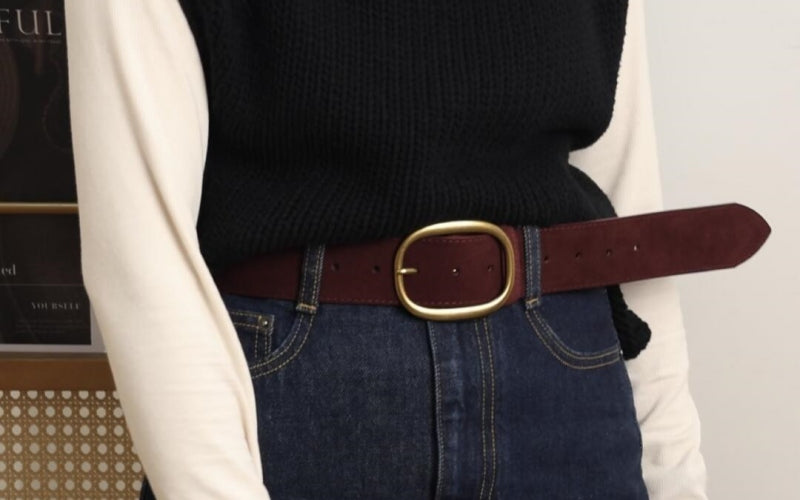
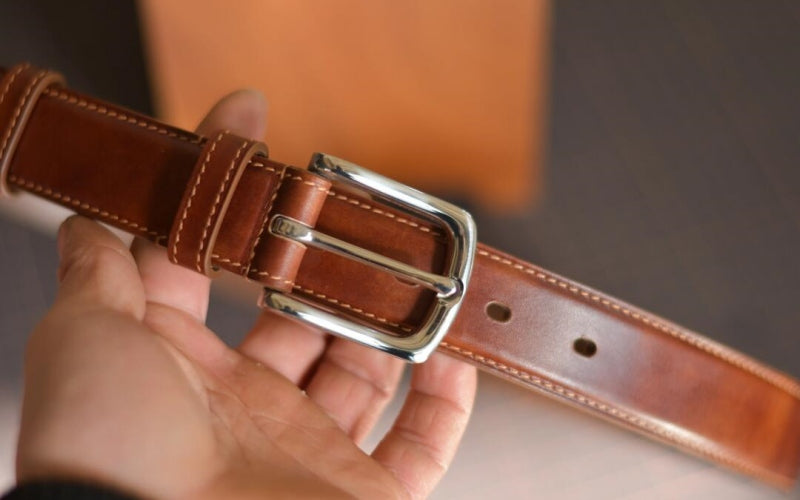
A correctly sized belt fastens on the middle hole — the third of five holes. This leaves two holes unused on each side, giving you room to adjust up or down if your weight fluctuates. If you're fastening on the first or last hole, your belt is the wrong size.
This is called the middle-hole rule, and it's the fastest way to check any belt for correct fit:
- Hole 1 (closest to buckle): Belt is too large — size down
- Holes 2–3: Correct fit range, with hole 3 (center) being ideal
- Hole 4: Acceptable, but you're approaching the limit
- Hole 5 (farthest from buckle): Belt is too small — size up
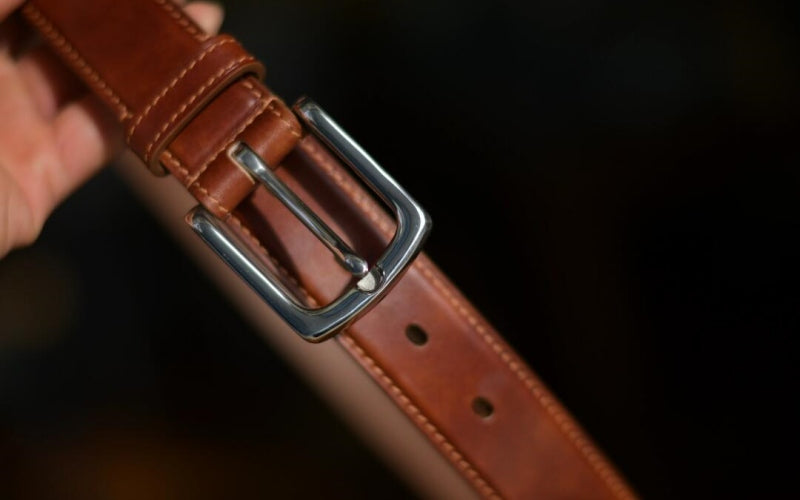
Most quality belts come with 5 holes spaced 1 inch apart, giving you a 4-inch adjustment range. At BELTLEY, every belt ships with 5 precisely spaced holes — and because we use full-grain leather rather than bonded or corrected leather, the holes stay clean and sharp over years of daily use. Bonded leather stretches and tears at the holes; full-grain holds its shape.
For the related question of tail length: How Far Should a Belt Extend Past the Buckle?

What If My Size Falls Between Belt Sizes?
If your measurement falls between belt sizes, always size up. A belt that is one size too large can be worn on a lower-numbered hole or, for leather belts, trimmed to length. A belt that's one size too short cannot be extended.
Leather stretches very slightly with wear — a brand-new belt may feel marginally snug at first. Full-grain leather, specifically, develops a slight give as it breaks in, conforming to your body over time. That natural stretch is part of why quality leather belts improve with wear rather than degrading.
If you're between sizes and buying a quality leather belt (rather than a fashion piece), sizing up by one is always the safer move. The tail can be trimmed at a cobbler for a custom fit, usually for a nominal fee.
The Most Common Belt Sizing Mistakes
A few errors that send people back to the checkout page:
Ordering pants size instead of pants size + 2. The single most frequent mistake. The fix is this article. You're already ahead.
Measuring the old belt incorrectly. If you're replacing a belt that fits, measure it from the buckle pin hole (the hole in the leather where the prong sits) to the hole you use. That measurement is your belt size. Don't measure tip-to-tip. For more: Does Belt Length Include Buckle?
Not accounting for thick waistbands or belt loops. Military-style pants, heavy denim, and reinforced waistbands add circumference. If you typically wear workwear or heavy denim, consider going up 3 inches instead of 2.
Buying a belt that's slightly too short "because it technically closes." Fastening on the last hole means zero room to adjust. One holiday meal and the belt is functionally useless.
For men's sizing specifics: How to Choose a Belt Size for a Man
The Bottom Line
Your belt should be 2 inches larger than your labeled pants size — not the same size. The +2" rule accounts for vanity sizing in pants and the difference in how each is measured. A correctly sized belt fastens on the middle hole, with two spare holes on each side for adjustment.
Getting belt size right matters more when the belt is worth getting right. BELTLEY's full-grain leather belts are built to last a decade — and a belt that fits correctly, on the correct hole, will hold its shape and its stitching far longer than one that's perpetually strained at hole five. With free worldwide shipping and 30-day returns, getting the size wrong costs you nothing but a return label.
Frequently Asked Questions
Q: Should my belt size be the same as my waist size?
Not exactly. Belt size is typically 2 inches larger than your labeled pants size. However, if you know your actual waist measurement (measured with a tape), your belt size should match that number — because belt sizing is based on real measurements, not labeled sizes.
Q: What size belt should I get for 34-inch pants?
Order a size 36 belt. The standard formula is pants size + 2 inches. If you're between sizes or typically wear a thick waistband, a size 38 gives you comfortable room. Visit BELTLEY's men's belt collection and use the size guide to confirm before ordering.
Q: How do I measure myself for a belt?
Wrap a soft tape measure around your waist or hips at the point where you'll wear the belt — over your pants, not against bare skin. That number is your target belt size. If it falls between whole numbers, round up. Alternatively, measure an existing belt from the buckle pin hole to the hole you use — that's your current belt size.
Q: Is it better to size up or down on a belt?
Always size up. A belt that's slightly large can be worn on a smaller hole or trimmed. A belt that's too short has no adjustment options. When in doubt, the next size up is the safe choice.
Q: Why does my belt feel too short even in my correct size?
Most likely, you're measuring from the wrong point. Belt length is measured from the buckle attachment pin to the center hole — not tip to tip. If your belt only covers your pants size, it's probably one size too small. Try the pants size + 2 formula and reorder.