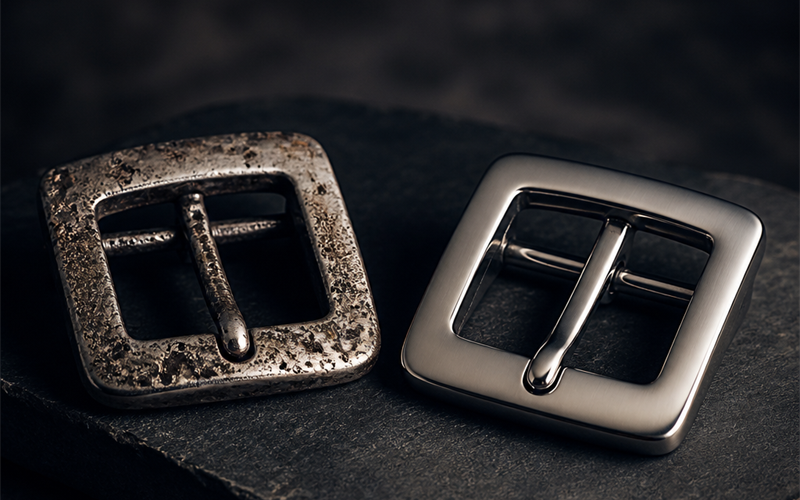
Salt Air & Coastal Living — How Sea Spray Damages Leather Belts
Quick answer: Coastal salt air corrodes plated buckles within 3-6 months and dries out leather fibers in months. The fix is a full-grain leather belt with a 316L stainless steel or solid brass buckle, wiped down weekly and conditioned every 6-8 weeks.
Last updated: May 2026 • By BELTLEY Editorial
TL;DR:
- Salt air corrodes plated buckles and dries leather faster than inland conditions.
- The damage is invisible at first. By the time you see it, the buckle is pitted and the belt edges are stiff.
- 316L marine-grade stainless steel and solid brass are the only buckle materials that survive long-term.
- Apply the BELTLEY 3-Material Rule: full-grain leather + 316L stainless or solid brass + sealed edges. Rinse, dry, and condition more often than you would inland.
If you live within 10 miles of an ocean — Honolulu, Charleston, La Jolla, Brighton, Sydney's Northern Beaches — your belts age differently. Sea spray rides the wind for kilometers. Microscopic salt particles settle on your buckle hardware and leather every time you walk outdoors. The damage builds quietly until one day you notice the belt looks tired and the buckle has dull pitting.
Salt is patient. It wins eventually if you don't fight back.
This guide breaks down what salt actually does, which belts survive, and the care routine that makes coastal belts last as long as inland ones.
What does salt air do to leather belts?
Salt air corrodes plated buckle finishes and slowly dries out leather fibers. Salt particles deposit on hardware and attack plated zinc, chrome, or nickel coatings within 3-6 months. The same salt also pulls moisture into and out of leather fibers, creating expansion-contraction cycles that stiffen and crack the leather over months.

It's a slow chemical attack. Salt-air corrosion rates run roughly 5-10x higher than inland air on plated metals. Your belt isn't immune — most coastal owners just don't connect "buckle pitting" or "stiff leather" to salt they can't see.
Key stat: Sea spray particles can travel up to 25 km (15 miles) horizontally within the planetary boundary layer, per Wikipedia's sea spray reference. You don't need to live on the beach to take coastal damage.
For broader coastal humidity damage, our hot humid climates belt guide covers the related humidity side.
How fast does salt corrode belt buckles?
Salt corrodes belt buckles at very different rates depending on material. Plated zinc shows pitting in 3-6 months of regular coastal wear. Solid brass develops gentle patina but resists structural damage for decades. 316L marine-grade stainless steel is essentially immune at any reasonable timeframe.
The marine industry standardized on 316L for the same reason boat fittings, watch cases, and dive gear are 316L — chloride corrosion resistance. Background on the alloy is on Wikipedia's 316L stainless steel page.
For coastal buyers, this is a non-negotiable spec. See our 316L stainless steel buckle collection and brass buckle collection.
Buckle corrosion timeline — coastal wear
| Buckle material | First pitting | Structural failure | Coastal verdict |
|---|---|---|---|
| 316L marine-grade stainless steel | Essentially never | None | Top pick |
| Solid brass (raw or lacquered) | Patina only | Decades | Top pick |
| 304 stainless steel | 2-4 years (minor) | Rare | Acceptable |
| Chrome-plated brass | 6-18 months | 3-5 years | Avoid |
| Nickel-plated zinc | 3-6 months | 1-3 years | Avoid |
| Pot metal / unspecified plated | 1-4 months | <2 years | Hard pass |
Which leather types resist salt air best?
Vegetable-tanned full-grain cowhide resists salt air best because its dense fiber structure absorbs less moisture than chrome-tanned alternatives. Crocodile and alligator leather perform even better — their natural oils and scale structure repel salt-laden moisture almost completely. Bonded leather and unfinished suede fail fastest.

Coastal owners who buy crocodile belts often report 20+ year lifespans with basic care. See our crocodile/alligator collection and the analysis in are alligator leather belts waterproof.
Does salt water actually touch your belt?
You don't need to swim with your belt for salt damage to happen. Coastal aerosol — the technical term for sea spray suspended in air — carries microscopic salt particles many kilometers inland. Walking on the beach for one hour deposits measurable salt on every exposed surface, including your belt. Multiply by daily wear and the damage compounds.
Even owners 5-10 miles inland accumulate meaningful exposure. The horizontal travel range is documented in the Wikipedia overview of sea spray.
Why do leather edges crack first in coastal climates?
Leather edges crack first in coastal climates because edges have exposed fiber ends that absorb moisture more readily than the finished face of the belt. Salt water cycles into and out of these fiber ends faster, accelerating the dry-stiffen-crack progression. Painted or burnished edges — a hallmark of quality Italian belts — seal the fibers and slow this damage dramatically.

For edge construction context, see our deep-dive on edge painting vs edge burnishing. The technique your belt's edges use predicts how it survives coastal climates.
What's the right coastal belt care routine?
Four steps. Wipe with a barely damp cloth weekly to remove salt deposits. Dry fully at room temperature — never with heat. Condition lightly every 6-8 weeks (more often than the 8-12 weeks recommended inland). Store away from open windows facing the ocean.
The light wipe-down is the most underrated step. Five seconds with a damp cloth removes salt that would otherwise spend a week pulling moisture out of your leather. It's the single biggest difference between a coastal belt that lasts 15 years and one that lasts 4.
Our leather care page covers the standard routine. Run it on a tighter schedule for coastal living.
What buckles should you avoid in coastal areas?
Avoid plated zinc, plated steel, chrome-plated brass, and any "matte finish" buckle that doesn't specify the underlying metal. Most fast-fashion belt buckles are zinc with thin nickel or chrome plating. The plating cracks within months of coastal exposure, and the zinc underneath corrodes rapidly.
If a product page doesn't disclose buckle alloy, assume the worst. Quality brands specify the alloy. Check our brass buckle belts and stainless steel buckle belts for how it should be listed.
Should coastal owners avoid pale leather colors?
Coastal owners should avoid pale natural-color veg-tan and very light tan leathers because salt deposits and sea-driven UV both cause uneven darkening and staining that show more on pale finishes. Espresso, dark brown, and black are the safer daily choices. Save pale colors for indoor occasions.

Our espresso leather belts and black leather belts are the coastal defaults. For color matching, see what color belt goes with everything.
How do you remove salt stains from a leather belt?
Gently wipe with a soft cloth dampened in a 1:1 mix of cool water and white vinegar. Pat dry with a clean cloth. Let the belt air-dry at room temperature for at least 4 hours. Once fully dry, apply a thin layer of leather conditioner. Don't rub aggressively — it can lift finish.
The same vinegar-and-water mix works on early salt rings, white haze, and minor mold. For severe staining, consult a professional cobbler before trying stronger solvents.
Are reversible belts a good idea coastal?
Reversible belts are fine for coastal owners as long as the construction is two layers of real leather (not one leather face glued to coated synthetic). The hinge buckle hardware needs to be stainless or solid brass. Cheap reversible belts often hide low-grade material on the "less visible" side, which deteriorates fast in salt air.

See our double-layer belt collection for properly constructed reversible options.
The Bottom Line
Coastal living rewards the BELTLEY 3-Material Rule — full-grain leather, 316L stainless or solid brass hardware, hand-finished edges. Salt air just accelerates the difference between cheap and well-made. The same materials that make any belt better make a coastal belt last 4x longer than its inland equivalent.
If you live within 25 km of saltwater, the materials in your buckle and the finish on your belt edges determine almost everything. BELTLEY's full-grain leather collection is the coastal foundation. The crocodile and alligator collection is the most salt-resistant leather on the market — recommended for daily coastal wear if budget allows.
Frequently Asked Questions
Q: How far inland does salt air affect leather belts?
Salt aerosol affects leather noticeably within 10-15 km of the coast and measurably up to 25 km inland depending on wind patterns. Owners in coastal cities like Charleston, San Diego, or Sydney see clear effects even when miles from the actual shoreline.
Q: Can I wear a leather belt at the beach?
Yes, but rinse and dry it after. Direct salt water immersion is more aggressive than aerosol exposure. If a wave catches your belt, rinse with fresh water within an hour and air-dry fully before storage.
Q: Will a stainless steel buckle ever corrode?
316L marine-grade stainless steel is essentially immune to salt corrosion under normal coastal use. Lower grades like 304 stainless can develop minor surface staining over years, but structural damage is rare. Plated stainless is a different (worse) animal.
Q: Does humidity make salt damage worse?
Yes. Salt deposits absorb humidity from the air, creating a constantly moist film on hardware and leather. The combo of coastal humidity and salt is more damaging than either factor alone. Owners in Honolulu and Charleston see the worst of both.
Q: Is crocodile leather worth it for coastal wear?
For long-term coastal owners, often yes. Crocodile and alligator leather resist salt-air damage exceptionally well due to natural oils and dense scale structure. See are alligator belts worth it for the value analysis.
Q: Should I store coastal belts differently?
Yes. Keep belts in a closed closet or drawer away from open windows facing the ocean. Use silica gel packs in humid coastal climates. Cedar belt racks help control both moisture and odor.


