Pants with No Belt Loops: Should You Wear a Belt Anyway?
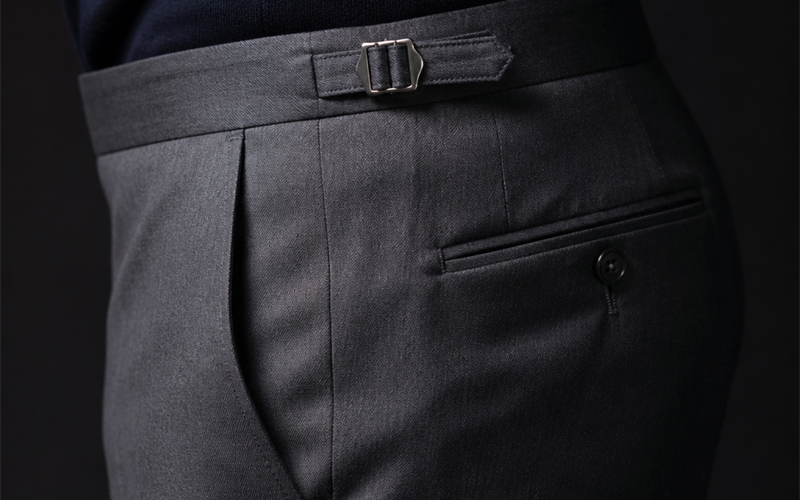
Quick answer: No — if pants ship without belt loops, the design assumes no belt. Wearing a loose belt over a loop-free waistband looks strange and doesn't function properly. The right alternatives: side adjusters (small tabs with buckles on each hip, included on most bespoke and quality dress trousers), braces/suspenders (formal tradition), or properly sized pants that need no additional support. The "wear it anyway" approach is almost never the right call.
Last updated: May 2026 • By BELTLEY Editorial
Why trust this guide: BELTLEY produces dress and sport belts but also advises customers on when a belt isn't the right answer at all — particularly for European-cut and bespoke tailoring traditions. Our team works with clients across French, British, Italian, and American dress conventions and knows when "no belt" is the correct answer.
TL;DR:
- No loops = no belt expected. Don't force it.
- Side adjusters are the modern dress-trouser solution.
- Braces (suspenders) are the formal-traditional solution.
- Loose-band belts over loop-free waistbands look amateur.
At a glance:
- French/British bespoke: side adjusters or braces, not belts
- American tailoring: usually loops, sometimes adjusters
- Cost to add side adjusters: $40-$90 at a tailor
- Cost of braces: $30-$200 depending on quality
- Updated — May 2026 · By BELTLEY Editorial
You pull on a new pair of dress trousers, reach for your belt, and realize there's nowhere for it to thread. This is increasingly common as European tailoring conventions filter into mainstream American menswear. Below: why the absence of belt loops is intentional, what the design expects you to use instead, and the one rare situation where a belt over loop-free pants still kind of works.
No Loops: Your Actual Options
The loop-free decision tree:
| Your situation | Go with |
|---|---|
| Dress trousers with side-adjusters | Use them — that's the design; a belt over them is double-fastening. |
| Formal event, loop-free trousers | Braces — the traditional answer, and more comfortable through a seated dinner. |
| Pants genuinely won't stay up | Tailor the waist — no accessory fixes a fit problem properly. |
| You just love wearing belts | A tailor can add loops for $20–$40 — then the belt is legitimate again. |
For the pants that DO have loops: BELTLEY's men's collection, $58–$289.
Should you wear a belt with pants that have no belt loops?
No — pants without belt loops are designed to be worn without a belt. The waistband is engineered to hold itself up either through precision fit, internal closure mechanisms (button + hook, snap, drawstring), side adjusters (small fabric tabs with buckles), or by being worn with braces/suspenders. Adding a belt over a loop-free waistband sits awkwardly, slides around without anchoring, and looks like you missed a memo about the pants' design intent.

Wikipedia's suit clothing entry notes that "a belt was originally never worn with a suit" — wartime restrictions on elastic shifted American tailoring toward belts, but French and British traditions kept side adjusters and braces. The pants you're looking at likely come from this tradition.
What are side adjusters and how do they work?
Side adjusters are small fabric tabs (typically 4-5" long) with buckles or button mechanisms mounted on each hip of the trouser. They tighten or loosen the waist by 1-2" of adjustment range, replacing the belt's function entirely. The mechanism is nearly invisible under a jacket and produces a cleaner silhouette than any belt can deliver because there's no horizontal break across the front of the trouser.
Three common types: 1) brace-style buckle (slide-through metal buckle, most common), 2) button-tab (one or two buttons on a fabric tab, Italian variation), 3) D-ring (small metal D-ring, military origin). All three serve the same function — micro-adjustable waist control without external hardware.
What about wearing braces (suspenders) instead?
Braces are the most formal trouser-support solution and the traditional answer for tuxedo and three-piece suit wear. Modern braces clip to the trouser waistband (clip-style) or button to inside-waistband loops (traditional). They hold the trouser up from the shoulders, allowing the waistband to sit naturally without compression.

Braces are increasingly common in 2026 as men rediscover the silhouette advantages — supporting trousers from the shoulders allows them to "fit and hang exactly as they should, while a belt may allow the trouser waist to slip down on the hips," per the suspenders Wikipedia entry. For loop-free pants, braces are often the intended solution.
Key stat: A pair of trousers fitted with side adjusters can micro-adjust within a ±1" range — versus the ±0.5" adjustment you get between adjacent belt holes. Side adjusters are also continuously variable, while belt holes are stepped.
Pant-support options without belt loops
| Solution | Cost | Aesthetic | Best For |
|---|---|---|---|
| Side adjusters (built-in) | $0 (already included) | Invisible, clean silhouette | Dress trousers, business |
| Side adjusters (added by tailor) | $40-$90 | Same as built-in | Retrofitting belt-loop pants |
| Braces (suspenders) | $30-$200 | Traditional, visible under jacket only | Formal, three-piece suits |
| Perfect tailoring (no support needed) | $0 (with correct fit) | Cleanest possible | All contexts when fit is precise |
| Internal hook + bar closure | $0 (already included) | Invisible | Some dress trousers |
| Belt over loop-free waistband | $0 | Looks wrong | Almost never appropriate |
Why doesn't wearing a belt over a loop-free waistband work?
Three reasons: 1) the belt can't anchor anywhere — without loops, it slides up, down, and rotationally with every movement, 2) it compresses the waistband at random points rather than evenly, often causing the bunching we cover in our belt bunching guide, and 3) it visually conflicts with the trouser's design intent — the clean waistband line is what the loop-free design was built to deliver, and a belt breaks that line.

The exception: a very wide, well-positioned waist cincher (1.5"+ wide) over a thick coat or jacket can work as a styling choice — but that's a sash function, not a belt-holding-pants-up function. For pants themselves, loops or no loops dictates whether a belt should be present.
When were belt loops added to dress trousers?
Belt loops became standard on American dress trousers in the 1940s-50s, driven by wartime elastic restrictions that pushed braces out of mainstream use. Before that, virtually all formal trousers were braces-only or side-adjuster only. French, British, and Italian bespoke tailoring largely preserved the loop-free tradition; American tailoring almost entirely adopted loops.

In 2026, the loop-free tradition is returning at the high end — bespoke and made-to-measure offerings increasingly default to side adjusters. The trouser you're looking at without loops is part of this revival, not an oversight.
Can a tailor add belt loops to a pant that doesn't have them?
Yes, but the work is more involved than removing loops. A tailor would need to: 1) match the waistband fabric, 2) construct 5 belt loops to standard dimensions, 3) attach them at proper spacing without disrupting the waistband structure, and 4) preserve any side adjusters or alternate closure mechanisms that were originally present. Cost: $50-$120 depending on the pant and the tailor. Result: looks identical to factory-built loops.

But ask yourself first whether you actually want loops. Many men who retrofit loops onto loop-free pants regret it after using side adjusters or braces for a few months. The loop-free silhouette is genuinely cleaner.
Related BELTLEY guides
- Do I Have to Wear a Belt If My Pants Have Belt Loops? — the reverse question
- Why French Men Almost Never Wear a Belt with a Suit — the no-belt tradition explained
- Belt Won't Hold Up My Pants — Is It the Belt or the Pants? — fit diagnostic
- Why Your Belt Is Bunching at the Waistband — what happens when belt and waistband don't match
- The Belt in Fashion History — Decade by Decade — when belt loops became standard
The Bottom Line
Pants without belt loops are designed to be worn without a belt — adding one is almost always the wrong move. Use the closure mechanism the pants came with (side adjusters, hook + bar, internal closure), wear braces if the context is formal enough, or rely on precision tailoring if the fit is perfect. The "wear a belt anyway" approach looks amateurish and never functions properly. At BELTLEY, we make belts for the contexts that need them — and we'll be the first to tell you when no belt is the right answer.
Frequently Asked Questions
Q: Are pants without belt loops more formal?
Often yes — bespoke, made-to-measure, and high-end ready-to-wear suits often ship without belt loops in deliberate continuation of European tailoring tradition. Tuxedo trousers traditionally have no loops and use braces or side adjusters.
Q: Can I add side adjusters to a pant that has belt loops?
Yes — a skilled tailor can remove belt loops and add side adjusters for $40-$90 per trouser. The conversion is the most common alteration for men adopting European tailoring conventions on American-cut pants.
Q: What's the dressier option — belt or side adjusters?
Side adjusters are dressier and traditionally more formal than belts. Most high-end bespoke tailoring uses adjusters by default. American formal wear conventions include belts; European formal wear conventions don't.
Q: How do I know if my pants have side adjusters or just no loops?
Check the hip area of the waistband for small fabric tabs with buckles or buttons. They're typically 4-5" long, located 3-4" back from the front of the trouser on each hip. If there are no tabs and no loops, the pants rely on perfect fit alone (or were designed for braces).
Q: Will braces look weird in 2026?
Not at all — braces are returning to mainstream menswear, particularly for three-piece suits and formal occasions. They were considered traditional in 1990, retro in 2010, and now read as polished and informed in 2026.


