O-Ring & D-Ring Belts: Minimalist or Messy?
Quick answer: O-ring and D-ring belts use two metal rings instead of a buckle. You thread the strap through both rings, then back through one, and friction locks it in place. They look minimalist and clean on quality leather or braided straps, but cheap canvas versions can look sloppy. The strap material makes or breaks the look.
Last updated: May 2026 • By BELTLEY Editorial
TL;DR:
- O-ring and D-ring belts replace the buckle with two rings and use friction to hold.
- No prong, no holes — you set the fit anywhere along the strap.
- On full-grain leather or braided straps they look intentional and minimalist.
- On flimsy canvas they can read cheap; material and finish decide the verdict.
The double-ring belt is one of the most divisive closures around. To some it is the cleanest, most understated way to hold up a pair of trousers; to others it looks like leftover gym gear. The truth about the D-ring belt (and its rounded cousin, the O-ring belt) sits in the middle — and depends almost entirely on what the strap is made of. This guide explains how the ring closure works, when it looks sharp versus sloppy, and how to wear one with intent. For the full lineup, see our types of belt buckles guide.

How does an O-ring or D-ring belt work?
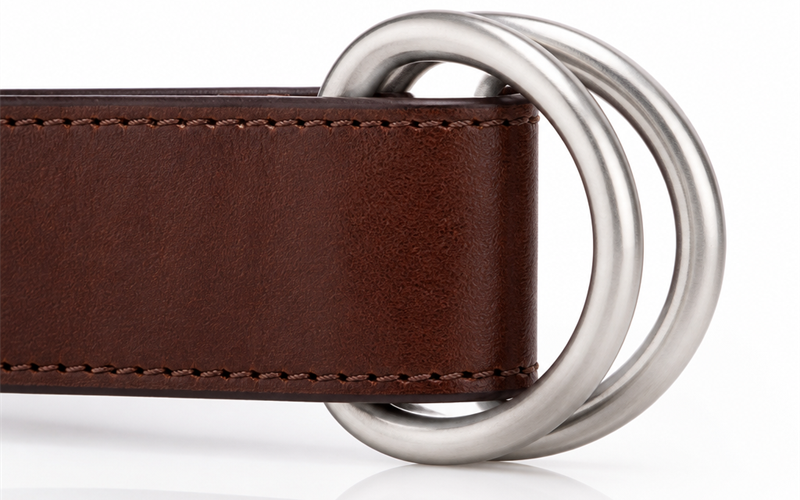
An O-ring or D-ring belt works by friction. You pass the strap through both rings, fold it back, and thread it under the first ring and over the second. Pulling the strap tight wedges it between the rings, and tension holds everything in place — no prong, no holes.

The two-ring system is a holeless, no-prong closure, which is exactly why it offers infinite adjustment: you set the fit anywhere along the strap rather than at fixed notches. D-rings (flat-backed, D-shaped) tend to grip slightly more firmly because the strap seats flat against the straight edge, while O-rings (fully round) give a softer, more casual look. Both are common on casual belts and webbing styles.
What is the difference between an O-ring and a D-ring belt?
The difference is the ring shape and the grip. A D-ring has one straight edge, so the strap seats flat and holds a touch more securely. An O-ring is fully circular, giving a softer, more relaxed look but slightly less bite on the strap.

In practice the two are close cousins, and brands use the terms loosely. D-rings lean a little more utilitarian and secure; O-rings lean a little more decorative and casual. On a braided strap, an O-ring can look especially elegant, which is why you will see it on woven designs — like our braided O-ring belt. The choice is mostly aesthetic.
Do O-ring and D-ring belts look cheap?
They can, but they do not have to. On thin canvas or flimsy webbing, a ring belt reads as cheap and casual. On full-grain leather or a tightly braided strap with solid metal rings, the same closure looks deliberately minimalist and refined.

The closure is neutral — the materials carry the verdict. Solid, well-finished rings and a substantial strap signal intent; lightweight rings and a papery strap signal an afterthought. This is the same principle behind every belt: quality leather and honest hardware elevate a simple design. A braided ring belt in particular can be genuinely elegant, as our guide to when and how to wear a braided belt explains.
| Factor | Looks minimalist | Looks messy |
|---|---|---|
| Strap material | Full-grain leather, tight braid | Thin canvas, frayed webbing |
| Rings | Solid, polished or matte metal | Lightweight, flimsy |
| Fit | Trimmed clean, neat tail | Long floppy excess tail |
| Context | Smart-casual, relaxed tailoring | Gym or utility settings |
Key stat: A ring closure has effectively infinite fit positions — versus the 5–7 fixed holes on a traditional prong belt — because friction holds the strap anywhere you set it.
How do you wear a D-ring belt without looking sloppy?
Wear a D-ring belt with the tail trimmed or tucked, on a quality strap, in a relaxed setting. The minimalist look depends on a neat finish — a long, flapping excess tail is what makes ring belts look messy.

Three habits keep it sharp: choose a leather or braided strap over thin canvas, make sure the strap length suits your waist so the tail is short, and lean into casual or smart-casual outfits rather than formal ones. A ring belt pairs naturally with chinos, denim, and relaxed tailoring. It is not a dress-belt replacement, but as a laid-back finishing piece it is hard to beat.
The Bottom Line
O-ring and D-ring belts are minimalist or messy depending almost entirely on the strap. The two-ring friction closure is clean, holeless, and infinitely adjustable — genuinely elegant on full-grain leather or a tight braid, genuinely sloppy on flimsy canvas with a long flapping tail. Pick a quality strap, keep the fit neat, and wear it casually, and the ring belt becomes one of the most understated pieces in your rotation. Explore BELTLEY's handwoven and braided belts to see the closure done right.
Frequently Asked Questions
Q: Are D-ring belts good for formal wear?
Not really. D-ring and O-ring belts are casual to smart-casual by nature, best with chinos, denim, and relaxed outfits. For suits and formal trousers, a prong or plaque buckle on a slim dress belt is the appropriate choice.
Q: Do O-ring belts slip?
A quality ring belt on a properly textured strap holds well, because tension wedges the strap between the rings. Slipping usually means the strap is too thin, too slick, or the rings are too large for the strap width. Matching solid rings to a substantial strap prevents it.
Q: Can you adjust a D-ring belt to any size?
Yes — that is a key advantage. Because the closure relies on friction rather than holes, you can set the fit anywhere along the strap. You can also trim a too-long strap to keep the tail neat, which is the main thing that keeps the look tidy.
Q: Are ring belts unisex?
Yes. The minimalist double-ring closure works equally well for men and women, and the style reads clean and casual across the board. Strap width and color are the main variables for tailoring the look to your wardrobe.