Men's Belt Math: Enough to Hold Up Your Pants (and Dignity)
TL;DR: Quick Answer and main takeaways
- Belt size = your trouser waist + 1–2 inches. You should buckle at the middle hole, with 2–4 inches of tail past the buckle.
- Belt width = outfit formality. Suits want 1"–1.25". Jeans can handle 1.5". Never wider on dress trousers.
- Belt color follows your shoes, not your pants. Black shoes = black belt. Brown shoes = brown belt. That's the whole color rule.

A belt is the one accessory most men put on without thinking and get wrong in ways they can't quite name. The buckle sits a hole too far left. The tail flaps past the second belt loop. The brown leather on a black-shoe day. None of it is hard to fix — but you have to know the numbers first.
That's what this post is: the math. Concrete numbers and rules that tell you exactly what to buy, how it should fit, and when to match what to what. BELTLEY has been making men's leather belts since 1999, and in 25+ years the questions we hear most often aren't about exotic leather or buckle styles — they're about the fundamentals. This is the fundamentals.

The Sizing Equation: How to Find Your Belt Size
This is the most misunderstood number in menswear, and it's also the simplest once you see it. Your belt size is not the same as your trouser size.
The rule: buy a belt 1–2 inches larger than your trouser waist size. If you wear 32" pants, buy a 34" belt. If you wear 36" pants, buy a 38" belt. The reason is that trouser sizing measures the garment at the waistband, while belt length is measured from the buckle bar to the middle hole. Those two measurements have a built-in gap, and the +1 to +2 inch formula accounts for it.
Effortless Gent's belt sizing guide puts it plainly: when you buy a belt one to two sizes up from your pant size, you should land naturally on the middle hole. That's exactly where you want to be. A standard 5-hole belt gives you two holes of adjustment in either direction — room for a bigger meal, a different pair of trousers, or a few months of changing waist measurements without needing a new belt.
The most accurate method if you're replacing an existing belt: measure from the buckle bar to the hole you currently use on your old belt. That number is your actual belt size. Order the same or go up one if your old belt was fitting at hole four or five.
You can also use BELTLEY's size guide — it takes 60 seconds and gives you the exact size to order based on a simple tape measure reading.

What Width Belt Should a Man Wear?
Belt width should match the formality of the outfit. Dress belts run 1"–1.25" (25–32mm). Casual belts run 1.38"–1.5" (35–38mm). Anything wider belongs on a western or fashion belt, not standard dress or casual wear. The thinner the belt, the more formal. The wider the belt, the more casual. That ratio never inverts.
The Art of Manliness' complete men's belt guide draws the same line: a slim 1" to 1.25" belt on a suit is correct; a 1.5" casual belt on the same suit is wrong, not because of some arbitrary rule but because the wider belt's visual weight fights the tailored silhouette of the trousers. The belt should complement the waistline, not dominate it.
Practically, most men need two widths: a 1.25" (32mm) dress belt and a 1.5" (38mm) casual belt. The 1.25" covers suits, dress trousers, and smart-casual chinos. The 1.5" covers jeans, casual chinos, and weekend outfits. That two-belt system handles about 95% of what men actually wear. BELTLEY's dress belt collection and full-grain casual leather belts are built specifically for those two use cases.
| Outfit Type | Belt Width | Belt Width (mm) |
|---|---|---|
| Formal suit / dress trousers | 1"–1.25" | 25–32mm |
| Business casual / chinos | 1.25"–1.38" | 32–35mm |
| Casual / jeans | 1.38"–1.5" | 35–38mm |
| Western / fashion belts | 1.5"+ | 38mm+ |
The Fit Formula: Where Should the Buckle Land?
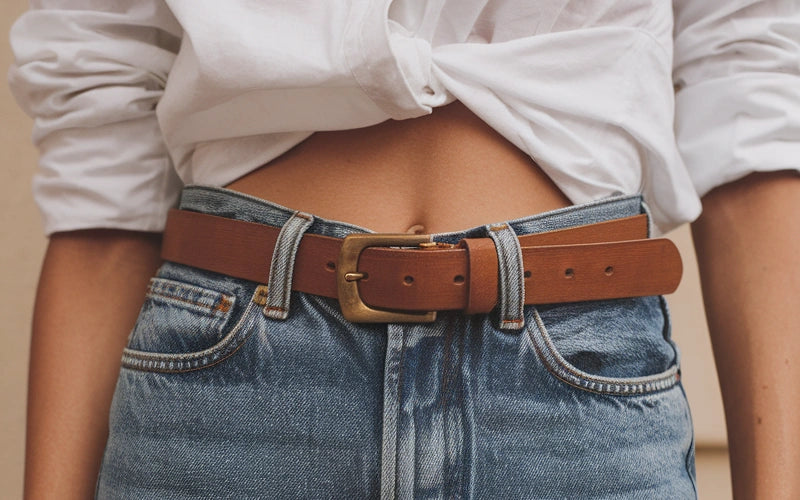
You've got the right size — now here's where it should land. The belt should buckle at the middle hole (hole three on a standard 5-hole belt), leaving 2–4 inches of tail past the buckle. That tail threads through your first belt loop and stops there. No flopping, no second-loop-reaching, no disappearing into the waistband.
If you're consistently buckling at hole one or two with extra tail dangling, the belt is too big. If you're straining at hole four or five, it's too small. The middle hole isn't a guideline — it's how standard belts are designed. The +1 to +2 inch sizing rule exists specifically to put you there.
A few specifics worth knowing: on a formal dress belt, 2 to 2.5 inches of tail looks cleanest — shorter is sharper in formal contexts. On a casual belt with jeans, 3 to 4 inches is natural and proportional to the wider strap. Our dedicated post on how far a belt should extend past the buckle covers the formality nuances in more detail if you want the full breakdown.
What Color Belt Should You Wear?
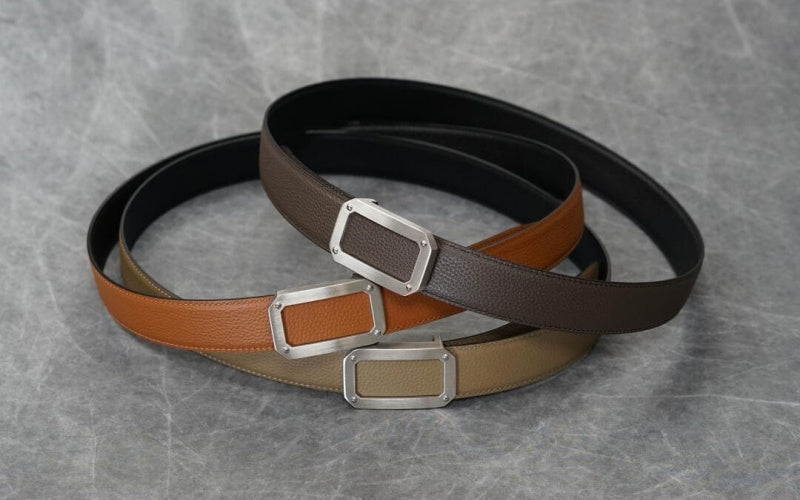
Match your belt to your shoes, not your pants. Black shoes call for a black belt. Brown shoes call for a brown belt. The pants are a neutral — they're almost never the deciding factor. It's the shoe leather that your belt needs to mirror, because the shoe and belt form the visual anchors at either end of your lower half. When they match, the outfit reads as deliberate. When they don't, even people who can't articulate why will sense something's off.
Nimble Made's breakdown of men's belt types reinforces the same logic: the belt-to-shoe relationship is the core coordination rule in men's dressing. Pants can be black, navy, grey, or khaki — the shoe color still determines the belt. A dark espresso brown belt with dark brown shoes and black pants works cleanly. A brown belt with black shoes and black pants creates a three-way leather conflict that nothing in the outfit resolves.
A few additional color specifics:
- Black shoes + black belt: the default for any formal or business professional outfit. Non-negotiable on suits.
- Brown shoes + dark brown belt: works across every casual and smart-casual register. Dark espresso or chocolate — not light tan, which has too wide a contrast gap against most trousers.
- Brown shoes + black belt: wrong. Don't.
- Burgundy/oxblood: works as an accent in casual outfits when shoes match the same warm leather family.
Our black leather belt collection and brown leather belt collection cover the two belts that handle nearly every color situation you'll encounter.

Should Your Belt Buckle Match Your Other Metals?
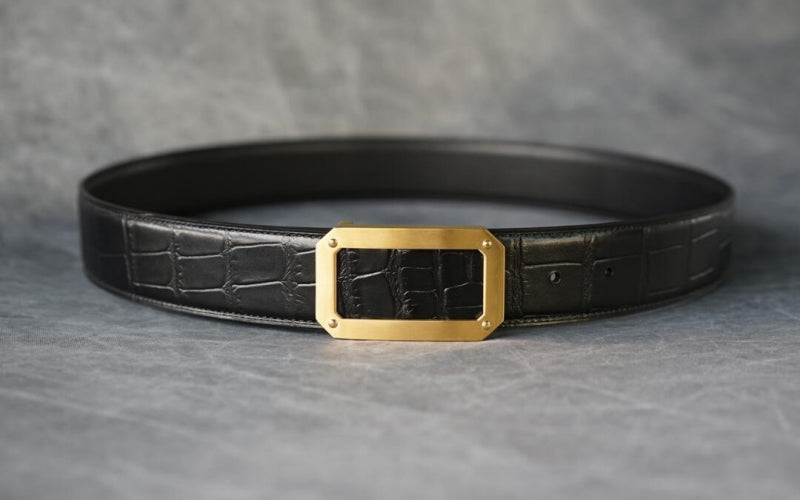
Yes — the metal finish on your belt buckle should match the dominant metal in the rest of your outfit. Silver buckle with silver watch and silver cufflinks. Gold buckle with gold watch and gold ring. Mixing metal finishes across accessories reads as mismatched even when no individual piece is wrong.
This rule is less rigid in casual settings than formal ones. In a suit, mismatched metals at the buckle, tie bar, and cufflinks are noticeable because the outfit is designed for precision. In jeans and a casual shirt, nobody is scrutinizing whether your silver belt hardware matches your brass watch case. But getting the metals right in formal contexts costs nothing and improves the outfit immediately.
A practical note on buckle hardware: a lot of mass-market belt buckles are plated zinc or alloy that looks fine initially and starts to show corrosion or flaking within a year or two. BELTLEY uses 316L stainless steel for every buckle — the same grade used in marine hardware and surgical instruments. It doesn't tarnish, doesn't scratch easily, and keeps the same finish for the life of the belt, which is covered by a 10-year warranty on materials and construction.
Real Men Real Style's guide to men's belts also notes that buckle size is part of the formality equation: a slim, low-profile frame buckle belongs on a dress belt; a larger, thicker-plate buckle belongs on casual and western belts. The bigger the buckle face, the more casual the signal. On a suit, this works against you; on jeans, it can work for you.
For more detail on building a complete belt wardrobe around these rules — including when to break them — our post on how to match a belt with your outfit for guys covers the full framework.

The Bottom Line
Men's belt math isn't complex. Buy your trouser size plus 1–2 inches. Buckle at the middle hole. Keep 2–4 inches of tail. Match belt width to outfit formality (1"–1.25" for dress, 1.5" for casual). Follow your shoes for color. Match the metals.
That's it. Six numbers and rules that cover every belt situation most men will encounter. The only remaining variable is the quality of the belt itself — full-grain leather that holds its shape at the buckle end, hardware that doesn't corrode, and construction that doesn't fail at the first hole after two years. At BELTLEY, every belt in the men's collection is built to those standards: full-grain hides selected by hand, 316L stainless buckles, and a 10-year warranty so you're not doing this math again anytime soon.

Frequently Asked Questions
Q: What size belt should a man buy?
Buy a belt 1–2 inches larger than your trouser waist size. A 34" waist takes a 36" belt. The goal is to buckle at the middle hole (third of five), which leaves 2–4 inches of tail past the buckle. If you already own a belt, measure from the buckle bar to the hole you use — that's your belt size.
Q: What width belt should men wear with dress pants?
A 1" to 1.25" (25–32mm) belt is correct for dress trousers and suits. Wider belts (1.5"+) belong on jeans and casual trousers. A wide belt on formal trousers looks visually out of proportion and undercuts the polished effect of tailored pants regardless of leather quality or buckle style.
Q: Should a man's belt match his shoes?
Yes — the belt should match the shoe leather in color and finish, not the pants. Black shoes require a black belt; brown shoes require a brown (ideally dark brown) belt. The belt-to-shoe pairing is what creates outfit coherence. The pants color is largely irrelevant to the belt decision.
Q: What is the belt middle hole rule?
A correctly sized belt should buckle at the middle hole — the third hole on a standard 5-hole belt. This gives two holes of adjustment in either direction and naturally produces the correct tail length (2–4 inches past the buckle). Consistently using hole one or two means the belt is too big; hole four or five means it's too small.
Q: Should belt buckle metal match watch metal?
In formal and business settings, yes — silver buckle with silver watch, gold buckle with gold watch. Metal consistency across accessories (buckle, watch, cufflinks, tie bar) looks intentional. In casual settings the rule relaxes, but matching metals is still the cleaner choice when it's easy to do.