How to Tell a Good Quality Leather Belt: 7 Signs That Never Lie
TL;DR: Quick Answer
- A good quality leather belt starts with the leather itself — full-grain is the only grade that develops patina, resists cracking, and lasts 10–15+ years.
- Check eight indicators: leather grade, thickness, edges, stitching, buckle hardware, smell, flexibility, and aging behavior.
- The "genuine leather" label is the biggest trap in the belt market — it sounds premium but indicates one of the lowest usable leather grades.
You're holding two belts. One costs $40, the other $160. They look similar in the store. Six months later, the cheap one cracks, peels, and the buckle turns green. The other belt barely looks broken in — it's actually getting better. The difference was visible from day one if you knew where to look.
This guide teaches you exactly how to tell a good quality leather belt by examining eight physical indicators that separate a belt built to last a decade from one built to last a season. BELTLEY's full-grain leather belts pass every single test below — here's how to verify that for yourself with any belt.

How Can You Tell If a Leather Belt Is Good Quality?
A good quality leather belt shows its grade through eight physical characteristics: full-grain leather with visible natural grain, 3.5–4mm thickness, burnished or painted edges, tight and even stitching (8–12 stitches per inch), solid metal hardware, an earthy leather scent, smooth flexibility without cracking, and the ability to develop patina over time. If a belt fails on any three of these, it's not worth the price tag.
These aren't subjective style preferences — they're measurable construction standards that the leather goods industry uses internally. Tanner Bates' comprehensive belt guide confirms that leather grade and construction method are the two factors that determine belt longevity more than any other variable. Let's break each indicator down so you can evaluate any belt in under 60 seconds.
Sign 1: The Leather Grade — Full-Grain vs. Everything Else
Full-grain leather is the only grade worth investing in for a belt you expect to wear daily. It uses the outermost layer of the animal hide — the layer with the densest fiber structure, the most natural oils, and the highest tensile strength. Full-grain leather lasts 10–15 years, resists cracking, and develops a rich patina that actually makes the belt look better with age.
Below full-grain, the quality drops fast:
| Leather Grade | What It Actually Is | Expected Belt Lifespan |
|---|---|---|
| Full-grain | Outermost hide layer, untouched surface | 10–25 years |
| Top-grain | Full-grain with surface sanded/buffed | 5–7 years |
| Genuine leather | Lower layers, heavily processed | 1–2 years |
| Bonded leather | Ground scraps glued together with polyurethane | 3–6 months |
The most important thing to understand: "genuine leather" is not a quality indicator. It's a marketing term that sounds premium but designates one of the lowest usable grades. According to Main Street Forge's leather grading breakdown, genuine leather has had its strongest fibers removed during processing, leaving a weaker material that cracks and peels within months of regular wear.
How to spot full-grain in person: Look for visible natural grain — tiny pores, subtle color variation, and occasional imperfections like healed scars or insect marks. These aren't flaws; they're proof that you're looking at the real, unprocessed hide surface. A belt with a perfectly uniform, plastic-like surface has been corrected or coated — meaning it's not full-grain. For a deeper comparison, BELTLEY's guide on full-grain leather belt vs. genuine leather explains exactly what you're paying for at each grade.

Sign 2: Thickness — The 3.5mm Rule
A quality leather belt measures 3.5–4mm thick. This thickness provides enough structural integrity to hold its shape under tension, support belt loops without folding, and resist the stretching that thins out cheaper belts within months.
Belts thinner than 3mm are almost always made from split leather (lower hide layers) or bonded material. They feel flimsy in hand, curl at the edges, and develop a permanent bend at the buckle hole you use most. American Bench Craft's quality checklist lists minimum 3.5mm thickness as a non-negotiable benchmark for any belt marketed as "full-grain."
Quick test: Hold the belt by the buckle end and let it hang vertically. A quality belt holds relatively straight with a gentle curve. A cheap belt droops like a wet noodle or curls toward one side.

Sign 3: Edge Finishing — Burnished, Not Raw
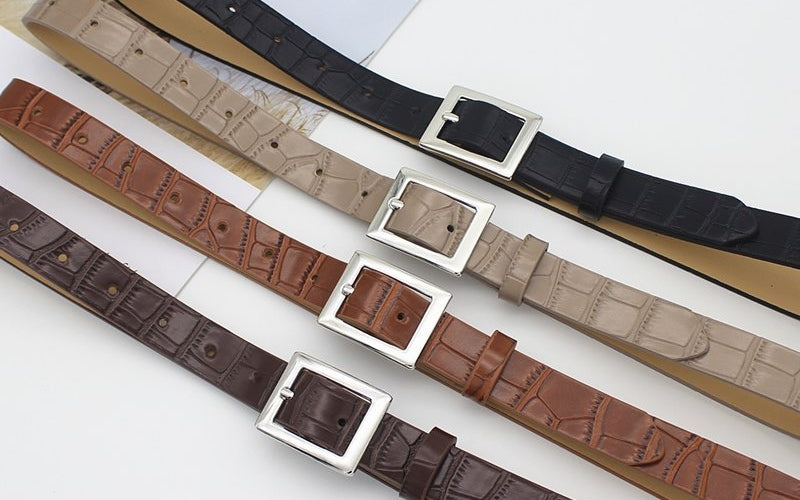
The edges of a leather belt reveal more about its quality than almost any other detail. A well-made belt has edges that are burnished (heated and rubbed smooth with wax or resin) or painted with a flexible edge coat that's been hand-applied and polished. The result is a smooth, rounded edge that won't fray, absorb moisture, or show fuzzy fibers.
Cheap belts have raw, rough edges where you can see loose fibers or layered material. Some low-cost manufacturers fold the edge over and glue it down — this looks clean initially but delaminates within weeks of regular wear. Hoplok Leather's anatomy of a quality belt identifies edge finishing as one of the most reliable quick-check quality indicators because it requires skill, time, and proper tooling — three things mass-produced belts skip.
What to look for: Run your thumb along the belt edge. It should feel smooth and slightly waxy — not rough, hairy, or sharp. If you can pick at the edge and pull fibers loose, the belt is poorly finished or made from bonded material.

Sign 4: Stitching — Count, Consistency, and Thread Quality
Quality stitching runs 8–12 stitches per inch, using waxed nylon or polyester thread that's UV-resistant and won't rot with sweat exposure. Each stitch should be uniform in length and tension, sitting in a straight line without wandering or bunching.
Buckle My Belt's leather quality guide notes that stitching quality is one of the fastest ways to separate handcrafted from machine-made belts: hand-stitched or quality-machine-stitched belts show even, deliberate stitch patterns, while cheap belts show loose threads, irregular spacing, and stitches that are already pulling at the point of sale.
Red flags in stitching:
- Thread fraying or unraveling at any point
- Visible glue around stitch holes
- Stitches spaced more than 3mm apart
- Thread color bleeding into the leather
- Skipped stitches or uneven tension
Some of the finest belts skip stitching entirely — using hot-stamped or folded-edge construction that relies on the leather's natural strength instead. This is a mark of confidence in the material, not a shortcut.


Sign 5: Buckle Hardware — Solid Metal vs. Plated Pot Metal
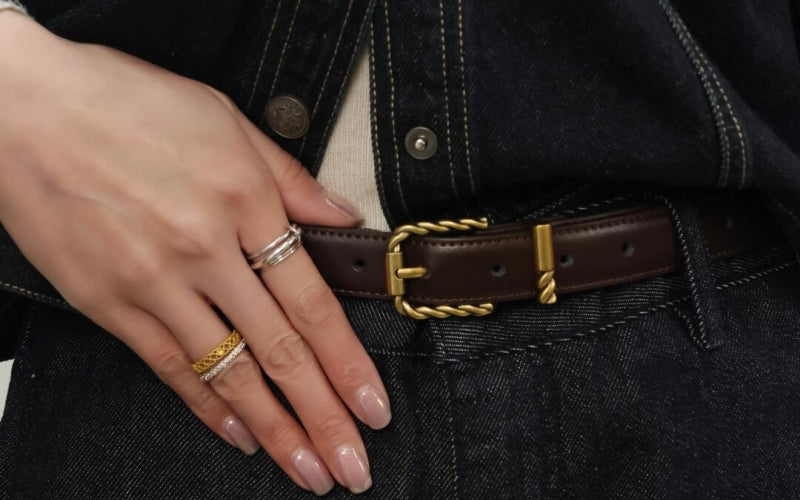
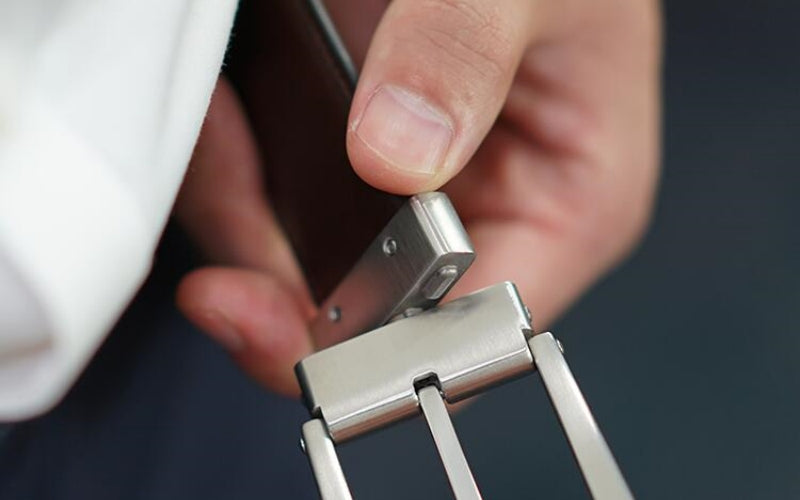
The buckle is where most cheap belts cut the biggest corners. Quality belts use solid stainless steel (316L or 304 grade), solid brass, or zinc alloy with thick plating. These materials resist corrosion, maintain their finish, and won't irritate nickel-sensitive skin.
Cheap belts use die-cast pot metal with a thin chrome or nickel plating that chips within weeks, exposing dull gray base metal underneath. Kakadu Traders' quality assessment guide identifies buckle weight as a fast indicator: heavier buckles typically use better alloys with greater resistance to deformation and corrosion.
How to check:
- Weight: A solid stainless steel buckle has noticeable heft. If the buckle feels hollow or toy-like, it's plated pot metal.
- Magnet test: Stainless steel (316L) is non-magnetic. If a magnet sticks to the buckle, it's cheap ferrous metal with plating.
- Prong quality: The buckle prong should be thick, smooth, and rounded — not thin and sharp enough to cut into the leather around belt holes.
BELTLEY uses 316L stainless steel buckles — the same surgical-grade alloy used in watches, marine hardware, and medical implants. It doesn't chip, corrode, or trigger nickel allergies. BELTLEY's stainless steel buckle belts showcase the difference this hardware makes in everyday wear.

Sign 6: Flexibility and Feel
A quality leather belt bends smoothly in a gradual arc. It doesn't crack, resist folding, or feel stiff like cardboard. The flexibility comes from the natural collagen fiber network in full-grain leather — densely interwoven fibers that flex without breaking.
Roll the belt into a circle. A good belt forms a smooth curve without cracking, creasing, or showing stress marks on the surface. Ezra Arthur's belt selection tips recommend this as a reliable in-store test because it reveals both the leather quality and the tanning process — properly tanned leather retains flexibility throughout its life, while over-processed or bonded leather becomes brittle.
Post-purchase indicator: After 2–3 weeks of daily wear, a full-grain belt develops a comfortable flex at your natural waist curve — molding to your body without losing its structure everywhere else. A cheap belt just goes limp.

Red Flags: 7 Warning Signs of a Cheap Belt
Knowing what to avoid is just as important as knowing what to look for. If a belt shows any three of these red flags, walk away:
- "Genuine leather" with no further grade specified. It's the leather industry's most misleading label — essentially the hot dog of leather.
- Chemical or plastic smell. Real leather smells like earth, not a factory.
- Peeling or bubbling surface. This means the "leather" is a polyurethane coating bonded to fabric or paper.
- Lightweight, hollow-feeling buckle. Plated pot metal that will chip and corrode.
- Raw or fraying edges. No edge finishing = no craftsmanship investment.
- Perfectly uniform surface. Natural leather has variation. A surface that looks printed or spray-painted is heavily corrected.
- No brand warranty. Any manufacturer confident in their product backs it with a warranty. No warranty means they know the belt won't last. BELTLEY backs every belt with a 10-year warranty — because the product earns that confidence.
Hanks Belts' guide to bad belt indicators adds glued (rather than stitched or riveted) buckle attachments and pre-punched belt holes with rough interior edges as additional signs of mass-production shortcuts.

How Do You Test Leather Quality at Home?
Three simple tests confirm real, quality leather without any special equipment. The smell test: genuine leather has an earthy, slightly sweet aroma — like a saddle shop or old library. Fake or bonded leather smells like chemicals or plastic. The water test: place a small drop of water on the surface. Real leather absorbs it within seconds; faux leather causes the water to bead up and roll off. The pinch test: pinch and release the leather surface — full-grain leather wrinkles briefly and bounces back; lower grades stay creased.
These three tests are endorsed by Popov Leather's authentication guide and work on any leather product — belts, bags, wallets, or shoes. The smell test is the most reliable because it's nearly impossible to fake the scent of vegetable-tanned or chrome-tanned real leather.
Advanced test — the flame test (use caution): Hold a flame near a hidden area of the belt edge. Real leather chars slightly and smells like burnt hair. Synthetic material melts, drips, or produces a chemical smell. This test is destructive, so only use it on a belt you're willing to sacrifice — but it's definitive.
How Long Should a Good Quality Leather Belt Last?
A full-grain leather belt with proper construction should last 10–15 years of daily wear. With basic care — occasional conditioning and proper storage — many full-grain belts exceed 20 years. The belt doesn't degrade; it develops character. The patina deepens, the leather softens at your natural bend points, and the color gains dimension that no factory finish can replicate.
By contrast, a "genuine leather" belt typically shows visible deterioration — cracking, peeling, color loss — within 12–18 months. BELTLEY's durability guide documents the structural reasons behind this gap: full-grain leather's intact fiber network distributes stress evenly, while processed grades have weakened fibers that concentrate stress at flex points until they fail.
The aging test is the ultimate quality proof. A year after purchase, look at your belt. Is it developing a warmer, richer color? Do the edges still feel smooth? Does the buckle still look new? If yes, you bought quality. If it's cracking, peeling, or fading — the eight signs above will help you make a better choice next time.
The Bottom Line
How to tell a good quality leather belt comes down to eight physical indicators: full-grain leather with natural grain visible, 3.5–4mm thickness, burnished edges, tight even stitching, solid metal buckle hardware, genuine leather scent, smooth flexibility, and the ability to develop patina over time. Master these checks and you'll never waste money on a belt that cracks in six months.
The real cost of a cheap belt isn't the $40 you spend — it's the $40 you spend again every year to replace it. A full-grain belt from a craft-focused DTC brand costs $80–$200 once and gives you a decade of daily wear that gets better with time.
BELTLEY's entire collection — from full-grain cowhide to exotic crocodile — is handcrafted by master artisans using the same construction standards outlined above: 316L stainless steel hardware, burnished edges, and a 10-year warranty that puts the brand's money where its craftsmanship is. Free worldwide shipping included.
Frequently Asked Questions
Q: Is "genuine leather" a sign of good quality?
No — "genuine leather" is one of the lowest usable leather grades. It uses inner hide layers that have been heavily processed, sanded, and coated. A genuine leather belt typically lasts 1–2 years before cracking and peeling. For real quality, look for "full-grain leather" on the label. See BELTLEY's detailed comparison of full-grain vs. genuine leather belts.
Q: What is the best type of leather for a belt?
Full-grain cowhide is the best all-purpose leather for belts — durable, develops patina, and works across all dress codes. For maximum longevity and scratch resistance, exotic leathers like crocodile and alligator outperform cowhide due to their natural osteoderm structure. BELTLEY's guide on which animal leather is best for belts covers every option in detail.
Q: How can I tell if a belt is real leather or fake?
Three quick tests: (1) Smell it — real leather has an earthy aroma, fake smells like chemicals. (2) Water test — real leather absorbs a water droplet within seconds, fake repels it. (3) Pinch test — full-grain leather wrinkles when pinched and bounces back, fake leather stays creased or doesn't wrinkle at all.
Q: How thick should a quality leather belt be?
A quality belt measures 3.5–4mm thick. This provides enough structure to hold its shape, resist stretching, and support belt loops without curling. Belts thinner than 3mm are typically made from split or bonded leather and won't maintain their form long-term.
Q: Does a good leather belt crack over time?
No — a properly made full-grain leather belt should never crack with normal use. Cracking is a sign of low-grade leather, bonded material, or lack of conditioning. Quality leather becomes more supple with age, not more brittle. For prevention tips, see BELTLEY's guide on how to keep leather belts from cracking.
Q: Are expensive belts always better quality?
Not necessarily. Quality correlates with price up to roughly $200–$400 for cowhide, then flatlines. Above that range, you're primarily paying brand tax — marketing, retail overhead, and logo premium. A $150 DTC full-grain belt can match or exceed the material quality of a $500+ designer belt from a luxury fashion house.