How to Measure Belt Size Without a Measuring Tape
TL;DR:
- The easiest method: measure an existing belt that fits well, from the buckle bar to the hole you use — that measurement is your belt size.
- No existing belt? Add 2 inches to your trouser waist size (e.g., 34" waist = size 36 belt).
- Need exact measurement? Use string or a strip of paper around your waist, then measure the marked length with a ruler.
Shopping for a belt online without a measuring tape nearby is more common than it should be, and getting the size wrong means a return trip. The good news: you have at least four accurate alternatives that require nothing more than a ruler, a piece of string, or a belt you already own. Here's each method laid out precisely.
Pick the Method That Matches What's in Your House
Four methods below — but you only need the one your situation allows:
| Your situation | Use this method |
|---|---|
| You own a belt that fits well | Measure it from the buckle bar to the hole you use — that's your size, most accurate method there is |
| No belt, but you know your pants size | Add 2 inches — a 34" waist takes a size 36 belt. Quickest method |
| You want exact numbers | String (or a paper strip) around the waist, mark it, measure against a ruler |
| It's for someone else | Measure one of their existing belts when they're not looking — method 1, gift edition |
Cross-check your result against BELTLEY's size guide before ordering. Each method, step by step:
Method 1: Measure an Existing Belt (Most Accurate)
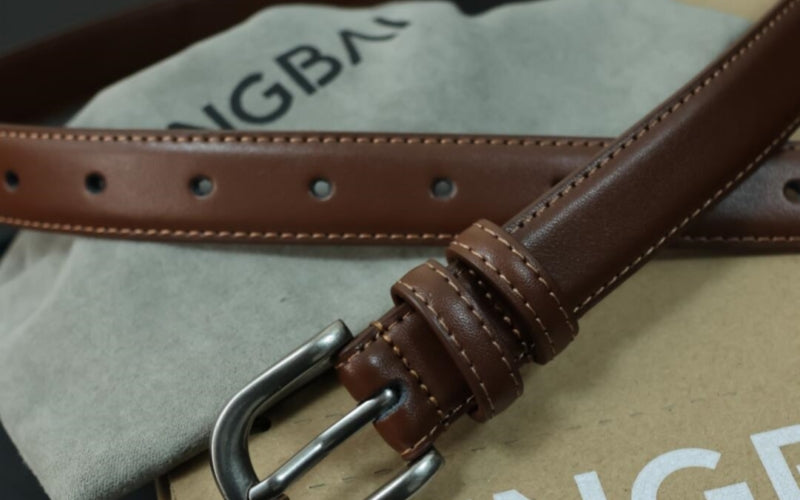
This is the most reliable method if you own a belt that fits well. Place the belt flat on a clean surface, buckle side up. Measure from the buckle bar — the horizontal pin inside the buckle frame that the leather folds around — to the hole you currently use to fasten the belt. Do not measure to the tip of the belt; that measurement includes extra tail length that varies by design.

This measurement is your belt size in inches. For example, if you measure 38 inches from buckle bar to working hole, you need a size 38 belt. Most quality belts are punched with five holes spaced one inch apart, with the middle hole intended as the "correct" fit. If you're between measurements, size up by one inch — it's easier to wear a belt on the first hole than to add a hole to leather.
For detailed visuals and size conversion charts, BELTLEY's size guide covers every measurement scenario including international sizing.
Method 2: Add 2 Inches to Your Trouser Waist Size (Quickest)
Belt sizing conventions in North America follow a straightforward rule: belt size = trouser waist size + 2 inches. A person wearing 34" waist trousers typically wears a size 36 belt. A 32" waist = size 34 belt. This accounts for the fact that a belt fastens at or slightly above the trouser waistband, which has a slightly smaller circumference than the belt's worn position.
This method works well for standard body proportions and regular trouser fits. It is less reliable for:
- High-waisted trousers (worn significantly above the natural waist)
- Relaxed or baggy fits (worn below the natural waist)
- Anyone between standard trouser sizes
In these cases, Method 1 (measuring an existing belt) or Method 3 (string method) will be more accurate. For more on how belt and pants sizing interact, our post on should your belt be the same size as your pants explains the standard rule with the exceptions that matter.
Method 3: String or Ribbon Around the Waist
If you have no existing belt but need a precise measurement, use any flexible material — string, ribbon, shoelace, or strip of fabric — as a substitute measuring tape.

Steps:
- Put on the type of trousers you'll typically wear with the belt.
- Thread the string through your belt loops at the position where you wear your belts.
- Pull the string comfortably snug — the same tension you'd fasten a belt at.
- Mark the point where the string completes the circuit (where it meets the starting end at the buckle position).
- Lay the string flat on a surface and measure from the starting end to your mark with a ruler or rigid tape.
- Add 1–2 inches to this measurement for the standard belt tail length past the buckle.
This method measures your actual wearing circumference, making it more precise than the trouser-size formula for anyone with non-standard proportions. As noted in Truth Belts' belt sizing guide, measuring directly at the wearing position — through the belt loops — produces the most accurate fit across body types.
Method 4: Paper Strip Method
Similar to the string method but more rigid, which some people find easier to mark accurately.

Steps:
- Cut a strip of paper about 1 inch wide and long enough to wrap around your waist (a sheet of A4/letter paper folded lengthwise works for most waist sizes under 40").
- Wear the trousers you'll pair with the belt.
- Wrap the paper strip through the belt loops and around your waist at the wearing position.
- Mark where the end of the strip meets itself with a pen or pencil.
- Lay flat and measure the marked length with a ruler.
- Add 2 inches for the tail.
This method has the advantage of providing a flat, easy-to-mark surface. It's especially useful when measuring for a belt as a gift and you need the recipient's size without a tape measure available.
How Belt Length Is Measured: Understanding What You're Buying
A potential source of sizing confusion: different brands measure belt length differently. The two conventions are:

Buckle bar to last hole: The most common and recommended convention — reflects how the belt will actually be worn. This is the number you produce using Method 1.
Total belt length (tip to buckle): Some brands measure the entire belt including the tail. A 42" total-length belt may only have a 38" effective wearing length.
When ordering, check which measurement convention the brand uses. BELTLEY measures from buckle bar to the standard center hole — the way it should be — so the size you order matches the size you measure. Our post on does belt length include the buckle explains this in detail with measurement diagrams.
Quick Reference: Belt Size by Trouser Waist
| Trouser Waist (in") | Belt Size (in") |
|---|---|
| 28 | 30 |
| 30 | 32 |
| 32 | 34 |
| 34 | 36 |
| 36 | 38 |
| 38 | 40 |
| 40 | 42 |
| 42 | 44 |
For women's belt sizing, which follows a slightly different convention, see our guide on how to size a belt for a woman. For men's sizing in more detail, see how to choose a belt size for a man.

The Bottom Line
Four methods, in order of accuracy: (1) measure an existing belt from buckle bar to working hole, (2) add 2" to your trouser waist size, (3) string through belt loops and measure, (4) paper strip substitute. All four give reliable results when done carefully. The most common mistake is measuring total belt length instead of working length — always measure to the hole you use, not the tip.
If you're still unsure after measuring, BELTLEY's size guide has a complete sizing chart and guidance for edge cases. Our full-grain leather belt collection is available across the full size range with free worldwide shipping and 30-day hassle-free exchanges if you need to adjust.
Frequently Asked Questions
Q: How do I know my belt size without a tape measure?
The fastest method: add 2 inches to your trouser waist size (e.g., 34" trousers = 36 belt). For precision, measure an existing belt from the buckle bar to the hole you use — that measurement is your belt size in inches.
Q: Is belt size the same as waist size?
No — belt size is typically 2 inches larger than trouser waist size. A size 36 belt fits a 34" waist. Belt size accounts for the belt wearing position being slightly above the trouser waistband and the fastening mechanics of the buckle.
Q: How do I measure a belt that already fits me?
Lay it flat and measure from the buckle bar (the horizontal bar inside the buckle frame) to the hole you typically use. That distance is your belt size. Do not measure from the belt tip — that includes the tail length, which varies by design.
Q: Can I use a shoelace to measure my belt size?
Yes. Thread a shoelace through your belt loops at the wearing position, pull snug, and mark where it completes the loop. Measure the marked length with a ruler. Add 1–2 inches for the tail length if ordering a new belt.
Q: What does "belt size 38" actually mean?
It means the belt is designed to fasten at a waist circumference of approximately 36 inches — the standard is belt size equals waist size plus 2 inches. The working length from buckle bar to center hole should be approximately 38 inches.