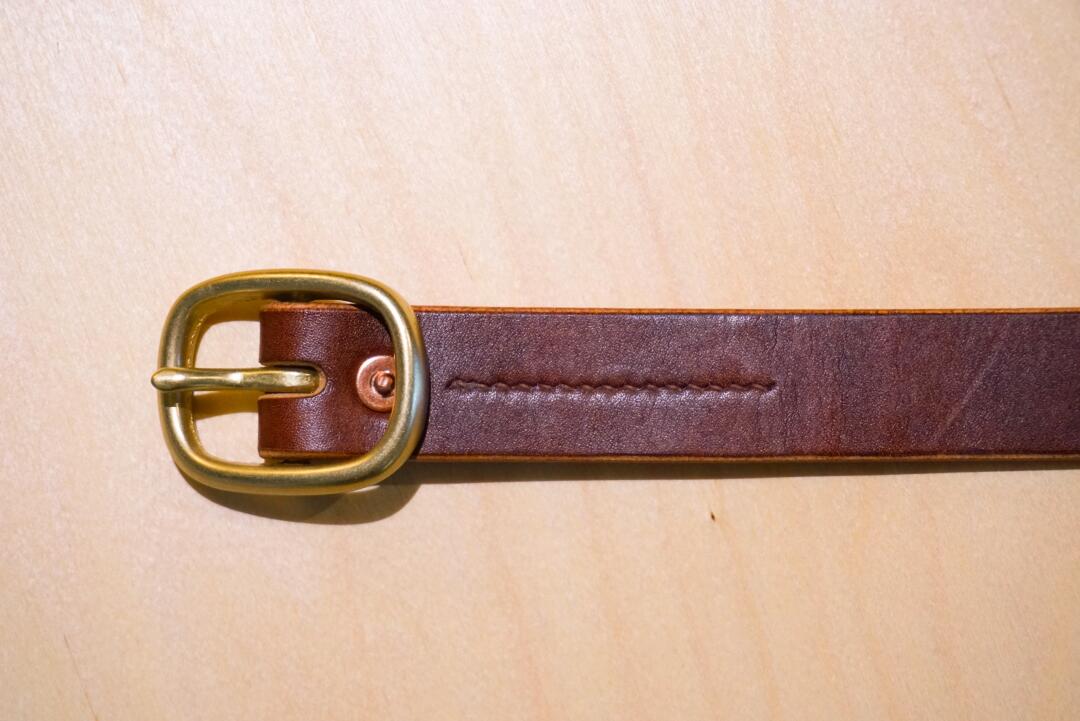
How Long Will a Full-Grain Leather Belt Last? Real Numbers
TL;DR: Quick Answer
- A full-grain leather belt lasts 10–20+ years with basic care — some exceed 30 years
- The biggest lifespan killers are dryness (no conditioning), wrong sizing (stress at holes), and cheap hardware
- Rotating 2–3 belts and conditioning every 3–6 months can double the effective lifespan of each belt

You bought a full-grain leather belt. Or you're thinking about it. Either way, you want to know how long it'll actually last before you need a replacement.
The short answer: a well-made full-grain leather belt lasts 10–20 years with regular wear and minimal maintenance. Some last much longer. But "full-grain" alone doesn't guarantee longevity. Hardware, construction, and how you treat the belt matter just as much as the leather itself.
This guide gives you the real numbers — by leather grade, by care level, and by use case — so you know exactly what to expect.

Your Lifespan Estimate, By Habit
The "10–20 years" answer shifts depending on how you treat the belt:
| Your situation | Realistic lifespan |
|---|---|
| One belt, worn daily, conditioned occasionally | 10–15 years |
| You rotate 2–3 belts and condition every 3–6 months | 20+ years each — rotation roughly doubles effective lifespan |
| You never condition anything | Dryness is the #1 killer — expect to halve the numbers above |
| Your belts keep failing early | It's usually sizing (stress at the holes) or cheap hardware, not the leather — diagnosis below |
The conditioning routine takes 10 minutes twice a year — the leather care guide walks through it. What kills belts early:
How Long Does Each Leather Grade Last?
Not all leather is created equal. The grade determines the baseline lifespan more than any other factor. Here's how they stack up in belt form:
| Leather Grade | Lifespan (Daily Wear) | Lifespan (Rotation/Care) | Why |
|---|---|---|---|
| Full-grain | 10–15 years | 20–30+ years | Intact fiber structure, highest tensile strength |
| Top-grain | 5–8 years | 8–12 years | Sanded surface removes strongest fibers |
| Genuine leather | 1–3 years | 3–5 years | Lower hide layers, thin and prone to cracking |
| Bonded / PU | 6–12 months | 12–18 months | Glued scraps or synthetic; delaminates quickly |
According to Szoneier Leather's lifespan research, full-grain leather belts can last 15–25+ years under optimal conditions. Vegetable-tanned full-grain pushes even higher — some handmade veg-tanned belts are still in use after 30+ years.
The gap between full-grain and genuine leather is massive. A genuine leather belt that costs $30 and lasts 2 years has a higher cost-per-year than a $100 full-grain belt lasting 15 years. Our breakdown of full-grain leather vs. genuine leather explains why the difference is so dramatic.

What Makes a Full-Grain Belt Fail Early?
Full-grain leather is tough. But it's not invincible. Here are the five things that shorten a belt's life — and most of them are preventable.
Dryness and Lack of Conditioning
This is the number one killer. Leather is skin. It needs moisture to stay flexible. Without conditioning, the natural oils evaporate over time, and the fibers become brittle. That's when cracks appear — usually at the most-used hole first.
According to Hanks Belts' cracking analysis, dry leather under repeated bending stress fractures at the weakest points. Conditioning every 3–6 months prevents this entirely. Our guide on how to keep leather belts from cracking covers the exact routine.
Wrong Size (Constant Stress at the Holes)
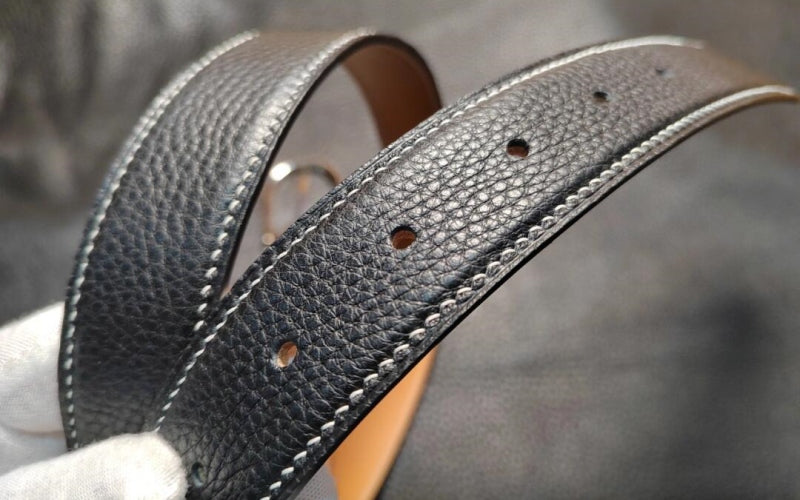
A belt that's too tight stretches the leather fibers beyond their limit at the buckle hole. A belt that's too loose slides back and forth, creating friction wear. Both accelerate deterioration at the holes — the most common failure point on any belt.
The fix is simple: wear the belt on the center hole. If you're on the first or last hole, the belt is the wrong size.

Cheap Hardware
The buckle outlasting the leather is a sign of a well-made belt. The opposite — a buckle that corrodes, tarnishes, or snaps before the strap wears out — is a sign of cost-cutting. Zinc alloy buckles pit and corrode from sweat exposure, which can stain and weaken the leather around the buckle attachment point.
Solid brass and stainless steel resist corrosion for decades. At BELTLEY, we use these exclusively because a buckle failure shouldn't end a belt's life.
Water Damage and Heat Exposure
Occasional light moisture is fine. Soaking is not. Prolonged water exposure swells the leather fibers, and if the belt dries too quickly (or with direct heat), those fibers contract unevenly and crack. According to Craft and Antler Co.'s belt care guide, UV exposure from sunlight also dries out the natural oils over time.
Poor Construction
Even full-grain leather fails early if the belt is poorly assembled. Glued edges delaminate. Weak stitching unravels. Multi-layer belts with cheap adhesive separate. According to Holdform's belt failure analysis, most leather belts fail due to poor construction — not bad leather.

How to Make Your Full-Grain Belt Last 20+ Years
Five habits separate a belt that lasts a decade from one that lasts two or three.
1. Condition Every 3–6 Months
Apply a thin layer of leather conditioner (mink oil, neatsfoot oil, or beeswax-based) with a soft cloth. Massage it in. Wipe off excess. Five minutes, twice a year minimum. This keeps the fibers supple and prevents cracking. Our leather care guide walks through the process.
2. Rotate Between 2–3 Belts
According to Torino Leather's belt care guide, rotating belts lets each one recover its natural shape and dry out from body moisture between wears. A belt worn every day gets 365 stress cycles per year. A belt in a three-belt rotation gets 120. That alone can double or triple effective lifespan.
3. Store Properly
Hang your belt or lay it flat. Never fold it — folding creates permanent creases that weaken the leather. Keep it in a cool, dry place away from direct sunlight. Avoid airtight containers; leather needs airflow to prevent mold.
4. Wear the Right Size
Use the center hole. If you're consistently on the first or last hole, the belt is too large or too small. The center hole distributes stress evenly across the buckle attachment and the leather.
5. Clean Before Conditioning
Wipe the belt with a damp (not wet) cloth before applying conditioner. Dirt and grime trapped under conditioner can scratch the leather surface and accelerate wear.

When Should You Replace a Full-Grain Leather Belt?
Even the best belt eventually shows its age. Here are the signs it's time for a new one:
- Deep cracks through the leather — not surface lines (which are patina), but structural cracks that compromise the strap's integrity
- Holes stretched beyond use — the prong no longer holds securely in any hole
- Buckle mechanism failure — the prong bends, the screw strips, or the attachment point tears
- Delamination — layers separating (more common in double-layer belts with weak adhesive)
- Permanent warping — the belt no longer sits flat and twists when worn
Surface scratches, color darkening, and slight softening are not signs of failure. They're signs of aging — and on full-grain leather, that's a feature, not a flaw. Our guide on the truth about leather belt durability explains the difference between wear and damage.

The Bottom Line
A full-grain leather belt lasts 10–20 years with basic care. Condition it twice a year, rotate it with one or two other belts, and wear the right size.
That's it. The leather gets better with age, not worse.
BELTLEY's full-grain leather belts are built for that kind of lifespan — handcrafted with stainless steel buckles, backed by a 10-year warranty, and designed to develop a patina you'll actually want to show off.

Frequently Asked Questions
Q: How long should a good leather belt last?
A good full-grain leather belt should last 10–20 years with regular care. Top-grain lasts 5–10 years. Genuine leather lasts 1–3 years. If your belt is cracking or peeling within 2 years, it's likely not full-grain. Thickness, hardware quality, and conditioning frequency all affect the final number.
Q: Can a full-grain leather belt last a lifetime?
With excellent care, yes. Handmade vegetable-tanned full-grain belts with solid brass or stainless steel hardware have been documented lasting 30+ years. Rotating the belt, conditioning regularly, and storing properly are the keys. The leather itself can outlast the hardware if the hardware isn't high quality.
Q: How often should you replace a leather belt?
Replace a full-grain belt when you see deep structural cracks, holes stretched beyond use, or buckle mechanism failure. Surface patina and color changes are normal aging — not damage. Most people replace genuine leather belts every 1–3 years. Full-grain should last far longer if properly maintained.
Q: Does conditioning actually extend belt life?
Yes, significantly. Conditioning replenishes the natural oils that leather loses through wear and evaporation. Without those oils, fibers dry out and become brittle — leading to cracks, especially at the holes. Conditioning every 3–6 months can add 5–10 years to a belt's lifespan compared to zero maintenance.
Q: Is it better to buy one expensive belt or several cheap ones?
One quality full-grain belt. A $100 belt lasting 15 years costs $6.67/year. Three $30 genuine leather belts over the same period cost $90 total but only last 2 years each — meaning you need 7–8 replacements ($210–$240) to cover the same timeframe. The math always favors quality. Our guide on how much a leather belt should cost breaks this down by tier.
,%20wrong%20sizing%20(stress%20at%20holes),...)