How Long Should a Leather Belt Last? Lifespan by Leather Grade
TL;DR: Quick Answer
- Full-grain leather: 10–20+ years with basic care — the only grade that improves with age.
- Genuine leather: 1–3 years before cracking and peeling. The label sounds premium but isn't.
- Bonded leather: 3–12 months. It's ground-up scraps glued together — disposable by design.
- If your belt is failing in under 2 years, the leather grade is the problem, not your wear habits.

A leather belt should be one of the longest-lasting items in your wardrobe. But "leather" covers a wide range of materials — from full-grain hides that develop character over decades to bonded scraps that peel apart in months.
The answer to how long should a leather belt last depends almost entirely on what type of leather you're actually wearing.
This guide gives you exact lifespans by grade, the cost math that shows which belts are genuinely cheaper long-term, and the signs that tell you when a belt is done.

How Long Does a Full-Grain Leather Belt Last?
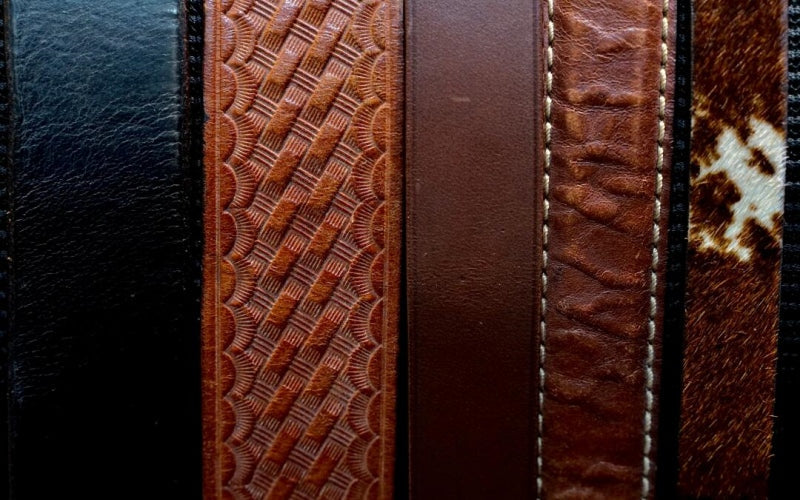
A full-grain leather belt lasts 10–20 years with regular wear and basic care. With conditioning every 3–6 months and proper storage, many full-grain belts exceed 25 years. Full-grain is the outermost layer of the animal hide — the densest, strongest part — and it's the only leather grade that develops patina rather than deteriorating.
Torino Leather's comparative analysis confirms that full-grain outlasts every other cowhide grade because its intact collagen fiber network distributes stress evenly instead of concentrating it at weak points. The surface hasn't been sanded or corrected, so the natural oils and grain structure remain intact — that's what prevents cracking.
BELTLEY's full-grain leather belts are built on this principle: the leather does the heavy lifting because it's the right grade from the start. No coatings to peel. No fillers to delaminate. Just the hide doing what hide does best.

Belt Lifespan by Leather Grade
Here's the realistic lifespan for each leather type under regular daily-rotation wear:
| Leather Grade | Expected Lifespan | Aging Behavior | Cost Per Year* |
|---|---|---|---|
| Full-grain cowhide | 10–20+ years | Develops rich patina; softens at flex points | $6–$20 |
| Exotic (crocodile/alligator) | 15–30+ years | Scale texture deepens; virtually scratch-proof | $4–$20 |
| Top-grain | 5–8 years | Coating fades and eventually cracks | $10–$30 |
| Genuine leather | 1–3 years | Cracks, peels, loses color | $20–$60 |
| Bonded leather | 3–12 months | Surface flakes off in sheets | $40–$80+ |
*Based on typical retail prices: full-grain $80–$200, exotic $100–$300 (DTC), top-grain $50–$100, genuine $30–$60, bonded $15–$30.
The cost-per-year column tells the real story. A $30 bonded belt replaced twice a year costs $60/year. A $150 full-grain belt lasting 15 years costs $10/year. The "expensive" belt is six times cheaper. Pampeano's lifespan research reaches the same conclusion: investing in quality leather once costs less than cycling through disposable belts indefinitely.
The exotic leather advantage: Crocodile and alligator hides contain natural osteoderms — bony plates beneath the scales — that resist scratching and scuffing better than any cowhide. A well-maintained crocodile belt at $150–$299 delivers the lowest cost-per-year of any belt option.

Why Do Some Leather Belts Crack So Fast?
Belts that crack within 1–2 years are almost always made from genuine leather, bonded leather, or corrected-grain leather with a polyurethane topcoat. These materials lack the dense fiber structure that keeps full-grain leather flexible over time. When the surface coating dries and cracks, the weak underlying material follows immediately.
Obscure Belts' analysis of genuine leather explains that "genuine leather" uses inner hide layers where the strongest fibers have been removed during splitting. What remains is a weaker substrate that manufacturers coat with paint or polyurethane to simulate the look of quality leather. That coating is what cracks — and once it starts, the belt is finished.
The "genuine leather" trap: The label sounds like a quality guarantee. It's actually a grade designation indicating one of the lowest usable leather levels. If a belt is labeled "genuine leather" without specifying "full-grain," expect 1–3 years at best.

6 Signs Your Belt Needs Replacing
Even quality belts eventually wear out. Replace yours when you see three or more of these:
- Surface cracking or peeling — especially at the buckle hole and hip-bend areas. Patina is deepening color; cracking is structural failure.
- Stretched belt holes — your primary hole has elongated into an oval and no longer holds tension.
- Frayed edges or broken stitching — the edge finish has worn through, showing loose fibers or separated layers.
- Buckle damage — bent prong, chipped plating, loose frame, or green corrosion on the metal.
- Permanent warp or droop — the belt won't hold straight when threaded through loops.
- Musty odor — moisture-trapped bacteria that doesn't respond to airing out.
Buckle My Belt's replacement guide adds that uneven color patching — light and dark zones from uneven dye wear — signals the finish is breaking down. Uniform patina = healthy aging. Blotchy patches = deterioration.
Grade matters here too. Cracking in a bonded belt after 6 months is expected. Cracking in a full-grain belt after 3 years means something went wrong — likely insufficient conditioning or prolonged moisture exposure. BELTLEY's leather care guide covers the conditioning schedule that prevents premature failure.

How to Make Your Belt Last Longer
Four habits separate a 5-year belt from a 20-year belt:
Rotate. Wearing the same belt every day concentrates sweat, stress, and flex damage. A 2–3 belt rotation lets each belt dry and rest between wears. Szoneier Leather's longevity guide estimates rotation alone doubles effective lifespan.
Condition. Leather is skin — it dries out. Apply leather conditioner every 3–6 months to restore moisture and prevent cracking. For exotic leather, use products specifically formulated for reptile hides.
Store properly. Hang on a hook or lay flat. Never roll tightly — it creates permanent curl. Keep away from direct sunlight and heat sources, which dry leather out and fade color.
Keep dry. Wipe off moisture immediately. Never store in humid closets or bathrooms. Moisture is the fastest destroyer of leather — it breaks down tanning agents and promotes bacterial growth.
For detailed product-specific care instructions, see BELTLEY's how to keep leather belts from cracking.

The Bottom Line
How long should a leather belt last? A full-grain belt: 10–20 years. An exotic leather belt: 15–30+. A "genuine leather" belt: 1–3 years. A bonded belt: months. The grade of leather determines the lifespan — not the price tag, not the brand name, and not how carefully you treat it (though care helps).
If you're replacing belts every year or two, upgrade the leather grade and break the cycle. BELTLEY's full-grain leather belts and crocodile belts are handcrafted to last decades — 316L stainless steel hardware, burnished edges, a 10-year warranty, and free worldwide shipping. One purchase. One decade. One belt that actually gets better with time.

Frequently Asked Questions
Q: How long does a genuine leather belt last?
A "genuine leather" belt lasts 1–3 years before cracking and peeling. Despite the name, genuine leather is one of the lowest usable grades — it uses inner hide layers that lack the fiber density of full-grain leather. For the full comparison, see BELTLEY's guide on full-grain vs. genuine leather belts.
Q: How often should you replace a leather belt?
A full-grain belt shouldn't need replacement for 10–15 years with basic care. Replace any belt when you see cracking, stretched holes, or broken stitching. If you're replacing belts every 1–2 years, the issue is leather grade, not wear — upgrade to full-grain.
Q: Can a leather belt last a lifetime?
Yes — full-grain and exotic leather belts conditioned regularly and stored properly can last 25–30+ years. Some well-maintained belts have survived multiple decades. The key factors are leather grade, conditioning frequency, and avoiding prolonged moisture exposure.
Q: How do you make a leather belt last longer?
Rotate between 2–3 belts, condition every 3–6 months, store flat or hanging (never rolled), and keep away from moisture and direct heat. These four habits can double or triple a belt's functional lifespan.
Q: Is it worth buying an expensive leather belt?
Yes — up to a point. A $100–$200 full-grain belt lasting 15 years costs $7–$13/year. A $30 belt replaced annually costs $30/year. The quality belt is cheaper over time and looks better doing it. Above $300 for cowhide, you're typically paying for brand name rather than better leather. See BELTLEY's analysis of whether expensive belts are worth it.