Best Leather for a Heavy-Duty Work Belt: Full Grain, Thickness& Build Guide
TL;DR:
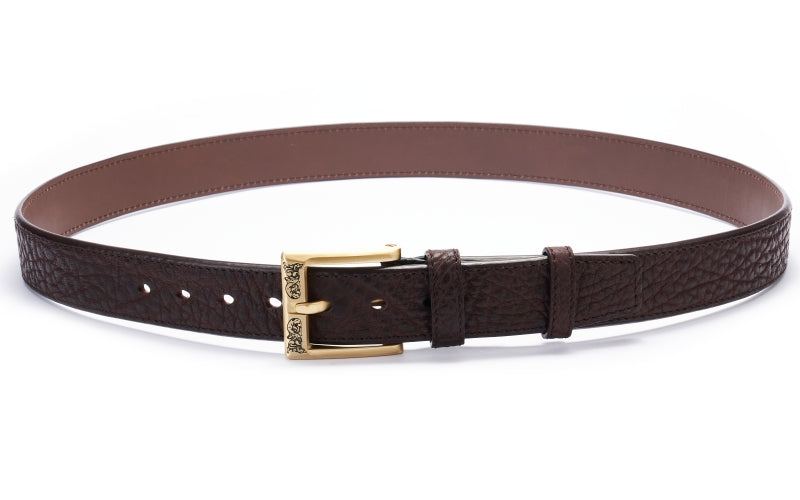
- The best leather for a heavy-duty work belt is full-grain, vegetable-tanned, 8–14 oz (3.2–5.6mm thick) — dense enough to resist sagging under tool weight and flexible enough to wear all day.
- Double-layer construction doubles that thickness and load-bearing capacity without significantly increasing weight.
- Buckle material matters as much as leather: solid brass or stainless steel hardware won't fail when a cheap zinc alloy buckle would.
A work belt takes punishment that no dress belt is engineered to handle: sustained weight from tools, constant flexion, sweat exposure, and 10-hour daily wear cycles. The same specifications that make a belt look good at a dinner also make it fail on a job site within six months. Here's a precise breakdown of what separates a belt that works from one that looks like it should.
Spec Your Work Belt in 20 Seconds
Build requirements by job type:
| Your situation | Go with |
|---|---|
| Carrying tools daily | 10–14 oz full-grain, double-layer, 1.5"+ wide — load-bearing is the design brief. |
| Heavy use but no tool weight | 8–10 oz single-layer full-grain — tough without the bulk. |
| Sweat and weather exposure | Vegetable-tanned over chrome-tanned — it handles moisture cycles without delaminating. |
| Buckles keep failing on you | The buckle was the weak link: solid brass or stainless, never zinc alloy. |
Full-grain straps with stainless steel hardware start at $58: BELTLEY's full-grain collection.
What Type of Leather Is Best for a Heavy-Duty Work Belt?
Full-grain leather is the only appropriate starting point for a work belt. It's the outermost layer of the hide, with intact fiber structure that provides tensile strength, resistance to abrasion, and the dimensional stability needed to hold shape under sustained load without stretching. No other leather grade meets these requirements at the functional level.

Specifically, full-grain vegetable-tanned leather is the gold standard for work belt applications. The vegetable tanning process creates a denser cross-linked fiber structure with better stretch resistance than chrome-tanned equivalents — critical when the belt must support tool weight at a fixed point all day. According to the Leather Working Group's Leather Manufacturer Standard, full-grain leather has roughly 3x the tear strength of genuine leather made from the same hide's inner layers. On a work belt, that margin matters.
Top-grain, genuine, and bonded leather are not suitable for heavy-duty work applications regardless of thickness or price.
What Leather Thickness Is Best for a Work Belt?
Leather thickness for belts is measured in ounces (oz) in North American leatherwork: 1 oz equals approximately 0.4mm of thickness. For heavy-duty work belts, the functional range is 8–14 oz (3.2–5.6mm).
8–10 oz (3.2–4.0mm): The minimum for work applications. Stiff enough to support moderate tool weight — a multitool, flashlight, or small pouch — without collapsing or curling. Appropriate for tradespeople who carry light EDC load but primarily need a durable everyday belt.
10–12 oz (4.0–4.8mm): The most common specification for dedicated work belts. Sufficient rigidity to support heavier EDC configurations without feeling restrictive during movement. This is the sweet spot for construction trades, outdoor work, and anyone who carries a loaded tool pouch or holster.
12–14 oz (4.8–5.6mm): Maximum thickness for standard work belt applications. Primarily used by leather artisans in custom strap work, competition shooting rigs, or heavy leather tool belts. At this thickness, a single-layer belt becomes very stiff and may require a longer break-in period.
For an explanation of the oz weight system in practical terms, our dedicated post on what "10-12 oz leather" means when buying a belt covers the measurement in detail.
Should a Work Belt Be Single-Layer or Double-Layer?
Double-layer construction significantly improves a work belt's performance under load. Two full-grain leather strips bonded and stitched together create a strap that:

- Maintains shape under sustained tool weight without the bowing that single-layer belts develop at stress points
- Distributes stress across two fiber planes, reducing the chance of through-failure at holes
- Provides a firmer, flatter profile that slides more easily through belt loops under load
A double-layer belt using two 5–6 oz pieces is equivalent in thickness to a single 10–12 oz belt — with superior fiber direction control, since each layer can be cut from the strongest belt region of the hide independently.
BELTLEY's double layer leather belt collection uses exactly this construction: two full-grain leather strips, bonded and saddle-stitched, with solid hardware on every piece. The Black Double Layer Full-Grain Belt and Heavy Duty Saddle Brown Belt are both built to handle sustained daily load.
What Width Should a Work Belt Be?
For heavy-duty work applications, 1.5 inches (38mm) is the standard width. This provides:

- Sufficient surface area to distribute tool weight across the hip without concentrated pressure
- Compatibility with standard work pant belt loops (typically sized for 1.5–1.75")
- A stable platform for holster attachment, pouch clips, and EDC accessories
Narrower belts (1.25" or less) are dress and fashion configurations — not appropriate for load-bearing work applications. A 1.5" belt worn daily in work conditions is why BELTLEY's 1.5" belt collection focuses on heavy-gauge, double-layer construction options.
What Buckle Hardware Survives Work Conditions?
Buckle failure on a work belt is a different problem than on a dress belt. Under daily load and movement, a cheap zinc alloy buckle will fatigue at the pin pivot point — the pin develops play, then the buckle frame cracks at the stress concentration around the pin hole. Solid metal buckles don't have this failure mode.
For work belts, specify:
- Solid brass: Excellent corrosion resistance, naturally antimicrobial, no plating to wear through. Weight indicates quality — solid brass buckles are noticeably heavier than hollow zinc alloy.
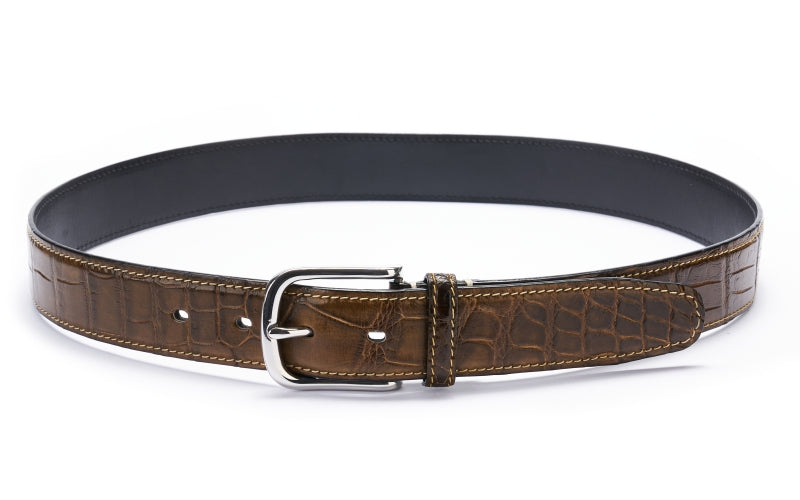
- stainless steel: Harder than brass, excellent resistance to sweat and chemical exposure, appropriate for outdoor and wet-environment work. BELTLEY's stainless steel buckle belts are built to this spec.
Nickel-plated zinc alloy — the most common mass-market buckle material — is not appropriate for work applications. The plating wears through at friction points within 6–12 months of daily use, exposing the soft alloy base to corrosion and mechanical stress.
How Should the Stitching and Edges Be on a Work Belt?
Stitching on a work belt is structural, not decorative. Saddle stitching with waxed linen or polyester thread at the buckle loop is the baseline — this is the highest-stress point on the belt, where buckle pull is concentrated. Double-row stitching at the buckle attachment provides additional margin. If the buckle loop is held only by glue, the belt is not a work belt regardless of leather quality.

Edge finishing on a work belt should be burnished or edge-painted to seal the fiber layers together. Raw or lacquer-only edges separate under the combined effect of sweat, flexion, and abrasion — the exact conditions a work belt endures. A burnished edge fuses the fibers; a lacquered edge merely coats them.
For the fullest picture of what makes a leather belt last under hard use, our posts on the most durable leather belt and the truth about leather belt durability cover every construction variable in detail.
The Bottom Line
The best leather for a heavy-duty work belt is full-grain, vegetable-tanned, cut in 8–14 oz thickness depending on load requirements, with double-layer construction for maximum rigidity and solid brass or stainless steel hardware. These specifications are not marketing positions — they're the engineering requirements for a belt that survives a decade of daily hard use without stretching, cracking, or failing at the hardware. Every other specification in leather, stitching, and edge finishing contributes to that goal.
Browse BELTLEY's double layer heavy-duty belt collection and full-grain leather belts — built to work belt specifications with transparent material details on every listing.
Frequently Asked Questions
Q: What leather thickness is best for a heavy-duty work belt?
8–14 oz (3.2–5.6mm) is the appropriate range. For most work applications — trades, construction, outdoor EDC — 10–12 oz is the sweet spot: stiff enough to support tool weight without collapsing, flexible enough to wear comfortably for a full shift.

Q: Is full-grain leather necessary for a work belt?
Yes. Full-grain leather is the only grade with the tensile strength and fiber density required for sustained daily load under work conditions. Genuine leather, top-grain (corrected), and bonded leather all begin to deform, stretch, or delaminate significantly faster under work belt stress.
Q: Is double-layer leather better for a work belt?
Yes, for load-bearing applications. Two layers of full-grain leather bonded and stitched together provide better shape retention under tool weight than single-layer equivalents, and distribute stress across two fiber planes, reducing failure at holes and buckle attachment points.
Q: What is the best belt buckle for a work belt?
Solid brass or stainless steel. These metals have no plating to wear through and no hollow structure to fatigue under load. Zinc alloy buckles — common in mass-market belts — develop buckle pin play and eventual frame cracking under sustained daily work belt stress.
Q: How wide should a work belt be?
1.5 inches (38mm) is the standard for heavy-duty work applications. This width provides sufficient surface area to distribute tool weight without concentrated hip pressure, and fits standard work pant belt loops. Narrower belts are dress configurations not suited to load-bearing use.
%20%E2%80%94%20dense%20enough%20to%20resist%20sagging%20under%20tool%20weight%20and%20flexible%20enough%20to%20wear%20all%20day...)