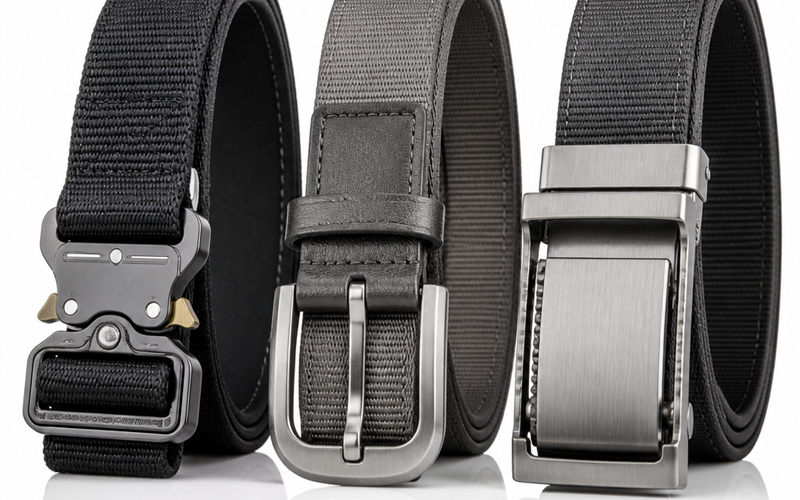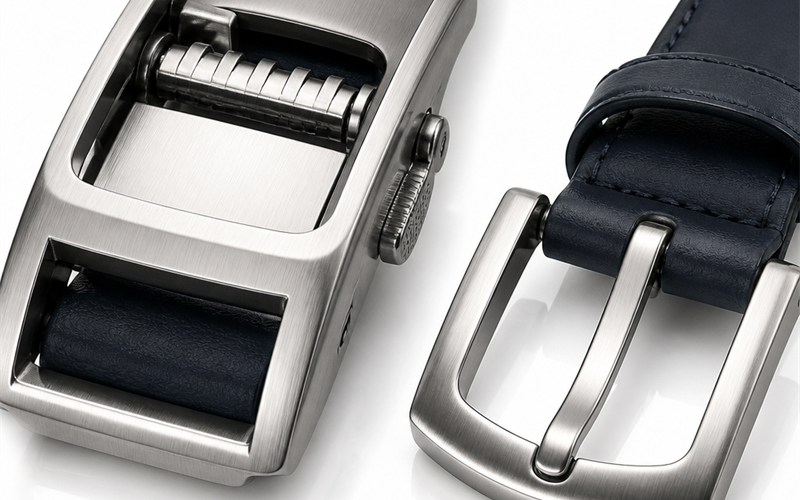
Why Some EDC Guys Hate Ratchet Buckles for Gun Belts
Quick answer: Some EDC carriers dislike ratchet buckles for gun belts because the track-and-pawl mechanism is a moving part that can wear, clog, or fail under the constant heavy load of a holster — unlike a simple prong that has nothing to break. They also worry about the buckle releasing under stress and about thinner ratchet straps sagging. Fans counter that quality ratchet belts are reliable and the micro-adjustment is worth it.
Last updated: June 2026 • By BELTLEY Editorial
TL;DR:
- The core gripe: a ratchet is a mechanism with moving parts that can wear or clog; a prong can't.
- Heavy daily holster load stresses the track more than ordinary belt use.
- Critics also cite thinner straps that sag and concern over release under stress.
- Defenders note quality ratchet belts hold up fine and the micro-fit aids all-day comfort.
Ratchet belts are one of the most divisive topics in everyday-carry circles. Walk into any r/CCW or r/EDC thread and you'll find carriers who swear by the micro-adjustment and others who won't trust one to hold a holster. The skeptics aren't being snobs — their concerns trace to a real engineering trade-off: a ratchet replaces the dead-simple prong-and-hole with a track-and-pawl mechanism, and any mechanism is one more thing that can fail under the relentless load of carrying a firearm. This guide lays out the actual objections fairly, where they hold up, and where a prong or Cobra makes more sense. It pairs with our full Cobra vs prong vs ratchet carry comparison.

Should YOU Trust a Ratchet for Carry?
The debate, resolved per carrier:
| Your situation | Go with |
|---|---|
| Maximum-simplicity philosophy | Prong — nothing moves, nothing wears, nothing jams. The skeptics' point stands. |
| Comfort-first daily carry | A quality ratchet serves fine — the failures critics cite cluster in cheap mechanisms. |
| Heavy rig, hard use | Prong or Cobra — track-and-pawl is the wrong tool at the load extremes. |
| Whichever side you land | Spend the argument-energy on strap stiffness — that's where gun belts actually live or die. |
Strap-first builds: BELTLEY's full-grain belts.
Why do some EDC carriers distrust ratchet buckles for gun belts?
Because a ratchet is a mechanism, and mechanisms can fail. The track-and-pawl system has moving parts that can wear down, clog with lint and debris, or break under the constant heavy load a holster places on a gun belt. A traditional prong buckle has essentially nothing to fail. For a belt that must perform reliably every day, simplicity is a feature.

This is the heart of the objection. A buckle in its simplest prong form is just a frame, bar, and pin — nearly nothing to break. A ratchet adds teeth, a pawl, and a release lever, each a potential failure point under stress. EDC carriers value gear that works without thinking, so they're wary of added complexity on a load-bearing belt. For the broader mechanism breakdown, see types of belt buckles.
Do ratchet belt mechanisms actually wear out under carry load?
They can, especially under heavy daily holster weight. The track and pawl take repeated stress every time you sit, move, or adjust, and over years that can wear the teeth or loosen the grip — the same way a slipping ratchet belt loses its hold. Quality ratchet buckles resist this far better than cheap ones, but the wear concern is legitimate for hard daily carry.

Key stat: A prong buckle has effectively zero moving parts, while a ratchet buckle relies on a track and spring-loaded pawl engaging hundreds of times a day — which is why EDC skeptics see the prong as the more failure-proof choice for a load-bearing gun belt.
The honest verdict: a well-made ratchet belt is reliable for everyday carry, but it is statistically more likely to develop an issue over a decade than a prong belt with nothing to wear. Carriers who prioritize absolute reliability over convenience choose the prong for that reason. Those who value the micro-fit accept the trade — and quality matters enormously, as covered in our ratchet buckle belts collection. EDC reviewers weigh both sides: Everyday Carry lists ratchet belts among its top carry picks, while gun-belt testers at Pew Pew Tactical stress that belt rigidity matters more than buckle type.
What other complaints do EDC users have about ratchet gun belts?
Three more: thinner or softer straps that sag under a holster, concern about the buckle releasing under stress, and harder cleaning when the track clogs with lint. A gun belt needs rigidity, and some ratchet belts prioritize a sleek look over the stiffness carry demands. If the strap sags, the micro-adjustment doesn't help.

Here's how the common EDC objections stack up:
| Objection | Valid? | Notes |
|---|---|---|
| Mechanism can wear/fail | ✅ Yes | More parts than a prong; quality reduces risk |
| Track clogs with lint | ⚠️ Sometimes | Cleanable, but a maintenance step |
| Thin strap sags under holster | ✅ Yes (some belts) | Stiffness matters more than buckle |
| Release under stress | ⚠️ Rare with quality | Quality buckles lock securely |
| Harder to dress up than prong | ✅ Yes | Prong leather conceals best |
The sag complaint circles back to the real issue: belt stiffness carries the holster, not the buckle. A flimsy ratchet belt sags; so would a flimsy prong belt. The fix is a rigid belt, ideally double-layer full-grain.
When is a prong or Cobra the better gun-belt choice?
Choose a prong when you want maximum simplicity, reliability, and dress versatility — a stiff full-grain prong belt carries a holster discreetly with nothing to fail. Choose a Cobra when you need maximum strength and fast release for hard use. Pick a ratchet only when its micro-adjustment comfort outweighs the added mechanism, and buy a quality one.

For most carriers who need to look professional while carrying, the prong on a stiff leather belt is the safest, most discreet pick. It hides in plain sight and has nothing to wear out. BELTLEY's double layer full-grain belts deliver the rigidity a gun belt needs with a simple, reliable prong buckle and a dress-casual look — the opposite of a tactical rig. For the strength comparison with Cobra, and where each buckle wins, see our dedicated carry guide, whether quick-release buckles are safe for everyday carry, and the box & prong buckle belts.
The Bottom Line
The EDC skepticism toward ratchet buckles on gun belts isn't snobbery — it's a rational preference for simplicity on a load-bearing belt. A ratchet's track-and-pawl mechanism adds moving parts that can wear, clog, or fail under the constant heavy stress of carrying a holster, while a prong buckle has essentially nothing to break. Add concerns about sag and dressing up, and many carriers land on a stiff full-grain prong belt as the most reliable, discreet choice. Ratchet defenders are right that a quality belt holds up and the micro-fit is comfortable — it's a genuine trade-off, not a clear loser. For carry that must look sharp and never fail, BELTLEY's double layer full-grain prong belts are built for the job.
Frequently Asked Questions
Q: Are ratchet belts reliable for everyday carry?
Quality ratchet belts are reliable for daily carry, but the track-and-pawl mechanism has more parts that can wear or clog than a simple prong buckle. For hard daily holster use, some carriers prefer a prong belt's simplicity; others happily accept the trade for the micro-adjustment.
Q: Do ratchet belt buckles break easily?
Cheap ones can — worn teeth or a failing pawl cause slipping or failure. Quality ratchet buckles are durable and hold securely. The concern for gun belts is that any mechanism is more failure-prone over years than a prong, which has nothing to break.
Q: Why do EDC carriers prefer prong belts for carry?
Simplicity and discretion. A prong buckle has no moving parts to wear out, and a stiff full-grain prong belt hides a holster in plain sight while looking like a normal dress or casual belt. For reliability-first carriers, fewer parts means fewer failure points.
Q: Does a ratchet belt sag under a holster?
It can if the strap itself is thin or soft — but that's a stiffness problem, not a buckle problem. The belt body carries the holster's weight, so a rigid belt (any buckle) resists sag while a flimsy one sags regardless. Choose a stiff, reinforced belt for carry.