Why Are Gucci Belts So Expensive? The Real Cost Breakdown
A Gucci belt will set you back anywhere from $400 to $1,200. For a strip of leather and a metal buckle, that's a serious chunk of change. So what exactly are you paying for?
The short answer: about 70% brand, 30% belt.
But the long answer is more interesting — and if you're about to drop half a grand on a designer belt, you deserve to know exactly where that money goes. Let's break it down.

The Actual Production Cost (Prepare to Be Surprised)
Here's the number nobody in luxury fashion wants you to see: it costs roughly $50–$80 to produce a Gucci belt. That includes the leather, the buckle, the stitching, the box, and the labor.
The average Gucci buckle? About $12 to manufacture. That same buckle retails attached to a $450+ belt.
We've written a detailed breakdown of how much it costs to make a Gucci belt, and the numbers are eye-opening. Gucci operates on an 8–10x markup from production cost to retail price. That means a belt that costs $60 to produce sells for $500–$600.
Is that unusual in luxury fashion? Not really. But it does raise a fair question: what are you actually paying for?

The 7 Reasons Gucci Belts Cost What They Do
1. A Century of Brand Heritage
Gucci was founded in Florence in 1921 by Guccio Gucci, a luggage maker who drew inspiration from the refined leather goods he saw while working at London's Savoy Hotel. That's over 100 years of history baked into every product.
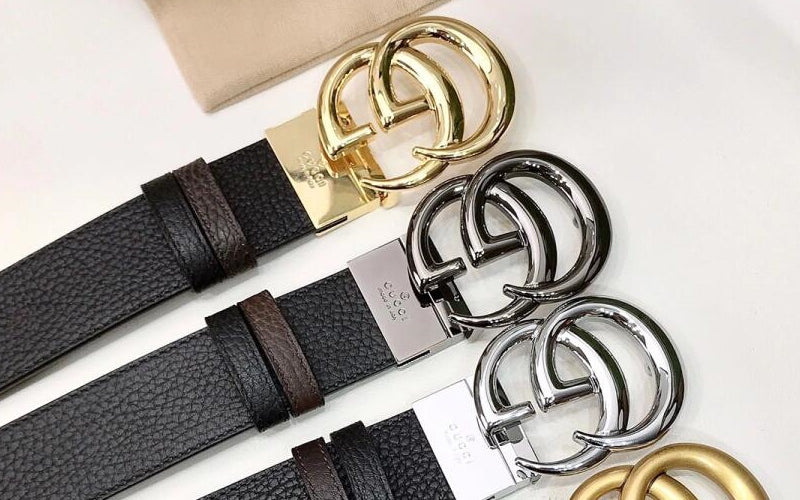
The interlocking GG logo — introduced in the 1960s as a tribute to the founder — has become one of the most recognizable symbols in fashion. When you buy a Gucci belt, you're buying a ticket into that legacy.
And that ticket isn't cheap.
2. Italian Craftsmanship (The Real Kind)
Credit where it's due: Gucci belts are genuinely well-made.
They're produced in workshops across Tuscany using full-grain calfskin leather. The process involves hand-skiving (shaving the leather down to a precise 3.8mm thickness), double stitching at 12 stitches per inch, and edge finishing that reportedly involves seven layers of paint, cured for 48 hours and polished to a glass-like sheen.
Each buckle is cast in molds — some of which have been in use since the 1970s — and hand-polished for up to three hours to eliminate micro-scratches.
That's genuinely impressive work. But here's the thing: the craftsmanship accounts for a fraction of the price. The labor and materials together are estimated at less than 15% of what you pay at the register.
3. The Marketing Machine
Gucci's parent company Kering reported that the brand spends approximately 12% of its revenue on marketing. For context, Gucci generates around $10–11 billion in annual revenue. That puts their marketing budget in the neighborhood of $1.2 billion per year.
Those celebrity endorsements, the runway shows in Milan, the Instagram campaigns, the flagship stores on Rodeo Drive — all of that is baked into the price of your belt.
When you see Harry Styles or Billie Eilish wearing Gucci, that's not a coincidence. That's a line item on a balance sheet. And ultimately, it's you — the customer — who funds it.
4. The Retail Markup Layer
Most Gucci belts aren't sold directly from the brand. A huge percentage moves through department stores and authorized retailers like Nordstrom, Neiman Marcus, and Saks Fifth Avenue.
Those retailers typically apply a 100–200% markup. So a belt that Gucci wholesales for $225 might hit the shelf at $450–$500.
Even when you buy from a Gucci boutique, you're still absorbing the cost of prime real-estate rent in cities like New York, Paris, and Tokyo. Those storefronts aren't cheap, and someone has to pay for them.
(Spoiler: it's you.)
5. Anti-Counterfeiting Costs
Gucci is one of the most counterfeited brands on earth. The company reportedly spends over $100 million annually fighting fakes — through legal teams, RFID microchips embedded in products, serial numbers laser-etched into buckles, and holographic logos visible under UV light.
That's a real cost, and it does protect your investment. But it also adds to the price tag.
6. Import Duties and Taxes
Italian-made leather goods shipped to the US face import duties of 4–8%, depending on the classification. Add sales tax, and the sticker shock compounds. A belt manufactured for $60 in Florence doesn't just magically appear on a shelf in Beverly Hills without a hefty logistics bill.
7. The Status Symbol Premium
Let's be honest about this one. A huge part of the Gucci belt's appeal isn't the leather or the stitching — it's what it signals.
That double-G buckle tells the world you can afford a $500 accessory. It's a visible marker of financial status. And in luxury fashion, exclusivity is the product. If everyone could afford it, nobody would want it.
This is what the industry calls the Veblen effect — a phenomenon where demand for a product increases as the price rises, because the high price itself is the draw.
You're not just paying more. You're paying more because it costs more. Think about that for a second.

Where Your $500 Actually Goes: A Price Breakdown
Let's put some rough numbers on a typical $500 Gucci belt:
| Cost Component | Estimated Amount | % of Retail Price |
|---|---|---|
| Raw materials (leather + buckle) | $30–$50 | 6–10% |
| Labor & craftsmanship | $15–$25 | 3–5% |
| Factory overhead | $10–$15 | 2–3% |
| Marketing & advertising | $55–$65 | 11–13% |
| Retail/distribution markup | $150–$200 | 30–40% |
| Brand premium (logo tax) | $150–$200 | 30–40% |
| Anti-counterfeit + logistics | $15–$25 | 3–5% |
The leather and buckle together? About $50 max. The brand name? $150–$200.
That's the math. Whether that math works for you depends entirely on what you value.

Are Gucci Belts Actually Good Quality?
Yes. Genuinely.
Gucci uses full-grain calfskin, solid brass buckles (plated with either 18k gold or palladium), and employs skilled Italian artisans. The construction quality is real.
But — and this matters — the quality is not $500 worth of quality. It's $80–$120 worth of quality with a $400 brand premium stacked on top.
You can get the same grade of full-grain leather, the same hand-finishing techniques, and equal (sometimes better) hardware for a fraction of the price. The difference is the logo on the buckle.
Want to understand what actually makes a belt worth its price? Our guide on how much a leather belt should cost breaks it down without the marketing spin.

Do Gucci Belts Hold Their Value?
Sort of. A 2023 study found that Gucci belts in mint condition retain about 85% of their resale value — which is strong compared to most fashion accessories.
But there's a catch. That resale value depends on:
- The specific model (iconic designs like the GG Marmont hold up better)
- Condition (scratches and patina work against you)
- Whether the style is still trendy (and trends shift fast)
The GG belt that every influencer wore in 2018? It's already looking dated. The oversaturation effect is real — when everyone has the same belt, it stops feeling exclusive. And when exclusivity fades, so does resale value.
We've covered this in depth: Do Gucci belts hold their value?
If you're buying a Gucci belt as an "investment piece," just know that leather belts are not stocks. They're accessories. Buy one because you love it, not because you expect a return.

The "Brand Tax" Problem in Luxury Fashion
Here's the concept that explains why Gucci belts (and most designer belts) cost what they do: the Brand Tax.
The Brand Tax is the premium you pay purely for a name. Not for better materials. Not for superior construction. Not for a longer lifespan. Just for the logo.
With Gucci, the Brand Tax accounts for roughly 30–40% of the retail price. That's $150–$200 on a $500 belt — going directly toward the privilege of wearing two interlocking G's on your waist.
This isn't unique to Gucci. We break down the same phenomenon across 12 reasons why designer belts are so expensive. The pattern is consistent across Hermès, Louis Vuitton, Ferragamo — they all charge a premium for the name.
The question isn't whether these belts are good. They are. The question is whether the name alone is worth 3–4x the price of an equally well-made belt without the famous logo.

What You Get When You Skip the Logo
Not everyone wants to pay for a celebrity endorsement deal and a flagship store on Fifth Avenue. Some people just want a really, really good belt.
Here's what a $100–$300 belt looks like when the Brand Tax is removed from the equation:
- Full-grain leather (the same grade Gucci uses — the top layer of the hide, unaltered and uncoated)
- 316L stainless steel buckles (the same alloy used in surgical instruments and dive watches — harder and more corrosion-resistant than brass)
- Jewelry-grade CZ stones with gold plating on statement buckles
- Hand-finished edges and hand-selected hides
- A 10-year warranty on materials and construction
That's not a hypothetical. That's what we build at BELTLEY. Every belt is handcrafted in small batches by artisans who specialize in exotic leather. We use full-grain leather, genuine crocodile, elephant, and python — materials that most luxury brands won't even touch because of the skill required to work with them.
And because we sell direct-to-consumer, there's no retail middleman doubling the price. No marketing budget burning through $1 billion a year. No Brand Tax.
The result? A belt that matches or exceeds Gucci's construction quality at a price that reflects the actual craftsmanship — not the logo.

So, Is a Gucci Belt Worth $500?
That depends on what you're buying it for.
If you're buying the logo — the status, the recognition, the double-G statement — then yes, Gucci delivers exactly what it promises. You're paying for membership in a club, and the belt is your entry pass.
If you're buying the belt — the leather, the buckle, the stitching, the thing that actually holds your pants up and completes an outfit — then no, you can do much better for much less.
A well-made full-grain leather belt from a DTC brand will outlast most designer belts, develop a richer patina, and cost you $60–$150. A handcrafted crocodile belt — made from the same exotic leather that Hermès uses for its Birkin bags — runs $150–$299 at BELTLEY. That same belt in a luxury boutique? $1,500+.
The difference isn't quality. It's overhead.
The Bottom Line
Gucci belts are expensive because Gucci is expensive. The brand has earned its place through a century of heritage, genuine Italian craftsmanship, and relentless marketing. The belts themselves are well-made — nobody's arguing that.
But the price? It reflects the brand, not the belt. You're paying $500 for $80 worth of materials and labor, plus $420 of brand name, marketing, and retail markup.
If you value the logo and what it represents, that's a perfectly valid choice. But if you value the craft — the leather, the hardware, the hand of an artisan — you can get more belt for less money by going direct.
Ready to see what handcrafted looks like without the Brand Tax? Browse our designer belt collection — and remember, every BELTLEY belt ships free worldwide and comes with a 30-day hassle-free return policy. Zero risk, zero middlemen.
[Image suggestion: Flat-lay of BELTLEY exotic leather belts arranged with leather swatches and buckles | editorial product shot]
Frequently Asked Questions
Q: How much does it actually cost to make a Gucci belt?
Estimated production cost is $50–$80, including materials, labor, and factory overhead. The leather runs $30–$50 and the buckle about $12 to manufacture. Gucci operates on an 8–10x markup from production to retail. Full cost breakdown here.
Q: Are Gucci belts real leather?
Yes. Gucci primarily uses full-grain calfskin leather sourced from Italian tanneries. Some styles use canvas with leather trim. The leather quality is genuine — it's the markup on top of that quality where questions arise.
Q: Do Gucci belts hold their value?
Iconic styles like the GG Marmont can retain up to 85% of their value in mint condition. However, trend-dependent designs depreciate faster. A belt is a fashion accessory, not a financial asset — buy it because you love it.
Q: How long does a Gucci belt last?
With proper care, a Gucci belt can last 5–10 years. The full-grain leather is durable and develops a patina over time. That said, a similarly constructed full-grain belt from a non-luxury brand will last just as long — the logo doesn't affect durability.
Q: What is the "Brand Tax" on a Gucci belt?
The Brand Tax is the premium you pay purely for the Gucci name — estimated at 30–40% of the retail price. On a $500 belt, that's $150–$200 going toward brand equity rather than materials or craftsmanship. Learn more about designer belt pricing.