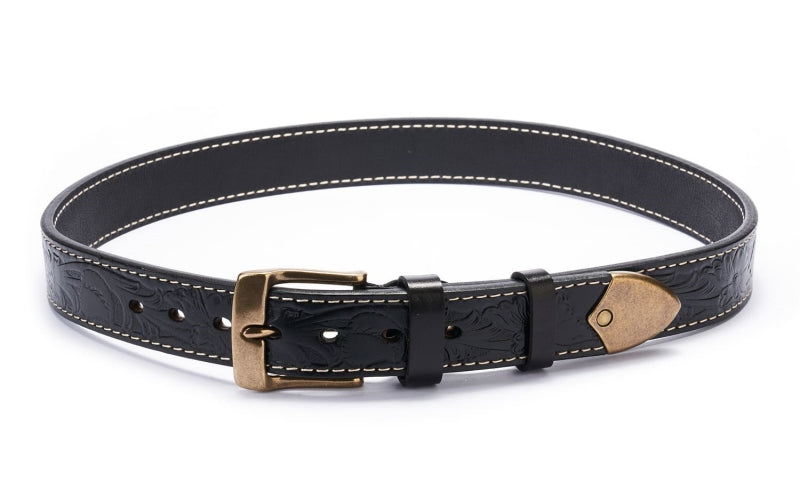
Thin vs. Thick Belts for Men: Which Width When?
TL;DR: (30 seconds Quick Answer)
- 30–35mm (1.18"–1.38") for suits and dress trousers — thinner is more formal
- 38–40mm (1.5"–1.57") for jeans and casual wear — the standard denim loop width
- Body type matters: shorter torsos and slimmer builds wear narrower; broader builds carry wider without losing proportion
- 2026 trend: 40mm+ is gaining ground in casual and smart-casual; 32mm holds steady for formal

Belt width affects how formal an outfit reads, how your torso looks proportionally, and whether the belt even fits through your trouser loops. Get it right and the belt disappears into the outfit doing its job. Get it wrong and it's the first thing anyone notices — for the wrong reason.
Here's the complete breakdown — with exact mm specs, body type guidance, and the two angles no other guide covers: how trouser rise changes perceived width, and how buckle face size needs to match the strap. Browse BELTLEY's belt collection by width to see how each measurement translates into a finished strap.

The Core Width Rules by Occasion
| Occasion | Width Range | Inches | Rule |
|---|---|---|---|
| Black tie / formal | 25–30mm | 1"–1.18" | Belt barely visible; understated hardware |
| Business / suits | 30–35mm | 1.18"–1.38" | Standard dress belt width |
| Smart casual / chinos | 35–38mm | 1.38"–1.5" | Versatile crossover width |
| Jeans / casual | 38–40mm | 1.5"–1.57" | Standard denim loop specification |
| Statement / workwear | 40–50mm+ | 1.57"–2"+ | Bold casual; chunky hardware |
The underlying logic: narrower communicates formality, wider communicates casualness. Dress trousers have narrow loops because the garment is formal; jeans have wide loops because the garment is casual. The belt width should match the formality signal of what it's threaded through.
According to the Art of Manliness guide to men's belts, the 1"–1.5" range covers the full working spectrum for most men — formal at the narrow end, casual at the wide end.

What Is the Right Belt Width for Suits and Dress Trousers?
32–35mm (1.25"–1.38") is the correct width for suits and dress trousers. This range fits the narrower belt loops on tailored trousers (typically 32–36mm internal) and maintains the slim, understated profile that formal dressing requires.
Going wider than 35mm on dress trousers fills the loops too tightly and shifts the visual register toward casual — the belt starts to look like it belongs on jeans, not a suit. A 32mm belt in smooth black or dark brown full-grain leather is the standard business dress choice. At 35mm, you have a more visible strap that still threads cleanly through most dress trouser loops.
BELTLEY's 1.25" (32mm) dress belt collection and 1.38" (35mm) options cover both ends of the formal-to-smart-casual spectrum.

What Is the Right Belt Width for Jeans?
38–40mm (1.5"–1.57") is the correct width for jeans. Standard denim loops are designed around this range — typically 38–44mm internal width. A 38mm belt fills these loops properly without overfilling or appearing to float.
Going narrower on denim — a 32mm dress belt through wide jeans loops — looks visually thin and unfinished. Going wider than 40mm starts to crowd the loops and adds bulk most casual outfits don't need.
Dalgado's comprehensive belt guide names 40mm the "defining spec" for full-grain leather jeans belts — matching the loop, filling the space, registering as a deliberate choice rather than an afterthought. BELTLEY's 1.5" (38mm) casual belt range is built around this standard.
How Body Type Changes the Equation
Width affects perceived torso proportions — which means the "correct" width shifts slightly based on your build.
Shorter / petite build: Stay at 32–38mm maximum. Wide belts create a strong horizontal dividing line across the midsection that visually shortens an already compact torso. A narrow-to-medium belt in a matching or tonal color reads as elongating.
Average height / medium build: Full working range applies. Standard width recommendations (32mm for formal, 38mm for casual) work proportionally.
Taller / longer torso: Standard widths can look proportionally thin. 38–45mm fills the visual space at the waistline without appearing oversized. A very slim belt on a tall frame with wide-leg trousers reads as underpowered.
Broader / athletic build: 38–45mm works well. Very slim belts can look disproportionately narrow against a wider frame. A 40mm belt in a substantial leather like full-grain cowhide or crocodile carries the right visual weight.
The Rise Factor — What No Other Guide Covers
Trouser rise changes how wide a belt appears, even at the same measurement. This is the detail most width guides skip entirely.
High-rise trousers (waist above navel): The belt sits higher on the torso where circumference is smaller. The same 38mm belt appears proportionally wider at high-rise than low-rise. Consider going one width narrower than you normally would — a 35mm belt on high-rise trousers reads as 38mm would on standard-rise.
Low-rise trousers (below natural waist): The belt sits at a wider circumference point. Standard or slightly wider belts read correctly. A narrow dress belt on low-rise jeans can look visually minimal to the point of disappearing.
Standard-rise trousers: No adjustment needed — standard width recommendations apply directly.

The Buckle-to-Width Ratio Rule
Belt width and buckle face width need to match — yet no competitor covers this. A buckle that's too narrow on a wide strap looks lost. A buckle that's too wide for the strap looks crowded.
The rule: Buckle face width should be within 5mm of the strap width, or slightly narrower.
- 32mm strap → 28–32mm buckle face
- 38mm strap → 34–40mm buckle face
- 45mm strap → 40–48mm buckle face
Plaque and rectangular buckles should align with the strap edges without significant overhang or gap. Box-frame buckles (where the strap inserts through the frame) naturally enforce this ratio by design — the frame opening matches the strap.
For the full breakdown of buckle styles and when to use each, see our guide on dress belt vs casual belt.
How Leather Type Affects Width Behavior
One detail competitors consistently miss: the same width in different leathers doesn't feel or look the same.
Full-grain cowhide at 38mm drapes with structure — it holds its shape through loops and lies flat against the trouser. The natural thickness and fiber density gives the strap presence.
Crocodile or alligator belly leather at 35mm appears slightly more substantial than the number suggests — the scale texture and natural luster add visual weight beyond the raw measurement. A 35mm crocodile belt reads as closer to 38mm in visual presence.
Thin chrome-tanned or corrected leather at 38mm may look wide but feel flimsy — the lack of fiber density means the strap can fold or pucker through loops, undermining the whole effect.
This is why material quality and width should be considered together. BELTLEY's handcrafted belts are built at consistent thickness (3.5–5mm strap depth) to ensure the listed width actually fills loops as intended — with 316L stainless steel hardware sized proportionally to each strap.

The Bottom Line
Thin vs. thick belts for men isn't a preference question — it's a specification question. The trouser determines the loop width; the loop width determines the belt; the belt determines which buckle. Start with what you're wearing the belt with, match the width to the loop, then calibrate for your body proportions and rise.
For suits and dress occasions: 32–35mm. For jeans and casual: 38–40mm. For the complete width reference, see our standard belt width in mm guide. Browse BELTLEY's men's belt collection filtered by width to find the exact specification you need — every belt lists strap width in both mm and inches.
Frequently Asked Questions
Q: Should men wear thin or thick belts?
It depends on the outfit. Thin belts (30–35mm) are correct for suits and dress trousers. Thick belts (38–40mm) are standard for jeans and casual wear. Wearing a thin dress belt with jeans looks underpowered; wearing a thick casual belt with a suit looks out of place. Match the belt width to the trouser loop width.
Q: Are thick belts in style for men in 2026?
Yes — the 40mm+ "Power Width" trend is gaining editorial attention for casual and smart-casual men's styling in 2026, driven by workwear and utility aesthetics. Formal widths (32–35mm) remain unchanged. For the full trend breakdown, see our post on whether thick belts are in style.
Q: What belt width is considered thin for men?
Any belt under 32mm (1.25 inches) reads as slim or thin in a men's styling context. The traditional dress belt range is 30–35mm — which appears narrow relative to casual widths. Anything under 25mm is genuinely slim and suited to very formal or minimalist contexts.
Q: What belt width works best for shorter men?
32–35mm is the most flattering belt width for shorter or more compact frames. Wider belts (40mm+) create a visible horizontal break across the midsection that reads as width rather than height. A narrower belt in a color close to the trouser creates a cleaner, elongated line.
Q: Does belt thickness (depth) matter as much as width?
Yes — strap depth (typically 3–5mm) determines whether the belt holds its shape through loops. A wide but thin-depth belt folds and puckers through wide loops, undermining the fit. Full-grain leather at 4–5mm depth holds structure at any listed width. Corrected or bonded leather at 2–3mm depth often fails to fill the loop cleanly regardless of listed width.

%0A%0A%0A30%E2%80%9335mm%20(1.18%22%E2%80%931.38%22)%C2%A0for%20suits%20and%20dress%20trousers%20%E2%80%94%20thinner%20is%20more%20formal%0A%0A38%E2%80%9340mm%20(1.5%22%E2%80%931.57%22)%C2%A0for%20jeans%20and%20casual%20wear%20%E2%80%94%20the%20standard%20denim%20loop%20width%0A%0ABody%20...)