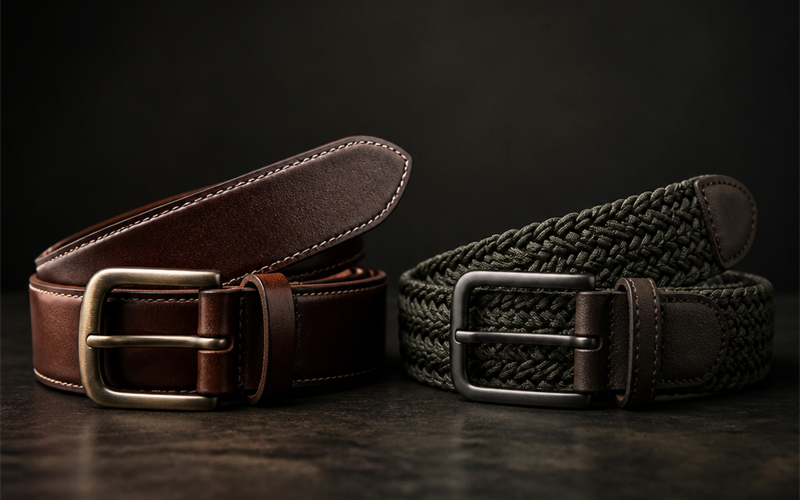
Leather Belt vs Webbing Belt for Everyday Wear
Quick answer: For everyday wear, leather wins on durability and lasts longer — a quality full-grain belt runs 5–10+ years versus 1–5 years for fabric webbing, and outlasts canvas roughly 1.5–2×. Webbing wins on immediate comfort, breathability, low maintenance, and weather resistance. Leather is the long-term investment; webbing is the easygoing daily-driver.
Last updated: May 2026 • By BELTLEY Editorial
TL;DR:
- Leather is more durable and longer-lasting — full-grain runs 5–10+ years and handles heavy loads better.
- Webbing (nylon, polyester, cotton) is lighter, breathable, comfortable from day one, and easy to wash.
- Lifespan gap: quality leather outlasts premium canvas by about 1.5–2× in identical daily use.
- Webbing shrugs off rain, sweat, and mold; leather needs occasional conditioning to avoid cracking.
The "leather belt vs webbing belt" question is really about what you want from a belt you'll wear every single day: longevity and structure, or comfort and convenience. Webbing — woven nylon, polyester, or cotton — is engineered for strength-to-weight, with breaking strengths that can exceed 10,000 pounds-force. Full-grain leather is engineered for a tight fiber structure that resists stretch and lasts for years. Both make legitimate everyday belts, but they age and feel completely differently. Below we compare durability, lifespan, comfort, weather, and maintenance, then tell you which suits your daily routine. Browse our full-grain leather belts and casual belts for reference while you read.
Daily Driver: Leather or Webbing?
The everyday call by what your days look like:
| Your situation | Go with |
|---|---|
| Work involves collared shirts | Leather — webbing reads weekend in every office. |
| Outdoor, active, low-maintenance life | Webbing — comfort and weatherproofing with zero care routine. |
| Cost-per-year shopper | Leather — 5–10+ years vs 1–5 makes full-grain the cheaper daily despite the sticker. |
| Honest two-belt rotation | Full-grain weekdays, webbing weekends — each does its actual job. |
The weekday half: BELTLEY's full-grain belts.
Which Is More Durable, Leather or Webbing?
Leather is more durable for long-term daily wear. A quality full-grain belt resists stretching and abrasion thanks to its tight fiber structure, outlasting fabric belts that eventually fray, stretch, and fade. Webbing is impressively strong in raw tensile terms, but it wears at the surface faster than leather under daily use.

The nuance is type of durability. Webbing material itself is extremely strong — Wikipedia notes woven webbing reaches breaking strengths over 10,000 pounds-force — but everyday belt failure isn't usually a snap; it's edge fraying, stretched weave, and faded color. That's where leather pulls ahead. Real Men Real Style notes in its guide to belts that leather is the structured, durable choice while webbing and canvas are relaxed alternatives, and even stretch-belt maker Arcade Belts concedes in its durability study that well-made leather "resists stretching under load and can last decades."
How Long Does Each Belt Last in Daily Use?
A quality full-grain leather belt lasts 5–10+ years with basic care. Premium canvas runs about 3–4 years; everyday nylon webbing about 3–5 years of heavy use; and cheaper canvas often shows fraying and stretch within 1–2 years. In identical daily routines, leather outlasts canvas by roughly 1.5–2×.

This lifespan gap is the core of the everyday-wear argument. A leather specialist comparison from Hoplok notes a good full-grain belt can last for over a decade with proper care, while fabric belts hold their appearance for only a few years before color fades and the weave stretches. So while a webbing belt costs less upfront, you may buy two or three of them over the life of one leather belt.
Key stat: In identical daily routines of commuting and manual work, full-grain leather belts outlast canvas by about 1.5–2× — roughly 5–7 years for quality leather versus 3–4 years for premium canvas.
| Factor | Leather belt | Webbing / fabric belt |
|---|---|---|
| Lifespan (daily use) | 5–10+ years | 1–5 years |
| Failure mode | Slow patina, rare cracking | Fraying, stretch, fading |
| Heavy-load support | High (tools, EDC) | Moderate |
| Out-of-box comfort | Stiff, needs break-in | Soft, immediate |
| Breathability | Low | High |
| Weather/sweat | Needs care | Resists; dries fast |
| Maintenance | Occasional conditioning | Machine/hand washable |
| Formality | Dress to casual | Casual only |
Is a Webbing Belt More Comfortable for Everyday Wear?
Yes, at first. Webbing is lightweight, breathable, and flexible straight out of the package, with no break-in period — which makes it genuinely comfortable for long, active, or hot days. Leather starts stiff but molds to your body over months, eventually offering a custom, conforming fit that fabric can't replicate.
So the comfort answer depends on your timeline. For immediate, all-day ease — especially in summer heat or during active wear — webbing is hard to beat. Its breathability also matters if you sweat; the weave lets air through where leather traps heat against the body. But the trade-off is that webbing stays the same until it loosens, whereas leather quietly improves. If you want leather's looks with a touch more adjustability, a woven leather option from our handwoven belts bridges the gap, combining a leather build with a more flexible feel.
Where Does Each Belt Win for Daily Wear?
Leather wins for professional, smart-casual, and heavy-duty daily wear — anywhere you want structure, polish, or load-bearing support like a tool or EDC belt. Webbing wins for casual, athletic, hot-weather, and low-maintenance daily wear, where comfort, breathability, and easy cleaning matter most.

Most people end up wanting both for different days. Leather is the belt you reach for with chinos and a button-down or anything with a dress code; webbing is the grab-and-go for weekends, the gym, travel, or yard work. If you're choosing webbing, understanding the fabric matters — our breakdown of a nylon belt vs a canvas belt explains which fabric suits which job. For the leather side of an everyday rotation, our men's belts range covers the staples.
What About Maintenance and Weather?
Webbing is far lower maintenance — most fabric belts are machine or hand washable, dry quickly, and resist mold and sweat damage. Leather needs occasional conditioning (roughly quarterly) to replenish moisture and prevent micro-cracks, and it's vulnerable to rain and salt if neglected.

This is a real everyday consideration, not a footnote. If your daily life involves sweat, rain, or rough conditions, webbing's wash-and-go nature is a genuine advantage — it dries fast and resists the mold that can attack untreated leather. Leather rewards a little care with decades of life, but it does require that care. Our guide to the truth about leather belt durability covers exactly what conditioning does and why neglected leather fails early, while how long a leather belt should last sets realistic expectations.
Which Should You Choose for Everyday Wear?
Choose leather if you want one durable belt that works across professional and casual outfits and lasts years; choose webbing if you prioritize daily comfort, breathability, easy cleaning, and a lower price. For most wardrobes, a quality leather belt is the better single investment, with a webbing belt added for active and hot-weather days.

Think of it as a core-plus-specialist setup. A full-grain leather belt is the everyday core — versatile, durable, and dressy enough for almost anything. A webbing belt is the comfort specialist for the days leather isn't ideal. Buying one good leather belt plus an inexpensive webbing belt typically costs less over a decade than replacing fabric belts repeatedly, while covering far more situations.
The Bottom Line
In the leather belt vs webbing belt comparison for everyday wear, leather is the durable, versatile long-term choice, and webbing is the comfortable, low-maintenance daily-driver. Leather lasts 5–10+ years, supports more, and dresses up; webbing is breathable, washable, weatherproof, and easy on day one. At BELTLEY, we build full-grain belts because that tight-fibered, decade-long durability is exactly what a fabric belt can't match over time — but we'd never argue against keeping a webbing belt for the gym and the beach. For the everyday belt that does the most and lasts the longest, start with our full-grain leather belts collection.
Frequently Asked Questions
Q: Which lasts longer, a leather belt or a webbing belt?
Leather, clearly. A quality full-grain leather belt lasts 5–10+ years, while fabric webbing belts run 1–5 years before fraying, stretching, or fading. In identical daily use, leather outlasts canvas by roughly 1.5–2×.
Q: Is a fabric webbing belt more comfortable than leather?
Out of the box, yes — webbing is lightweight, breathable, and flexible with no break-in, which makes it comfortable for hot or active days. Leather starts stiff but molds to your body over months for a custom fit that fabric can't replicate.
Q: Is a webbing belt good for everyday wear?
Yes, for casual, athletic, and hot-weather daily wear. Webbing is breathable, washable, weather-resistant, and inexpensive. It's not suitable for formal or professional settings, where leather's structure and polish are required.
Q: Do leather belts need more maintenance than fabric belts?
Yes. Leather benefits from occasional conditioning (about quarterly) to prevent cracking and is vulnerable to rain and salt if neglected. Most fabric webbing belts are machine or hand washable, dry quickly, and resist mold, making them much lower maintenance.
Q: Should I buy a leather or webbing belt first?
For most people, buy a quality leather belt first — it's more versatile, works across professional and casual outfits, and lasts years. Add a webbing belt afterward for active, hot-weather, and low-maintenance days when comfort outranks polish.