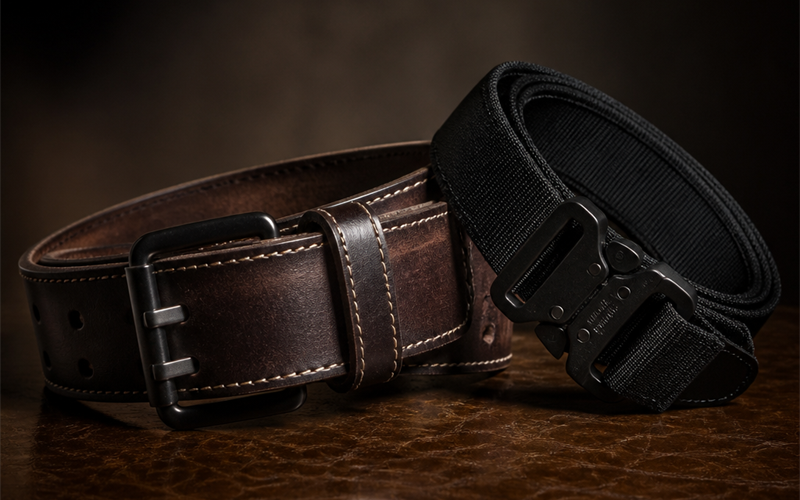
Leather Belt vs Cordura Nylon Tactical Belt: EDC Test
Quick answer: Both can carry a serious load without sagging — the difference is everything around it. A quality leather gun belt (thick full-grain, often with a stiffening core) carries discreetly and dresses up; a Cordura nylon tactical belt is lighter, lower-maintenance, dries fast in heat, and accepts attachments, but reads casual and can't be repaired once damaged. Choose leather for discreet everyday carry, nylon for duty and humid climates.
Last updated: May 2026 • By BELTLEY Editorial
TL;DR:
- The leather belt vs tactical belt choice for EDC is about context — discreet/dressy vs rugged/duty.
- Both can be made rigid enough to support a holstered handgun and spare magazine without sagging.
- Cordura/ballistic nylon (800–1000D) is light, low-maintenance, and dries fast; once damaged it's done and not repairable.
- A load-bearing leather belt follows the BELTLEY 3-Material Rule: full-grain leather + solid metal buckle + sealed edges, often doubled or cored for stiffness.
For everyday carry, a belt isn't an accessory — it's the platform that holds your holster in place. A regular department-store belt sags under a loaded holster, which is why both leather gun belts and Cordura nylon tactical belts exist: each is engineered for rigidity and load support, just from opposite materials. Leather brings stiffness through thick full-grain (often 9 oz or doubled, sometimes with a steel or polymer core) and a polished look; Cordura nylon brings high-denier weave strength, light weight, and weather resistance. This is a genuine performance test, not a style debate. Below we compare rigidity, durability, climate behavior, repairability, and concealment. For a related fabric breakdown, our nylon belt vs canvas belt guide is a useful companion.
EDC Material Call: Leather or Cordura
The honest split by carry life:
| Your situation | Go with |
|---|---|
| Office concealment, dress codes | Thick full-grain — carries the load while passing as a dress belt. |
| Hot climate, sweat-heavy days | Cordura — dries fast, shrugs off what slowly hardens leather. |
| Range and attachments | Cordura with MOLLE-friendly hardware — modularity is its home turf. |
| One belt, decades horizon | Leather — repairable and re-conditionable; damaged Cordura is done. |
The discreet-carry build: BELTLEY's full-grain belts.
Which Is Better for Carrying a Load, Leather or Cordura?
Both work — when built for it. A purpose-made leather gun belt uses thick full-grain, often doubled or with a stiffening core, to hold a holster steady; a tactical belt uses high-density nylon webbing (typically 800–1000D ballistic nylon or Cordura) for the same job. A regular belt of either material will sag. The deciding factors are construction and your carry style.

The key is that neither material carries well in its everyday form. As gun-belt reviewers at Pew Pew Tactical stress, a carry belt must be sturdy enough to hold a loaded handgun plus a spare magazine without sagging, which is why both leather and nylon options add reinforcement — leather through thickness or a core, nylon through dense webbing and stiffeners. Get a belt actually designed for carry, in either material, and load support is a solved problem.
Which Belt Is More Rigid — and Which Stays Comfortable?
Cordura tactical belts and reinforced leather belts can both be extremely rigid; the trade-off is comfort and break-in. A steel-cored or doubled leather belt is very stiff and takes time to break in, while a stiffened nylon tactical belt is rigid from day one but can feel bulky and less comfortable for all-day, all-purpose wear.

Rigidity is a spectrum, and more isn't always better for EDC. Belt maker Obscure Belts notes that hybrid reinforced gun belts use flexible steel between leather layers, making them very rigid but difficult to break in, while full tactical belts "sacrifice comfort for functionality" and can be "heavy and uncomfortable to wear for long periods." For discreet daily carry under normal clothes, a thick full-grain or double-layer leather belt often hits the sweet spot of rigid-enough plus comfortable. For duty use where you're hanging gear off the belt, a stiff tactical belt earns its bulk.
Which Lasts Longer, and How Do They Fail?
Leather is the more repairable and longer-serving option when maintained; Cordura nylon is lower-maintenance but effectively disposable once damaged. A full-grain leather belt can be conditioned and last many years, and worn holes can be re-punched. A nylon tactical belt resists wear well, but once the webbing frays or the stitching goes, it's reached end of life and can't be safely repaired.
This is the core durability difference. Cordura is genuinely tough — Wikipedia notes the nylon-based fabric was marketed as as strong as mild steel yet able to stand up under repeated flexing and is used in military gear and abrasion-prone applications. But "tough until it fails, then replace it" is a different model from leather's "maintain it and it lasts." Leather rewards care with longevity; nylon rewards neglect with low fuss but no second life. Our deeper look at the truth about leather belt durability explains what keeps a leather carry belt going for years.
Key stat: Tactical belts typically use 800–1000D ballistic nylon or Cordura, while a quality leather gun belt runs around 9 oz (≈3.6 mm) full-grain — often doubled or steel-cored — to resist the sag a loaded holster causes.
| Factor | Leather gun belt | Cordura nylon tactical belt |
|---|---|---|
| Rigidity / load support | High (thick/cored full-grain) | High (dense webbing/stiffener) |
| Weight | Heavier | Lighter |
| Break-in | Needed (esp. cored) | Rigid from day one |
| Maintenance | Condition periodically | Minimal |
| Hot / humid climates | Can mildew if neglected | Dries fast, resists better |
| Repairability | Re-punch holes; long life | Replace once damaged |
| Attachments (MOLLE/D-ring) | No | Yes |
| Dress / concealment | Dresses up; discreet | Casual; duty look |
What About Climate, Sweat, and Maintenance?
Cordura nylon wins in heat and humidity. It's breathable, dries quickly after sweat or rain, and resists mildew better than untreated leather, with almost no upkeep. Leather can mildew, stiffen, or crack in hot, humid, sweaty conditions if it isn't conditioned and dried properly — it needs care that nylon simply doesn't.

This is a real consideration for anyone carrying in a hot climate or sweating through long days. A nylon tactical belt you can rinse and air-dry is genuinely easier to live with in those conditions. Leather isn't disqualified — coated and well-finished full-grain handles moisture far better than cheap leather — but it asks for maintenance. If your environment is consistently hot and humid, factor that upkeep into the decision. For climates that punish leather, our broader guidance on belt care still applies: dry it, condition it, and don't store it damp.
Which Looks Better for Everyday Concealed Carry?
Leather, easily. A quality leather gun belt looks like a normal dress or casual belt, so it conceals the fact that you're carrying and pairs with slacks, a jacket, or business attire. A Cordura tactical belt reads unmistakably casual or duty-oriented and won't pass in a professional or dressed-up setting.

For discreet everyday carry, appearance is part of the function — the belt shouldn't announce itself. Leather blends into a normal wardrobe; nylon doesn't. This is where a load-bearing leather belt built to the BELTLEY 3-Material Rule shines: full-grain leather, a solid metal buckle, and sealed edges, often doubled for stiffness, gives you a belt that supports a holster and looks like it belongs with a sport coat. A nylon belt looks great with jeans or shorts but can't make that jump. For the dress-capable end of carry-ready belts, our full-grain leather belts and men's belts ranges are the place to start.
Which Should You Choose for EDC?
Choose a reinforced leather belt for discreet, everyday concealed carry and any time you need to dress up; choose a Cordura nylon tactical belt for duty use, the range, hard-use days, attachment-heavy setups, and hot, humid climates. Many serious carriers own one of each for different contexts.

The clean rule: leather for blend-in daily carry and dress, nylon for hard-use and heat. If most of your carrying happens under normal clothes in everyday life, a stiff full-grain or double-layer leather belt is the better all-rounder. If you carry on duty, run a holster plus pouches, or live somewhere hot and sweaty, a tactical nylon belt is the practical tool. As with most belt questions, the answer for an active carrier is often both — matched to the situation rather than forced into one.
The Bottom Line
In the leather belt vs Cordura nylon tactical belt EDC test, both carry a load well when properly built — the real differences are looks, maintenance, climate behavior, and repairability. Leather conceals, dresses up, and lasts for years with care; Cordura is lighter, lower-maintenance, weather-tough, and attachment-ready, but casual and disposable once damaged. At BELTLEY, we build full-grain and double-layer leather belts to the 3-Material Rule because a properly stiffened leather belt gives you a carry platform that also looks like a normal belt — something nylon can't do. For discreet, durable, carry-ready leather, start with our full-grain leather belts or a rigid double-layer belt.
Frequently Asked Questions
Q: Is a leather or nylon tactical belt better for concealed carry?
For discreet everyday carry, leather is usually better — a quality gun belt looks like a normal belt and dresses up, while staying stiff enough to hold a holster. Nylon tactical belts are better for duty use, hard wear, attachments, and hot, humid climates, but read casual.
Q: Are Cordura nylon tactical belts more durable than leather?
They're extremely tough and low-maintenance, but they fail differently. Once a nylon belt frays or its stitching goes, it's at end of life and can't be safely repaired. A maintained full-grain leather belt lasts for years and worn holes can be re-punched, making leather more repairable long-term.
Q: Which belt is stiffer for holding a holster?
Both can be very stiff. Reinforced leather gun belts use thick or doubled full-grain, sometimes with a steel or polymer core, while tactical belts use dense 800–1000D nylon webbing with stiffeners. A regular belt of either material will sag — you need one built specifically for carry.
Q: Is a nylon tactical belt better in hot, humid weather?
Generally yes. Nylon is breathable, dries quickly after sweat or rain, and resists mildew with minimal upkeep. Leather can mildew or stiffen in hot, humid conditions if neglected, so it needs conditioning and proper drying — though well-finished full-grain handles moisture much better than cheap leather.
Q: Can a leather gun belt look formal enough for work?
Yes — that's a key advantage. A quality full-grain leather gun belt looks like a normal dress or casual belt, so it conceals carry and pairs with slacks or a jacket. A Cordura tactical belt reads casual or duty-oriented and won't suit professional or dressed-up settings.


%20carries%20discreetly...)