Is It Okay to Wear Black Shoes with a Brown Belt?
TL;DR: Quick Answer and main takeaways
- In formal and business professional settings: no. Black shoes require a black belt — this is one rule that still holds.
- In casual and smart-casual settings: it can work, but it's never the stronger choice. A matched belt always looks more intentional.
- The fix is simple: own a black belt. It solves this problem permanently and costs less than the shoes causing the issue.
Most style questions have genuinely flexible answers in 2026. This one mostly doesn't. Black shoes with a brown belt is a mismatch — not because of an arbitrary rule handed down from some menswear committee, but because of how the eye reads the two anchor points of an outfit. In formal contexts it looks like an oversight. In casual contexts it looks like you grabbed the wrong belt on the way out the door.
That said, there are specific situations where the combination is tolerable, and a few where it's genuinely fine. The honest answer requires separating those situations rather than giving a blanket yes or no. This post does exactly that.

Is It Okay to Wear Black Shoes with a Brown Belt?
No — not in formal, business, or any context where the outfit is expected to look considered. In casual wear it's more forgivable, but still not the stronger choice. The belt should always match the shoe leather in color family. Black shoes call for a black belt; brown shoes call for a brown belt. When the belt and shoes are in different leather families, they create visual dissonance at the two anchor points of the outfit — the waist and the hem — and the disconnect is visible even to people who can't articulate why.
Black Lapel's guide to matching belt and shoes is direct on this: the belt-shoe coordination rule isn't about being conservative, it's about visual coherence. When those two elements match, the eye reads the outfit as a deliberate system. When they don't, the outfit reads as assembled rather than composed.

Why the Belt-Shoe Rule Exists in the First Place
The rule isn't arbitrary. It's based on how visual composition works in an outfit.
In any dressed look, the belt sits at the waist and the shoes sit at the hem. Those are the two points that frame the lower body — and the eye moves naturally between them. When the belt and shoes are in the same leather family (both black, both brown, both espresso), the lower half of the outfit reads as unified. The eye moves smoothly from waist to foot without stopping.
When the belt and shoes are different — brown belt, black shoes — the eye stops at each point, registers the difference, and the outfit reads as incomplete. It doesn't look rebellious or creative. It looks like two separate decisions that didn't know about each other.
Effortless Gent's visual guide to matching belt and shoes shows this clearly with outfit photos: matched belt-shoe combinations look finished; mismatched ones look like something's missing even when every other element is correct. The pants, shirt, and jacket can all be excellent — the wrong belt still undermines the whole thing.
This is also why the fix is so simple. A quality black leather belt costs significantly less than a pair of black dress shoes. If you own black shoes and a brown belt, the solution isn't nuanced styling advice — it's buying a black belt. Our post on brown belt vs. black belt covers when each leather color is the right call and why having both handles nearly every outfit situation.

When Does Black Shoes with a Brown Belt Actually Work?
Casual settings where the outfit deliberately plays with contrast and the mismatch reads as intentional. Think: workwear or heritage-style outfits where mixed leather tones are part of the aesthetic, textural outfits where the belt is largely hidden under a jacket or untucked shirt, or genuinely relaxed contexts — weekend errands, casual dining — where nobody is scrutinizing the leather coordination.
The conditions that make it more tolerable in these contexts:
The outfit is clearly casual. A relaxed outfit with an untucked shirt, chinos, and a jacket partially obscuring the belt reduces the visual importance of the belt-shoe relationship. The mismatch is still there — it's just less visible and less consequential in a low-formality setting.
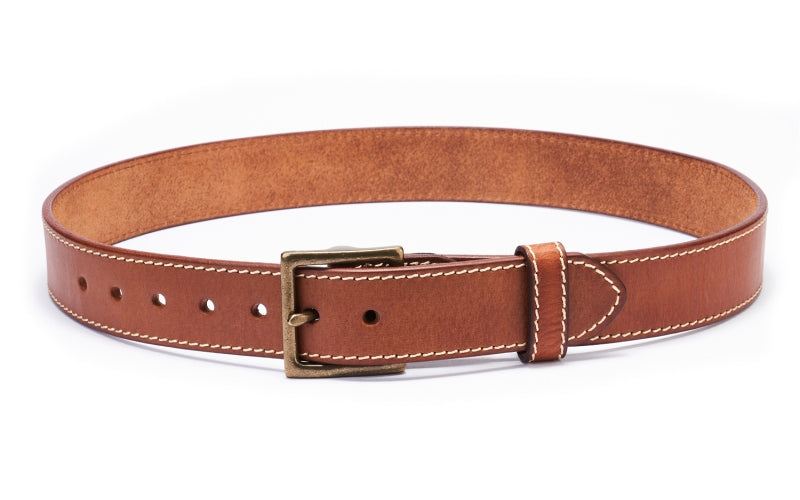
The brown is a warm, rich tone. Warm brown (cognac, chestnut, tan) against warm-toned black shoes works better than cool brown against cool black. As Leather Italiano's breakdown of the black-and-brown combination notes, undertone clashes compound the problem: a warm brown leather next to cool-finish black shoes creates a double visual conflict. If the undertones are at least compatible, the mismatch is less jarring.
The belt isn't visible as the focal point. A slim belt mostly hidden under a blazer is a different situation from a 1.5" statement belt sitting fully exposed on jeans. The more visible the belt, the more the shoe coordination matters.
Even in these cases, a matched belt is still the stronger choice. "Tolerable" isn't the same as "correct."

What to Do If You're Already Wearing This Combination
Sometimes you're already dressed and the mismatch is what it is. Practical options:
Change the shoes. If you have brown shoes available and the outfit can absorb the switch, swap the footwear to match the belt. Brown shoes are generally more flexible than black in casual contexts anyway — most outfits that work with black shoes also work with dark brown.
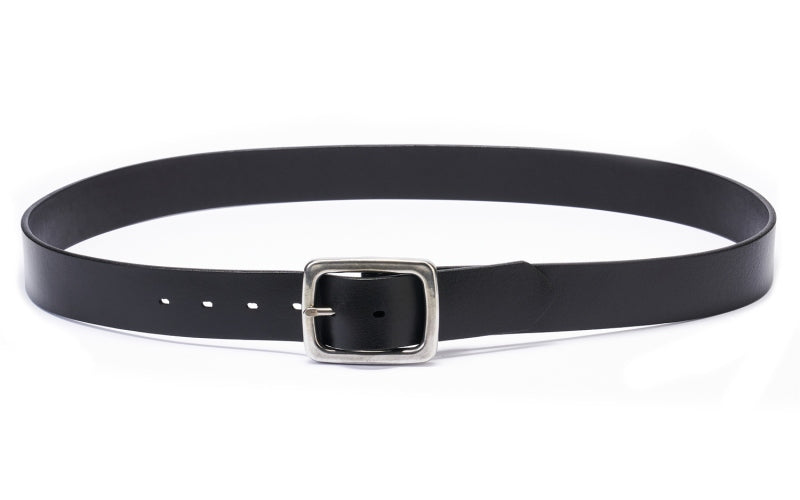
Change the belt. If the shoes are locked in (you're already at work, or the dress shoes are the right call for the event), swap the belt. A black dress belt resolves the mismatch immediately and works with every black shoe situation you'll ever face.
Let the jacket do the work. If neither change is possible, keep the jacket or blazer on and wear it closed or at least covering the belt as much as possible. The mismatch is less visible and less disruptive when it's not the first thing the eye lands on.
The long-term answer — which prevents this situation entirely — is making sure your wardrobe has a black belt and a brown belt. Two belts solves it permanently. Our men's belt collection has both in full-grain leather starting at under $100 each, and the brown leather belt collection covers every shade from light tan to deep espresso. Once you have both, this particular problem disappears from your life.

Is Matching Belt and Shoes Still a Rule in 2026?
Yes — in formal and business contexts, it's still the standard. In casual wear, the rule has relaxed, but matched leather always looks more intentional than mismatched. The broader shift in menswear toward less rigid rules applies mainly to formality levels, color blocking, and texture mixing — not to the fundamental visual principle of coordinating the two leather anchor points in an outfit.
Bespoke Post's guide to the new rules of belt-shoe matching puts the modern consensus accurately: the rule has softened from "must match exactly in color and finish" to "must match in leather family." Brown belt with tan shoes is fine. Black belt with dark charcoal shoes is fine. Brown belt with black shoes — still the exception that rarely looks better than the alternative.
What has genuinely changed is the expectation of exact-match uniformity. A belt and shoe in the same leather family but slightly different shades — dark cognac belt with medium-brown leather loafers — reads as intentional and sophisticated. The goal is coordination, not cloning.
For the adjacent question — whether belt and shoes need to match exactly — our post on should belt and shoes match exactly covers that nuance in full. And if you want the complete color framework across every outfit situation, our guide on what color belt goes with everything maps it out clearly.

The Bottom Line
Black shoes with a brown belt: not okay in formal or professional settings, tolerable in casual contexts under specific conditions, but never the strongest choice in any context. The rule isn't outdated — it reflects how the eye reads visual coherence in an outfit. The belt and shoes anchor either end of the lower body; when they match, the outfit reads as deliberate; when they don't, something always feels off even if the viewer can't name it.
The fix is genuinely simple. A black belt costs less than the anxiety of second-guessing this combination every time you get dressed. At BELTLEY, we've been making full-grain leather belts since 1999 — built to last, finished with stainless steel buckles, and backed by a 10-year warranty that makes the investment obvious. Our black leather belt collection has slim dress options and wider casual options in every waist size. Buy it once, stop thinking about this question.
Frequently Asked Questions
Q: Is it okay to wear black shoes with a brown belt?
No — not in formal or business settings. Black shoes require a black belt to maintain the visual coherence of the outfit. In casual settings, the mismatch is more forgivable but still not the stronger choice. The simplest fix is owning both a black belt and a brown belt so the shoe color always has a matching option.
Q: Why can't you wear a brown belt with black shoes?
The belt and shoes are the two leather anchor points of an outfit — one at the waist, one at the hem. When they're in different color families, the eye registers the disconnect and the outfit reads as unfinished. The rule exists because of how visual composition works, not as an arbitrary convention.
Q: Does the belt always have to match the shoes?
The belt should always be in the same leather family as the shoes — black with black, brown with brown. They don't need to be identical in shade or finish, but they shouldn't be from different color families. A dark cognac belt with medium-brown shoes works. A brown belt with black shoes doesn't.
Q: Can you wear a brown belt with black pants and black shoes?
No — if the shoes are black, the belt should be black regardless of the pants color. The pants are a neutral; the shoe color is what determines the belt. Black pants don't change the belt-shoe rule.
Q: What if I only own a brown belt and black shoes?
Short-term: keep the jacket on to minimize the belt's visibility, or swap the shoes for brown if the outfit allows. Long-term: add a black belt to your wardrobe. It's a one-time fix that eliminates the mismatch problem permanently for every black-shoe outfit.