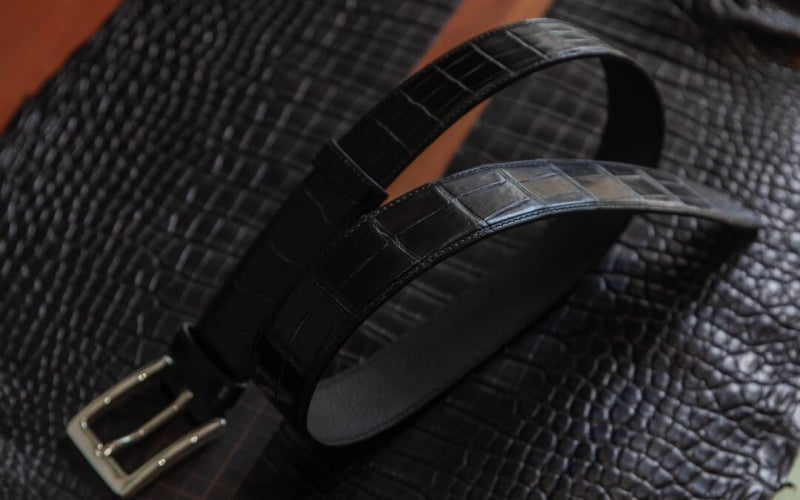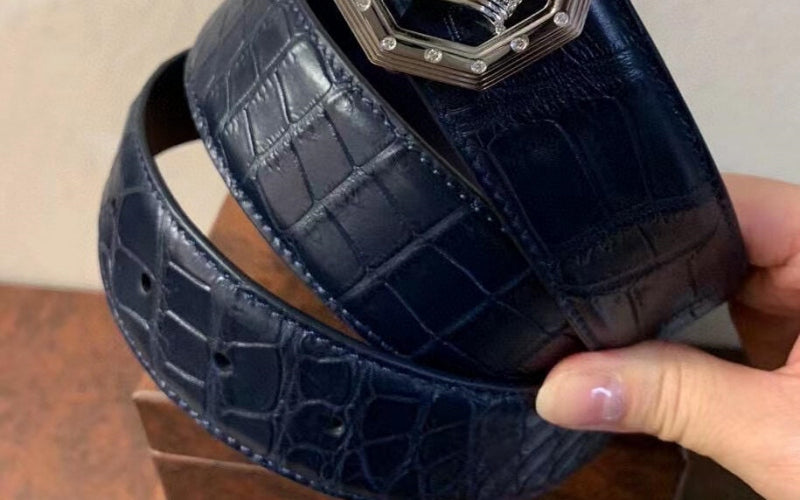
Is Crocodile Leather Better Than Alligator Leather?
TL;DR: Quick Answer
- Neither is objectively better — they excel at different things. Crocodile is slightly more durable and scratch-resistant; alligator is softer, more uniform, and absorbs dye more evenly
- The real difference is aesthetic preference, not performance — both last 20+ years and are roughly 3x stronger than cowhide
- Watch out for caiman — a much cheaper, lower-quality leather frequently mislabeled as "crocodile" at bargain prices
You're shopping for an exotic leather belt and the listing says "crocodile." The next one says "alligator." A third says "croc" with no further detail. Are these the same thing? Is one worth more? Will one last longer on your waist? The confusion is universal — and it's costing buyers money when they can't tell the difference. Here's a side-by-side breakdown that actually helps you choose.

What Is the Difference Between Crocodile and Alligator Leather?
Crocodile and alligator leather come from different species with distinct scale patterns, textures, and visual markers. Crocodile scales are more irregular with visible sensory pores on each scale; alligator scales are more uniform and symmetrical with no pores but a distinctive umbilical scar on the belly.
Here's the full comparison:
| Feature | Alligator | Crocodile |
|---|---|---|
| Scale pattern | Uniform, symmetrical, square "tile" pattern | Irregular, varied, V-shaped ridges |
| Sensory pores (ISOs) | Absent | Present — tiny dot/dimple visible on each scale |
| Umbilical scar | Present — star-shaped cluster of tiny scales on belly | Absent |
| Texture | Softer, smoother, more pliable | Tougher, more rigid, more textured |
| Dye absorption | Even, consistent color | Irregular, multi-tonal depth |
| Scratch resistance | Good | Slightly better |
| Durability | 20-25+ years | 20-25+ years |
| Tensile strength | ~3x cowhide | ~3x cowhide |
The biological reason for the sensory pore difference is fascinating. Crocodiles have integumentary sense organs (ISOs) across their entire body — tiny pressure receptors that detect vibrations in water, helping them hunt. Alligators only have ISOs around their jaws, not on their body scales. According to the Louisiana Department of Wildlife and Fisheries' crocodilian leather guide, this is the single most reliable way to distinguish the two leathers.
Is Crocodile Leather More Durable Than Alligator?
Crocodile leather has a slight edge in scratch resistance and rigidity, but both leathers are equally durable in practical terms. A well-maintained belt from either species lasts 20-25 years — the difference in scratch resistance is marginal and only noticeable under close inspection.
Crocodile's tougher surface comes from its slightly thicker, more raised scale structure. This makes it fractionally more resistant to surface abrasion from daily wear. Alligator's softer, flatter surface conforms more readily to your body — a quality many belt owners prefer because the leather breaks in faster and develops a richer patina over time.
As Taza Leather's comparison guide notes, both leathers are roughly 3x stronger than cowhide in tensile strength. The durability difference between them is cosmetic, not structural. Your choice should come down to which texture and pattern you prefer on your belt — not which will "last longer," because both will outlast you.

Which Is More Expensive: Alligator or Crocodile?
In the U.S. market, alligator leather typically commands a 10-20% premium over comparable Nile crocodile leather. This price gap reflects sourcing regulations and market demand rather than inherent quality differences.
American alligator production is concentrated in Louisiana and Florida, with approximately 350,000 farm-raised skins entering the market annually. The supply chain is tightly regulated by state wildlife agencies and CITES Appendix II requirements. Nile crocodile, sourced from 13 approved African countries, has a larger total global supply but involves more complex international logistics.
The price picture shifts at retail. Luxury houses charge $1,200-$5,000+ for either leather — the Brand Tax overwhelms any material cost difference. At DTC pricing, a genuine crocodile belt runs $150-$350, making the alligator-vs-crocodile price gap negligible in your actual spending. The bigger pricing trap is caiman leather being sold at crocodile prices — which we'll cover next.

The Caiman Problem: The Third Leather Nobody Warns You About
Caiman leather is a significantly lower-quality exotic leather that is frequently mislabeled as "crocodile" by discount sellers. It comes from the caiman — a smaller South American relative of the alligator — and has bony calcium deposits (osteoderms) beneath the scales that make it stiff, brittle, and difficult to work with.
Here's how caiman stacks up:
| Feature | Alligator | Crocodile | Caiman |
|---|---|---|---|
| Quality tier | Top | Top | Mid-low |
| Flexibility | Very supple | Supple | Stiff and rigid |
| Osteoderms (bone) | None in belly | None in belly | Present throughout — causes cracking |
| Scale appearance | Smooth, flat, uniform | Textured, irregular | Rough, bumpy, uneven |
| Wholesale price | $$$ | $$$ | $ |
| Typical use | Luxury belts, bags, straps | Luxury belts, bags, straps | Western boots, budget goods |
According to Pan American Leathers' comparison, caiman skins cost a fraction of alligator or crocodile wholesale. The bone deposits make caiman leather prone to cracking along fold lines — a fatal flaw for a belt that bends around your waist hundreds of times.
The practical risk: if you see a "genuine crocodile belt" priced at $50-$80, it's almost certainly caiman. A legitimate crocodile or alligator belt from a reputable source starts at $150 minimum. At BELTLEY, we use exclusively Nile crocodile belly leather — zero caiman, zero compromise. For more on identifying quality, see our guide on alligator leather quality markers.

How to Tell Alligator From Crocodile on a Finished Belt
Look for sensory pores and the umbilical scar — these two markers are the quickest, most reliable way to identify the species on a finished leather product. You don't need a lab or a magnifying glass; both are visible to the naked eye.
Here's your identification checklist:
-
Check for sensory pores (ISOs) — Look closely at individual scales. If each scale has a tiny dot or pinhole near its center, it's crocodile. If the scales are smooth with no pores, it's alligator. This is the single most definitive test, confirmed by AMTAN's identification guide.
-
Find the umbilical scar — On belly-cut alligator leather, look for a cluster of elongated, webbed small scales roughly in the center of the belly area. Crocodile belly leather does not have this marking.
-
Assess scale uniformity — Alligator scales form a consistent, tile-like grid. Crocodile scales vary more in size and shape across the same area, creating a more organic, less geometric pattern.
-
Feel the texture — Alligator feels smoother and flatter under your fingers. Crocodile has a more raised, textured surface with slightly more pronounced ridges between scales.
-
Check for embossed fakes — If the pattern repeats with machine-perfect regularity and no natural variation, it's embossed cowhide, not exotic leather. Real scales have slight size differences and natural imperfections. For a broader comparison of leather types used in belts, including belly vs. hornback cuts, we've covered it in detail.

Which Should You Choose for a Belt?
For dress and formal belts, alligator is the stronger choice. Its uniform scale pattern and even dye absorption create a polished, refined look. For casual or statement belts, crocodile's more textured, irregular pattern adds visual depth and character.
Quick decision guide:
- You want polished and refined → Alligator belly, glazed finish, 1.25"-1.38" dress width
- You want textured and bold → Crocodile, matte or sueded finish, 1.5" casual width
- You want maximum versatility → Either leather in dark brown — covers both formal and casual
- You have a limited budget → Either DTC-priced over designer-priced; avoid caiman marketed as "crocodile"
Both leathers are backed by BELTLEY's 10-year warranty on materials and construction, and both receive the same conditioning and care routine.
The Bottom Line
Crocodile leather isn't better than alligator, and alligator isn't better than crocodile. They're parallel options with different aesthetics — crocodile is slightly tougher with a more organic texture; alligator is softer with a more uniform, refined pattern.
Both last 20+ years, both are 3x stronger than cowhide, and both develop beautiful patina with age. The real question is which visual character you prefer — and the real trap is paying crocodile prices for caiman.
At BELTLEY, every belt is handcrafted from Nile crocodile belly leather, fitted with stainless steel buckles, and priced without Brand Tax. Browse the full crocodile and alligator collection and let the texture decide.

Frequently Asked Questions
Q: Can you use crocodile and alligator leather interchangeably for belts?
Yes. Both leathers perform equally well as belt material — similar strength, similar lifespan, similar care requirements. The choice is aesthetic. Alligator reads more formal due to its uniform pattern; crocodile reads more textured and casual. For more detail, see our full alligator vs. crocodile belts guide.
Q: Is caiman leather worth buying for a belt?
For a dress or everyday belt, no. Caiman's bony osteoderms make the leather stiff and prone to cracking along fold lines — a critical weakness in a belt. Caiman works in rigid applications like western boot shafts where flexibility isn't required, but it's a poor material for belts at any price point.
Q: Why are sensory pores absent on alligator leather?
American alligators have integumentary sense organs (ISOs) only around their jaw area, not across their body. Crocodiles have ISOs distributed across all body scales. Since leather goods are made from body skin (belly, flanks, back), only crocodile leather shows the characteristic pore markings.
Q: Which exotic leather takes dye better?
Alligator absorbs dye more evenly, producing consistent, uniform color across the surface. Crocodile's varied scale structure creates subtle tonal depth — the dye settles differently between raised ridges and recessed areas, resulting in a multi-dimensional color effect. Neither is "better" — it depends on whether you prefer solid color or tonal variation.
Q: How do I care for crocodile vs. alligator leather differently?
You don't — the care routine is identical. Condition both with a reptile-specific leather conditioner every 4-6 weeks, store flat or loosely coiled in a breathable dust bag, and avoid prolonged moisture or heat exposure. Both leathers are water-resistant but not waterproof.