How to Match Belts and Shoes Without Losing Your Mind (or Style)
TL;DR: Quick answer
Here's the short answer: match the color family, not the exact shade — then make sure the leather type and formality level align. If you do those two things, you'll look put-together every time.
That's the rule. Now let's talk about why it works, when to bend it, and the details that separate "looks fine" from "looks great." From classic black oxfords to exotic crocodile leather belts, there's a method to all of it.

The 5 Dimensions of Belt-Shoe Matching
Most guides tell you one thing and call it a day. Real coordination involves five things:
- Color — the most obvious, and often misunderstood
- Leather type — smooth with smooth, exotic with intentional contrast
- Texture and finish — matte vs. glossy, grainy vs. polished
- Width and formality — the wrong width kills an otherwise great outfit
- Hardware — buckle metal should echo shoe hardware
Master all five and matching becomes instinctive. Let's go through each.

1. Color Matching: The Rule Everyone Knows (Sort Of)
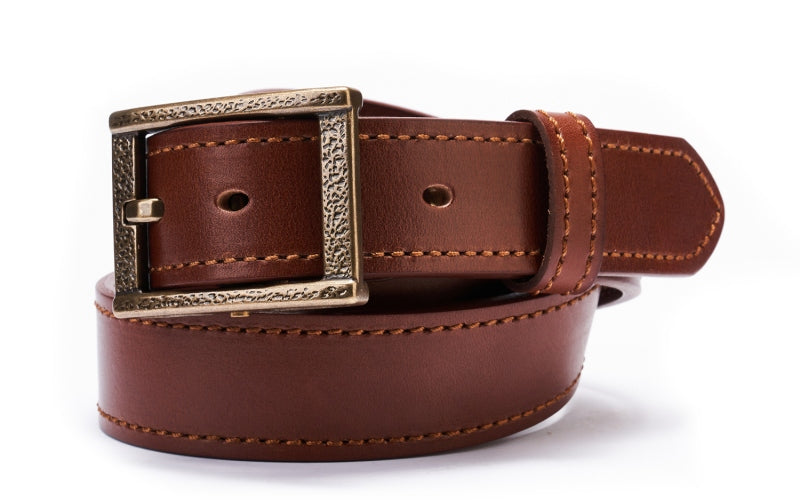
Black shoes → black belt. Brown shoes → brown belt. That's the foundation.
But here's what most guides skip: you're matching color family, not color code. A tan belt works perfectly well with cognac shoes. A rich dark espresso belt looks excellent with walnut oxfords. You don't need a Pantone chart — you need to make sure both pieces are living in the same neighborhood.
Where it gets tricky is the black-and-brown divide. Mixing a brown belt with black shoes — or vice versa — used to be a hard no. Today it's more nuanced. In creative or casual environments, a deliberate contrast can work. In a formal or conservative setting (job interview, black-tie adjacent, courtroom), stick to the match. Always.
A few reliable color pairings:
| Shoe Color | Belt Match | Notes |
|---|---|---|
| Black | Black | Safe, sharp, always correct |
| Dark brown / oxblood | Dark brown / espresso | Rich and polished |
| Cognac / tan | Brown or tan | Warm and relaxed |
| Burgundy / wine | Brown or dark burgundy | Avoid black — it deadens the warmth |
| Navy or blue suede | Brown or navy | A brown belt adds warmth |
| White sneakers | Any neutral | Rules relax in casual territory |
For black leather belts, versatility is the whole point — black shoes, dark jeans, charcoal trousers, black boots. It's the belt you grab when you're not thinking. For brown leather belts, the range is wider and warmer, but requires a bit more thought.

2. Leather Type: The Match That Most People Miss
This is where the detail-oriented really separate themselves.
Match the leather category. A smooth, polished leather belt should pair with smooth, polished leather shoes. A pebble-grain belt works well with pebble-grain shoes. A suede belt looks best alongside suede loafers or desert boots.
It doesn't need to be identical — it needs to feel intentional. When the textures are wildly different (a rough rugged belt with razor-polished cap-toes), the outfit looks like you borrowed pieces from two different wardrobes.
For exotic leather specifically: exotic leather belts — crocodile, alligator, elephant, python — carry their own visual weight. They read as a statement piece. You have two good options:
- Let it lead: pair the exotic belt with clean, simple shoes (smooth leather oxfords, plain loafers) so the belt gets the attention it deserves.
- Echo it thoughtfully: pair with shoes made from a compatible exotic leather, only if the leathers are in the same family. Crocodile belt + crocodile shoes works when the colors align. Mixing croc and python in one outfit, though — that's fighting, not harmonizing.
At BELTLEY, we've been hand-selecting exotic hides since 1999. Every piece is chosen for consistent scale pattern and color depth, which means our belts actually do look intentional next to quality footwear — not like an afterthought.

3. Texture and Finish: The Unsung Variable
Within the same color and leather type, finish matters enormously.
High-shine shoes → high-shine belt. Patent leather calls for a polished, lacquered belt. A matte, brushed belt next to patent shoes reads as an error — even if the colors match.
Matte shoes → matte or semi-matte belt. This is the more forgiving end of the spectrum. A good full-grain leather belt with natural pull-up finish works beautifully with most casual and business-casual shoes.
Suede shoes are special. Suede is a texture in its own right, and it pairs best with belts that have visual softness — a suede belt if you want to go full tonal, or a smooth matte leather belt if you want contrast without clash.
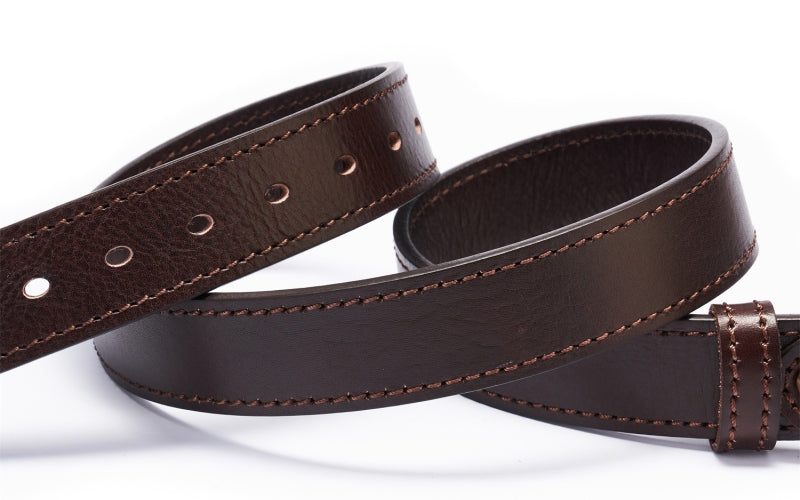
For the curious: this is also why we use full-grain leather at BELTLEY rather than corrected-grain or bonded leather. Full-grain has a natural, nuanced surface that reads beautifully at every finish level — and improves with age in a way that cheap leathers simply don't.
4. Width and Formality: Getting the Proportions Right
The width of your belt should match the formality of your outfit — and by extension, your shoes.
Dress shoes → narrow belt. For leather oxfords, derbies, monk straps, and loafers worn with a suit or dress trousers, a 1" to 1.25" belt is the standard. Anything wider looks blocky against fine tailoring. Check our dress belts for the right options.
Casual shoes → medium to wide belt. With boots, chunky leather loafers, or clean sneakers, a 1.38" or 1.5" belt is proportionally correct and visually balanced.
Boots specifically: the belt width should complement the visual weight of the boot. A thick-soled chelsea boot can handle a 1.5" belt. A slim, sleek ankle boot pairs better with something narrower.
Here's a quick cheat sheet:
| Dress Code | Belt Width | Shoe Type |
|---|---|---|
| Black tie adjacent | 1"–1.18" | Patent leather oxfords |
| Business formal | 1.18"–1.25" | Oxfords, derbies |
| Business casual | 1.25"–1.38" | Loafers, derbies, clean boots |
| Smart casual | 1.38"–1.5" | Chelsea boots, loafers, leather sneakers |
| Casual | 1.5" | Boots, chunky shoes |
See the full breakdown in our guide to dress belts vs. casual belts.

5. Hardware: The Detail That Closes the Look
Your belt buckle's metal finish should coordinate with the hardware on your shoes — the eyelets, the cap-toe broguing, the hardware on monk straps, the aglets on Chelsea boots.
Silver buckle → silver-toned shoe hardware. This is the classic formal combination. Our stainless steel buckle belts use 316L marine-grade stainless — it won't tarnish, won't flake, and stays sharp indefinitely.
Gold buckle → gold-toned shoe hardware. Warmer, richer. Works especially well with brown or tan leather shoes and a warm-toned belt.
Mixed metals are a modern reality — many shoes don't declare a clear metal allegiance. In that case, carry the metal you choose through your other accessories (watch, cufflinks, rings) and let it be a deliberate choice, not a miss.
Also worth knowing: our jewelry-grade CZ stones on rhinestone buckle belts use gold plating that's designed to last — not the kind of plating that looks great in the store and starts peeling six months later. That matters when you're trying to maintain a coherent hardware look across an outfit.
For more on buckle coordination, read: Should Your Belt Buckle Match Your Watch?
When to Break the Rules (and When Not To)
Good style is knowing the rules. Great style is knowing when they bend.
Break them in casual settings. White sneakers and a cognac crocodile belt? That's a deliberate fashion statement and it works — the contrast is the point. Chunky black boots with a warm tan suede belt? Intentional, and sharp.
Don't break them in formal contexts. A job interview, a wedding, a board presentation — these aren't the moments to experiment. Match the colors, match the formality, match the metal. Save the creative combinations for environments where they read as stylish rather than careless.
One rule that's actually non-negotiable: the formality level of the belt should never exceed the formality level of the shoes, or vice versa. A formal narrow plaque buckle belt with chunky platform sneakers isn't edgy — it's just confusing.
For the black-brown question specifically, read: Brown Belt vs. Black Belt — When to Wear Each.
Quick-Reference: 5 Outfit Scenarios
Scenario 1 — Business suit, black oxfords Belt: Black, 1.18"–1.25", smooth leather, silver or gunmetal buckle. Done.
Scenario 2 — Navy suit, brown cap-toes Belt: Dark brown or cognac, 1.25", smooth full-grain, gold buckle. Classic combination.
Scenario 3 — Dark jeans, brown Chelsea boots Belt: Brown or espresso, 1.38"–1.5", slightly textured leather or even suede if the boots are suede.
Scenario 4 — Chinos, loafers, weekend lunch Belt: Tan or cognac, 1.38", casual plaque or box-and-prong buckle. Relaxed but considered.
Scenario 5 — Smart casual, exotic leather belt as the feature Belt: Crocodile or alligator in black or brown, 1.25"–1.38". Shoes: smooth leather loafers or clean oxfords in a matching color. Let the belt be the conversation starter.
For the full exotic leather breakdown: When to Wear an Alligator Belt.

The BELTLEY Approach
We make belts for people who notice this stuff — and for people who want to look like they do without spending hours thinking about it.
Every belt in our men's leather belt collection is crafted in small batches by artisans who've spent decades working with exotic and full-grain leathers. The hides are hand-selected. The buckles are 316L stainless or solid brass — hardware that actually holds up to daily wear. And the 10-year warranty on materials and construction means you're not replacing this belt next year.
No Brand Tax. Direct to you. Free worldwide shipping (USA 4–8 days). If it's not right, 30-day returns, no questions asked.

Frequently Asked Questions
Q: Do belts and shoes have to match exactly?
No — they should coordinate, not be identical. Match the color family and the formality level. A tan belt and cognac shoes look intentional and polished. An exact shade match is neither required nor always possible.
Q: Can I wear a brown belt with black shoes?
In formal settings, no — it's a clear mismatch. In casual or creative environments, a deliberate contrast can work if the rest of the outfit is intentional. When in doubt, match the color. Read the full breakdown: Can I Wear a Brown Belt with Black Shoes?
Q: Should the belt buckle match the shoe hardware?
Yes, when possible. Silver buckle with silver-toned shoe hardware, gold with gold. In practice, many shoes are metal-neutral — in that case, coordinate your buckle with your watch or other accessories and make it a deliberate choice.
Q: How wide should a belt be with dress shoes?
For formal leather shoes worn with a suit, 1" to 1.25" (25–32mm) is the correct range. Wider belts look blocky with fine tailoring. See our standard belt width guide for the full breakdown.
Q: Can you wear an exotic leather belt with regular shoes?
Absolutely — it's actually one of the cleanest combinations. Pair a crocodile or alligator belt with smooth leather shoes in a matching color, and let the belt do the talking. The key is keeping the shoe simple so the textures don't compete.
Q: Should a belt be lighter or darker than shoes?
Slightly darker is typically safer — it grounds the look. But within the same color family, lighter or darker both work. A cognac belt with walnut shoes looks intentional. Where you lose points is crossing the color family line entirely.