Guide to Matching Belts with Sweaters: Rules, Width & Color
TL;DR: Quick Answer and main takeaways
- Match belt width to sweater weight — slim belts (1" or under) for thin knits and turtlenecks; medium belts (1.25"–1.5") for chunky or oversized styles.
- Neutral leather (black, brown, tan) pairs with almost any sweater color; suede adds softness that complements knitwear better than high-shine leather.
- The belt doesn't have to match your shoes when worn with a sweater — but it should be intentional, not accidental.
A belt with a sweater isn't just functional. Done right, it's one of the sharpest styling moves in a cold-weather wardrobe — creating shape, adding a material contrast, and breaking up an otherwise one-note layered look. Done carelessly, it looks like an afterthought.
The difference comes down to three decisions: belt width relative to sweater weight, leather texture relative to knit texture, and color relative to everything else the outfit is doing. Get those three right and the combination works every time. This guide walks through each one — for every sweater type, and for both men and women.

Can You Actually Wear a Belt with a Sweater?
Yes — belts work with sweaters in most cases. The key is matching the belt's weight and formality to the sweater's. A slim leather or suede belt over a tucked thin-knit sweater reads polished. A wide belt cinched over a chunky oversized sweater creates shape. The combination fails when the belt is too formal for the knit, or too heavy for the fabric.
The only sweater style where a belt rarely works is a structured blazer-style knit worn in a formal business context — the belt disrupts the clean tailored line. Everything else — chunky knits, cashmere, oversized pullovers, turtlenecks, cardigans — responds well to a belt when the proportions are right. As The Art of Manliness explains in their complete guide to men's belts, the belt's width should always echo the formality and weight of the rest of the outfit.

Matching Belt Width to Sweater Type
Width is the most important variable. Get it wrong and the proportion throws off the entire look, regardless of color or material.
Chunky knit sweaters call for a medium-to-wide belt — 1.25" to 1.5" minimum. A slim belt over a heavy-knit fabric visually disappears and looks weak against the bulk of the textile. A wider belt cinched at the natural waist creates deliberate structure against the oversized knit. For women, this is the classic "cozy but put-together" formula. For men, a 1.5" casual belt over a half-tuck works well with jeans or chinos. Browse BELTLEY's 1.5" leather belt collection for options that hold up against heavier knitwear.
Thin knits and cashmere need a slimmer belt — 1" to 1.25". Cashmere and fine merino are delicate both visually and physically. A heavy belt overwhelms the fabric's softness. A slim or medium leather belt, or a suede belt, keeps the proportions balanced. The belt should complement the knit's refinement, not compete with it.
Oversized sweaters worn as a dress or with leggings benefit from a medium belt cinched at the natural waist or just above the hip. This is primarily a women's styling move, and it works because the belt creates definition in a silhouette that would otherwise lack structure. Wardrobe Oxygen's guide to tucking sweaters notes that the key is placing the belt at the narrowest point of your torso, not at the fabric's hem.
Turtlenecks pair well with a slim belt (1" or under) at the hip over high-waisted trousers or skirts. The belt should stay lean — a turtleneck already adds visual weight at the top, and a wide belt adds more. A slim leather belt in a neutral tone keeps the proportion clean.
Cardigans work differently. An open cardigan worn over a shirt can be belted at the waist to create a layered, almost coat-like effect. A closed chunky cardigan functions like a sweater — follow the same rules. For open-front belting, the belt becomes a focal point rather than an accent, so the leather quality shows more — a full-grain leather belt rather than a fabric or braided option holds the look together.

What Color Belt Goes with a Sweater?
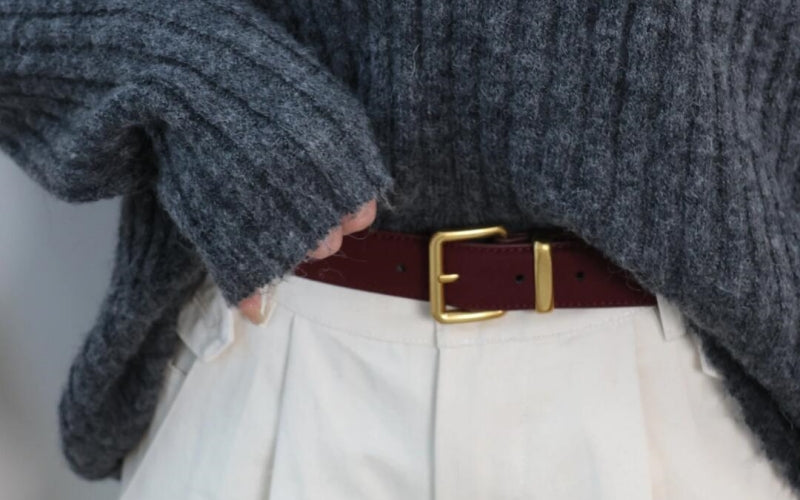
For most sweater outfits, a neutral belt — black, brown, tan, or cognac — is the right call. Neutral leather lets the sweater be the focal point while the belt does structural work. Brown leather in particular bridges warm-toned knitwear (camel, rust, olive, burgundy) more naturally than black. Black leather works with cooler-toned sweaters (grey, navy, charcoal) and monochrome looks.
Color matching doesn't need to be exact, but it does need to be deliberate. The three-color principle in fashion — well documented in fashion color theory guides — holds that an outfit reads as intentional when no more than three distinct colors are in play. Your belt color should either repeat a color already in the outfit or anchor as a neutral. A burgundy belt with a burgundy sweater is a tonal match that works. A bright green belt with a navy sweater is a conflict that doesn't.
For a practical rule: black belt with grey, navy, or black sweaters; brown or tan belt with earth tones, cream, camel, or olive sweaters. Our post on what color belt goes with everything maps this out for the full wardrobe. For the specific brown vs. black decision, this guide is worth a read.

Leather vs. Suede vs. Fabric: Which Belt Texture Works Best with Knitwear?
Suede and matte leather are better choices with knitwear than polished or patent leather. High-gloss leather belongs in a formal context — it reads as dressy, and knitwear is inherently casual. The contrast in formality between shiny leather and a wool sweater creates visual tension that makes the outfit look mismatched. Matte or semi-matte leather, suede, or even woven leather all sit more naturally against the textured surface of knitwear.
As Fustany's guide on wearing belts with knitwear points out, the texture contrast between a smooth leather belt and a textured knit works best when the belt has a matte or natural finish. Suede is particularly versatile — its softness echoes the knit's texture rather than opposing it.
One exception: if the sweater outfit is styled formally — tucked into tailored trousers for an office setting — a semi-polished dress belt can work. The formality of the rest of the outfit justifies it.

How Do You Wear a Belt Over a Sweater Without Looking Bulky?
Avoid bulk by using a thinner belt than you think you need, placing it at the narrowest part of your waist rather than at the hem of the sweater, and choosing a belt with a low-profile buckle. A large statement buckle over knitwear adds visual mass. A simple frame or flat buckle keeps the silhouette clean.
For women adding a belt over a pullover or oversized sweater, Extra Petite's belt-tuck technique is effective: place a thin belt at the natural waist, then pull the sweater fabric slightly over the belt from below so it blouses gently. This hides the belt and creates a draped waist effect that looks intentional without adding bulk. The fabric falls, the waist is defined, and the layering looks effortless.
For men, the trick is the half-tuck — tuck the front of the sweater into your trousers and leave the back out. It creates the impression of a tucked-in belt setup without the weight of full fabric tucked all the way around.

Belt and Sweater Matching for Men
For men, the sweater-belt combination is most practical in two contexts: casual outfits where the belt is under a tucked-or-half-tucked sweater, and smart-casual looks where the sweater is layered over a collared shirt with the belt visible above the trouser waistband.
In both cases, the belt should match the shoes in leather tone and finish — this is the one rule that holds even in casual knitwear contexts. A brown suede belt with tan leather boots and a camel wool sweater is a well-considered look. The same brown suede belt with black oxfords and a grey merino breaks the leather harmony. Keep the leathers coherent and the color palette tight.
A 1.25" to 1.5" casual leather belt in brown or black covers most men's sweater combinations. For smart-casual and business casual, a men's dress belt in the same tonal family as your shoes is the cleaner choice.

The Bottom Line
Matching a belt with a sweater is about proportion, texture, and color coherence — not rigid rules. Slim belt for delicate knits, medium-to-wide for heavy or oversized ones. Suede or matte leather over polished or patent. Neutral leather colors that either echo or anchor the rest of the outfit.
The details matter more when the belt is visible — which it often is with knitwear, since sweaters tend to be shorter or looser than a dress shirt. That's why leather quality shows up clearly in this context. A full-grain leather belt develops the kind of surface character and natural matte finish that works with knitwear in a way that corrected-grain leather simply doesn't. For more on building a complete matching system across your wardrobe, our belt matching guide for women covers the full outfit framework.
Frequently Asked Questions
Q: What kind of belt goes with a chunky knit sweater?
A medium-to-wide belt (1.25"–1.5") in matte or suede leather works best with chunky knits. Slim belts visually disappear against heavy-weight fabric. For women, cinch the belt at the natural waist. For men, a 1.5" casual leather belt worn over a half-tuck keeps the look proportional.
Q: Should a belt match your shoes when wearing a sweater?
For men, yes — the leather color and finish of your belt should match your shoes even in casual knitwear outfits. For women, the rule is more flexible: the belt can match the shoes, repeat a color in the sweater, or stand as a deliberate neutral. What to avoid is a belt color that conflicts with both the sweater and the shoes without a reason.
Q: Can you wear a belt over an oversized sweater?
Yes. A medium-width belt cinched at the natural waist over an oversized sweater is a standard styling technique that creates shape in a deliberately relaxed silhouette. Place the belt at your narrowest point, choose a low-profile buckle to avoid bulk, and let the fabric blouse slightly over the belt for a relaxed, draped effect.
Q: Is suede or leather better with knitwear?
Suede is generally the better choice with knitwear because its matte, soft-textured surface echoes the knit's texture rather than contrasting with it. Polished leather reads as formal and can clash with casual knitwear. Matte full-grain leather is a close second — it has the structure of leather without the formality of a high shine.
Q: What belt width works with a turtleneck?
A slim belt — 1" or under — pairs best with turtlenecks. The turtleneck already adds visual weight at the neckline, so keeping the belt minimal balances the proportions. Wear it at the hip over high-waisted trousers or a skirt rather than at the waist, and keep the buckle simple.

%20for%20thin%20knits%20and%20turtlenecks;%20medium%20belts%20(1.25%22%E2%80%931.5%22)%20for%20chunky%20or%20oversized%20styles.%0ANeutr...)