Dress Belt vs. Casual Belt: How to Tell the Difference (And When to Wear Each)
TL;DR:Quick answer
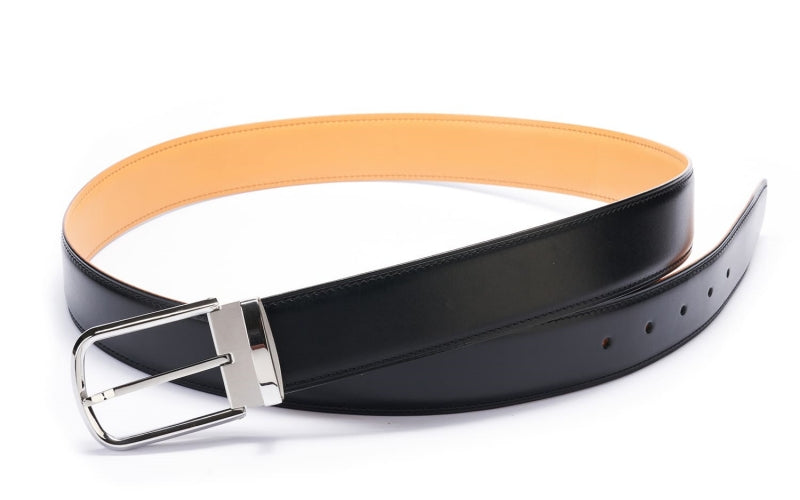
- A dress belt is narrow (1"–1.25"), smooth leather, with a small polished buckle — built to complement suits and formal trousers. A casual belt is wider (1.5"+), textured or matte, with a larger buckle — built for jeans, chinos, and weekend wear.
- The six defining differences: width, leather finish, buckle style, color, edge treatment, and stitching.
- One belt can bridge both categories: a 1.38" full-grain leather belt in dark brown with a brushed silver buckle. But dedicated belts for each role always look better.
Picking the wrong belt for the occasion is one of the most common style mistakes men make — and one of the easiest to fix once you understand what separates a dress belt from a casual belt.
The distinction isn't just about width or color. It's about six specific attributes that, taken together, tell everyone in the room whether your belt belongs with that outfit.
This guide breaks down every difference between dress belts and casual belts, explains when to wear each, and covers the edge cases — including where exotic leather belts and women's belts fall on the spectrum.

Which Belt Does Today Call For?
The six differences below matter — but your situation decides faster:
| Your situation | Go with |
|---|---|
| Suit or formal trousers | Dress belt — 1"–1.25", smooth leather, small polished buckle |
| Jeans, chinos, weekends | Casual belt — 1.5"+, textured or matte, buckle with some presence |
| You want one belt to bridge both | 1.38" full-grain in dark brown with a brushed silver buckle — the documented compromise |
| Wondering where your croc belt fits | Belly cut = dress; hornback = casual. Finish matters too — covered below |
Both categories are in the men's collection, filterable by style. The six defining differences:
What Is the Difference Between a Dress Belt and a Casual Belt?
A dress belt is designed to disappear into a formal outfit — slim, smooth, polished, invisible. A casual belt is designed to be seen — wider, textured, expressive, part of the outfit's personality. The difference comes down to six attributes that work together.
| Feature | Dress Belt | Casual Belt |
|---|---|---|
| Width | 1"–1.25" (25–32mm) | 1.5"–2" (38–50mm) |
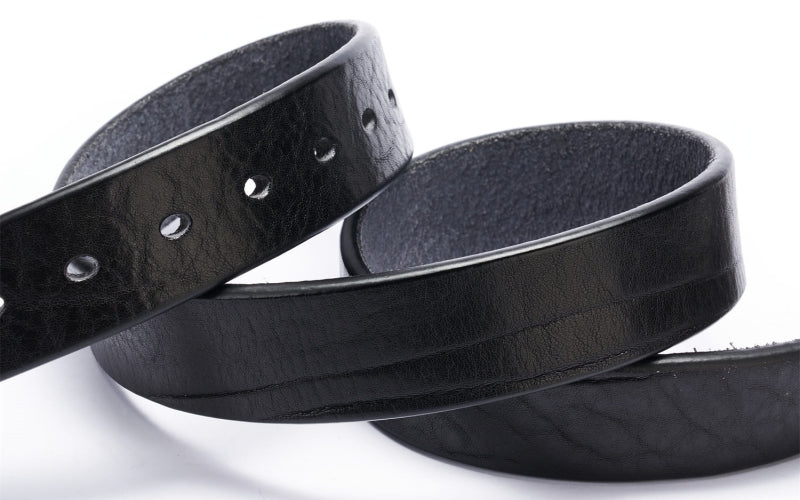
| Leather | Smooth calfskin, polished, high-sheen | Distressed, suede, braided, canvas, nubuck |
| Buckle | Small frame/prong, polished silver or gold | Larger, decorative, matte, roller, western |
| Color | Black, dark brown, oxblood | Tan, cognac, olive, navy, any color |
| Edge | Painted or sealed — clean, uniform | Burnished or raw — shows leather character |
| Stitching | Minimal, tone-on-tone or hidden | Contrast thread, heavier gauge, decorative |

The Art of Manliness and Real Men Real Style both use this same framework as the standard for classifying men's belts.
Get all six attributes aligned and the belt reads as clearly formal or clearly casual.
Mix them — a wide belt with a polished buckle, or a narrow belt with distressed leather — and the belt sends confusing signals.
How Wide Should a Dress Belt Be vs. a Casual Belt?
A dress belt should be 1"–1.25" (25–32mm) wide. A casual belt should be 1.5" (38mm) or wider. Width is the single fastest visual indicator of formality — even from across a room.
The width distinction exists for a practical reason: suit trousers have narrower belt loops than jeans. A 1.5" casual belt literally won't fit through most dress pant loops. And a 1" dress belt threaded through wide jeans loops looks like a string holding up a tarp — the proportions are wrong.
| Width | Category | Best With |
|---|---|---|
| 1" (25mm) | Dress | Slim suits, evening wear |
| 1.25" (32mm) | Dress | Standard suits, dress trousers |
| 1.38" (35mm) | Crossover | Business casual, blazer + chinos |
| 1.5" (38mm) | Casual | Jeans, chinos, weekend |
| 1.75"–2" (45–50mm) | Casual | Heavy denim, workwear, statement |
For a full width breakdown with measurements, see our belt width guide in MM.

What Buckle Style Goes with Each?
A dress belt buckle should be small, flat, and polished — a single-prong frame buckle in silver or gold is the standard. It should lie flush against the waistband without protruding. A casual buckle can be larger, chunkier, matte-finished, and decorative — roller buckles, double-prong, western-style, or statement hardware all work.
The metal rule also shifts by formality. The Gentleman's Gazette is explicit: for dress belts, buckle metal must match your watch and cufflinks (silver with silver, gold with gold). For casual belts, the rule relaxes — mixed metals and antiqued finishes are fine.
At BELTLEY, every buckle is crafted from stainless steel or solid brass — materials that hold their finish through years of daily wear. A polished stainless steel buckle stays consistent against your dress accessories, while a brass buckle develops a warm patina that works beautifully in casual contexts.

Can You Wear a Dress Belt with Jeans?
You can, but it usually looks off. A thin, glossy dress belt against heavy denim creates a visual mismatch — the proportions clash and the shine level feels out of place against casual fabric. Primer Magazine's belt guide describes this as one of the most common belt mistakes men make.
The exception: dark, slim-cut jeans worn with a tucked-in button-down and a blazer — essentially a smart-casual outfit that's closer to dress trousers in spirit. In that context, a clean 1.25" belt can work. But for standard casual denim, a 1.5" casual belt in matte leather with a simple buckle is always the better call.

Can You Wear a Casual Belt with a Suit?
No — not in any traditional professional or formal setting. A wide, textured, or heavily buckled belt undermines the clean lines a suit is designed to create. Buckle My Belt's formality guide frames it simply: a casual belt with a suit signals that you don't own the right belt, not that you're being creative.
The only exception is an intentionally deconstructed suit look — unstructured blazer, open collar, no tie, possibly paired with sneakers. In that creative-casual context, a clean leather belt in the 1.38" range with a matte buckle can work. But this is a fashion-forward choice, not a professional one.

Is a Crocodile Belt a Dress Belt or a Casual Belt?
It depends entirely on the finish — not the leather type. Glazed crocodile or alligator leather with a high-gloss surface is among the most formal belt materials available, suitable for suits and evening wear. Matte-finished crocodile reads as smart-casual and pairs with blazers and chinos. Distressed or vintage-finished exotic leather leans casual and works with denim.
This makes exotic leather uniquely versatile across the formality spectrum — more so than standard calfskin, which is either polished (dress) or distressed (casual) with less overlap. Browse BELTLEY's crocodile belt collection for both glazed and matte options that cover multiple formality levels.

Do Women Follow the Same Rules?
The core framework applies — smooth/polished = formal, textured/matte = casual — but women have significantly more flexibility across all six attributes. Wider belts (1.5"–2"+) are fully professional for women when worn over blazers or dresses to cinch the waist. Statement buckles work in office settings that would reject them on men. Chain belts and braided belts cross formal-casual boundaries more fluidly in women's fashion.
The biggest difference: women's dress belts serve a dual function as both a functional accessory and a styling tool. A wide belt over a shift dress is a "dress belt" in terms of occasion even though its width would classify it as casual by men's standards. For more, see our guide on what kind of belts are in style for women in 2026.

Can One Belt Work for Both Dress and Casual?
Yes — with a specific formula. A 1.38" (35mm) full-grain leather belt in dark brown with a semi-matte finish and a brushed silver prong buckle is the closest thing to a universal belt. It fits dress trouser loops and jeans loops.
The finish is polished enough for business settings but not so glossy that it looks wrong with denim. Dark brown pairs with more outfits than black.
That said, a versatile belt is always a compromise. It won't look as sharp with a charcoal suit as a dedicated black dress belt, and it won't feel as relaxed with worn-in jeans as a distressed tan casual belt.
If you're building a wardrobe, start with the versatile option, then add dedicated pieces as your needs grow. Our guide on how many belts a man should have covers the ideal collection size.

How Many Dress Belts and Casual Belts Should You Own?
The minimum is two — one black dress belt and one brown casual belt. That covers suits and jeans. But most men's wardrobes need more range.
| Collection Level | Dress Belts | Casual Belts | Total |
|---|---|---|---|
| Bare minimum | 1 (black) | 1 (brown) | 2 |
| Well-rounded | 2 (black + dark brown) | 2 (cognac + tan/braided) | 4 |
| Complete | 3 (black, brown, exotic) | 3 (cognac, tan, woven) | 6 |
The cost-per-wear math favors quality: a $200 full-grain belt worn three times a week for 10 years costs $0.13 per wear. A $40 bonded leather belt that cracks in eight months and gets replaced three times costs more. For more on this, see our guide on how much a leather belt should cost.
The Bottom Line
The difference between a dress belt and a casual belt comes down to six attributes: width, leather finish, buckle style, color, edge treatment, and stitching. A dress belt is narrow, smooth, polished, and invisible.
A casual belt is wider, textured, expressive, and part of the outfit's character. Wearing the right type for the occasion is one of the simplest ways to look put-together — and wearing the wrong type is one of the fastest ways to undermine an outfit you spent real time assembling.
Start with one of each in quality leather, and you'll cover every situation from boardrooms to barbecues. Browse BELTLEY's dress belts and casual belts for handcrafted options in full-grain and exotic leathers, built with stainless steel hardware and backed by a 10-year warranty.
Frequently Asked Questions
Q: What is the main difference between a dress belt and a casual belt?
Width and finish. A dress belt is 1"–1.25" in smooth, polished leather with a small buckle. A casual belt is 1.5"+ in textured or matte leather with a larger or decorative buckle. The six defining attributes are width, leather finish, buckle, color, edge treatment, and stitching.
Q: Can you wear a casual belt with dress pants?
Not recommended. A wide, textured belt with dress trousers creates a visual mismatch that signals you don't own the right belt. Stick to a slim, smooth-finished belt with dress pants and save the casual belts for jeans and chinos.
Q: What color dress belt should I buy first?
Black — it covers charcoal, navy, and black suits with black shoes. Your second dress belt should be dark brown, which handles navy, grey, and earth-toned suits with brown shoes. Together, these two colors cover 95% of professional needs.
Q: How do I know if my belt is formal or casual?
Check the five-point test: (1) Width under 1.38"? (2) Smooth, polished leather? (3) Small, understated buckle? (4) Classic color — black or dark brown? (5) Clean, finished edges? If three or more answers are yes, it's a dress belt. If most answers are no, it's casual.
Q: Is a braided belt formal or casual?
Casual. The woven texture inherently signals informality regardless of the leather quality or buckle style. Braided belts pair best with chinos, linen trousers, and casual denim — never with suits. See our guide on braided belts in 2026 for styling tips.
Q: Should your belt and shoes match exactly?
For formal outfits, yes — match color and shine level as closely as possible (black belt + black shoes, brown belt + brown shoes). For casual outfits, close is fine — staying in the same color family is enough. The matching rule is strictest at the formal end and loosest at the casual end.
,%20smooth%20leather,%20with%20a%20small%20polished%20buckle%20%E2%80%94%20built%20to%20complement%20suits%20and%20formal%20trousers.%20A%20casual%20belt%20is%20wider%20(1.5%22+),%20textured%20or%20...)