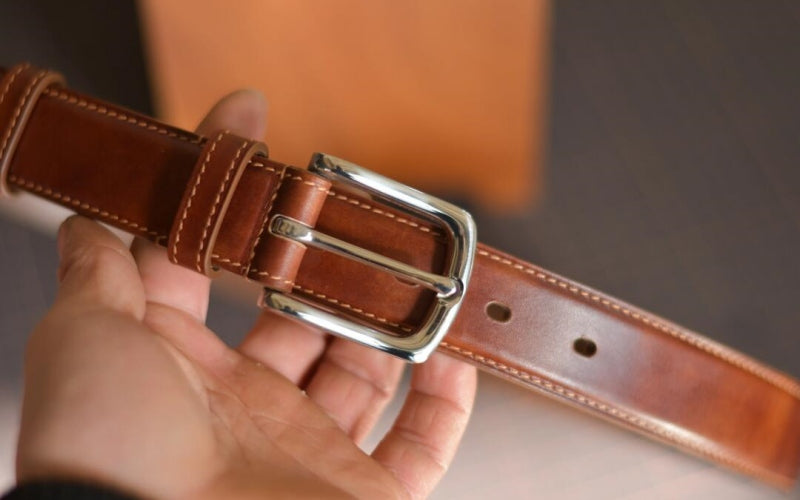
Who Said Belts and Shoes Have to Match? Let’s Shake Things Up
TL;DR: Quick answer
- Nobody specific said it — the belt-shoe matching rule grew out of early 20th-century formal menswear culture, when dress codes were rigid and accessories were few.
- Today it's context-dependent: match in formal settings, coordinate (not copy) in casual ones.
- The better framework: match color family + formality level + hardware metal — not the exact leather shade.
- The rule isn't dead. It just got a much-needed scope reduction.
Somewhere between your grandfather's closet and your first job interview, someone told you that your belt and shoes must match. Exactly. Always. And you believed them, because it was delivered with such confidence that questioning it felt embarrassing.
But who, exactly, issued that decree? And does it still hold?
The short answer: the rule has a real origin, a reasonable logic for its time, and a clear expiration date for certain contexts. Understanding all three is what separates someone who follows rules from someone who understands them. Browse BELTLEY's men's leather belts while you read — the collection shows what coordinated-but-not-matchy actually looks like in practice.

Who Said Belts and Shoes Have to Match?
No single person coined the rule. It emerged organically from early 20th-century formal menswear conventions, when Western dress codes were highly codified and men's accessory options were limited. Matching leather accessories — belt, shoes, briefcase, watch strap — was a signal of social awareness and personal discipline.
The underlying logic was sound for its era. Before 1960, mainstream Western menswear for office and social settings was almost entirely formal. Suits were the default. Dress codes were explicit. In that environment, matching leather accessories wasn't a style choice — it was grooming. Like shining your shoes or pressing your collar.
According to Dalgado's history of the belt, belts as everyday accessories only became standard in men's wardrobes in the early 20th century, replacing braces in tailored clothing. As belts entered formal dress, they inherited the same coordination logic applied to other leather goods: if it's leather and visible, it should match.
Nobody put it in a rulebook. It was absorbed through culture — tailors, fathers, military dress codes, etiquette guides. By mid-century, it felt like physics.

Why the Rule Made Sense — Then
The 1920s through 1950s were the golden age of the matching-everything school. And in that context, the rule did its job well.
Men's wardrobes were simpler and more formal. A working professional owned a handful of suits, a couple of pairs of shoes, and the accessories to match them. Coordination was straightforward because the wardrobe itself was narrow. A black suit needed black shoes and a black belt. Brown shoes needed a brown belt. Done.
The fashion media of the era reinforced this. Esquire's earliest style guides treated accessories coordination as a fundamental — not a preference — of well-dressed men. The logic filtered into etiquette books, military dress regulations, and eventually, into the cultural shorthand we still inherit.
It was never meant to be a universal law for all dress codes. It was a rule for a specific context: formal and semi-formal Western menswear. The problem is that the context changed, and the rule didn't.

Is the Belt-Shoe Matching Rule Still Valid in 2026?
Yes — in formal contexts. No — as a universal rule. The belt-shoe match remains the correct call for suits, business formal, and black-tie-adjacent occasions. For business casual, smart casual, and everyday wear, strict matching has been replaced by coordination: same color family, compatible formality, aligned hardware.
The shift happened gradually across the 1980s and 1990s as business casual became the dominant dress code. When the suit stopped being the default, the rules written for suits stopped being defaults too.
GQ's modern style coverage consistently treats the belt-shoe match as situational rather than absolute. The consensus among contemporary style authorities: the rule is a useful baseline, not a binding law.
What hasn't changed is the underlying principle — accessories should feel coordinated, not random. Replacing "match exactly" with "harmonize intentionally" is not abandonment of the rule. It's a refinement.
When Should You Still Match Belt to Shoes?
Match belt to shoes in formal and business-formal settings: suits, dress pants with a blazer, black-tie or semi-formal events, job interviews, court appearances, and any context where precision signals respect. In these environments, a mismatched belt and shoes reads as an oversight, not a style statement.
This is where the original rule remains fully intact. A black suit with a brown belt is still a mistake in 2026 — not because of tradition, but because formal contexts have a visual grammar that coordination reinforces. Mismatched accessories in formal settings say "I didn't notice." Matched accessories say "I paid attention."
For these occasions: BELTLEY's dress belts in black or espresso are the straightforward answer — narrow profile, clean hardware, leather that photographs as well as it wears.

When Can You Confidently Skip the Match?
In casual and smart-casual settings, strict belt-shoe matching is optional. Intentional contrast — a brown belt with black jeans and black boots, or a cognac belt with navy trousers and tan suede loafers — reads as stylish when the choices are deliberate. The key word is deliberate.
The test isn't "do they match?" It's "do they look like someone chose them together?"
A few combinations that work without matching:
- Dark brown belt + black jeans + black sneakers — the casual dress code makes the contrast read as intentional, not careless
- Cognac belt + charcoal trousers + white shirt + dark brown oxfords — tonal family maintained, exact match not required
- Burgundy braided belt + blue jeans + tan boots — the contrast is the point; three warm tones in the same palette
What doesn't work is random: a bright tan belt with black shoes and a gray suit. That's not breaking the rule — it's just not having one. See more combinations: Brown Belt vs. Black Belt — When to Wear Each

The Replacement Framework: Harmonize, Don't Match
The smartest update to the old rule isn't "anything goes." It's a three-point coordination check that works across every dress code:
1. Color family, not color code. Your belt and shoes should live in the same color neighborhood. Black and black. Brown and tan. Cognac and walnut. They don't need to be identical — they need to feel like they know each other.
2. Formality parity. A sleek, narrow dress belt belongs with dress shoes. A thick, distressed leather belt belongs with casual boots. Mixing formality levels is the mismatch that actually matters. Explore the full spectrum: Dress Belt vs. Casual Belt
3. Hardware alignment. The metal on your buckle should echo the metal on your shoes — and your watch, if you're wearing one. Silver buckle with silver-toned shoe hardware. Gold with gold. This single coordination move ties an outfit together more effectively than exact leather matching. For more on this: Should Your Belt Buckle Match Your Watch?
Get these three right and the question of whether your belt "matches" your shoes becomes irrelevant. The outfit works.

The Bottom Line
Nobody said belts and shoes have to match — it was absorbed from a formal menswear culture that treated coordination as discipline. The rule made perfect sense when suits were the default and wardrobes were narrow. It makes less sense applied to every outfit in every context in 2026.
The updated version: match in formal settings, harmonize in everything else. Same color family. Matching formality. Aligned hardware. Those three things replace the old rule and cover every situation it was ever meant to address — plus the ones it wasn't.
BELTLEY has been making belts since 1999. One thing that hasn't changed in 25+ years: a well-made leather belt in the right shade, with the right hardware, coordinates itself. Check the casual leather belt collection for options that work across dress codes — backed by a 10-year warranty and 30-day returns if the shade isn't right.

Frequently Asked Questions
Q: Who invented the rule that belts and shoes must match?
No single person invented it. The belt-shoe matching rule evolved from early 20th-century formal menswear conventions, where coordinating leather accessories was considered basic grooming for dressed occasions. It was reinforced by tailors, etiquette guides, and military dress codes — never formally codified, but widely absorbed as common sense.
Q: Is it still a fashion rule that belts and shoes must match?
In formal contexts — suits, business formal, black-tie events — yes, the rule still applies. In casual and smart-casual settings, it has softened considerably. Modern style guidance treats belt-shoe coordination as a preference, not a requirement, outside of formal dress codes.
Q: What's the modern alternative to strict belt-shoe matching?
The modern approach is coordination by color family, formality level, and hardware metal — not exact leather matching. A cognac belt with walnut shoes works. A chocolate brown belt with black boots in a casual outfit works. What doesn't work is crossing dress code levels (a formal dress belt with rugged workboots) or placing wildly different metals side by side.
Q: Does the belt-shoe matching rule apply to women?
Less so than for men, and it always did. Women's fashion has historically allowed more accessory experimentation. The core principle still holds — coordinated accessories look more intentional than random ones — but strict color-matching between belt and shoes has never been as rigid a rule in women's fashion as in men's formal dress.
Q: What should I focus on instead of matching my belt to my shoes exactly?
Focus on three things: color family (same general tone), formality level (dress belt with dress shoes, casual belt with casual shoes), and hardware metal (silver buckle with silver-toned shoe hardware, gold with gold). Get those three aligned and the belt and shoes will read as coordinated regardless of whether the leather shades match precisely.