Do Hermes Belts Have Serial Numbers or Fake?-Detailed Answer
TL;DR: Quick Answer
- Hermès belts do not carry traditional serial numbers — they use blind stamps (a date stamp + a craftsman stamp) instead.
- The date stamp is a single letter indicating the year of manufacture; the craftsman stamp identifies the individual artisan.
- Spotting a fake requires checking the stamp quality, stitching, leather texture, buckle finish, and sizing format — not just looking for a number.

You spent serious money on a Hermès belt — or you're about to. The first question that hits: do Hermès belts have serial numbers, and if mine doesn't, is it fake? The short answer surprises most people. Unlike brands that print serial codes on everything, Hermès uses an entirely different identification system.
Understanding that system is the single fastest way to separate an authentic belt from a counterfeit. Below, we break down exactly what to look for and what real designer belts use to prove their legitimacy.

Do Hermès Belts Have Serial Numbers?
No. Hermès belts do not have serial numbers in the way most people expect. Instead of a numeric code, Hermès stamps each belt with a blind stamp — a small, heat-pressed marking on the leather that encodes the year of production and the artisan who made it. This system has been in place since 1945, making it one of the oldest traceability methods in luxury fashion.
The confusion is understandable. Brands like Louis Vuitton and Chanel use alphanumeric serial codes, so buyers assume every luxury house does the same. Hermès chose a different path: discreet letter-based stamps that only reveal their meaning if you know the code. According to Yoogi's Closet's Hermès authentication guide, these stamps are the primary tool professional authenticators use when verifying Hermès leather goods.
If someone tries to sell you a Hermès belt and points to a long numeric "serial number" as proof of authenticity, that's actually a red flag — not reassurance.

What Is the Hermès Blind Stamp?
The blind stamp is a two-part marking pressed into the leather of every authentic Hermès item. The first part is the date stamp — a single letter indicating the year of manufacture. The second is the craftsman stamp — a unique identifier for the artisan who built the piece by hand.
Hermès has rotated through several date stamp formats over the decades. According to FASHIONPHILE's stamp reference guide, the system breaks down like this:
| Era | Format | Example |
|---|---|---|
| 1945–1970 | Letter alone or with a dash | A, B, C… |
| 1971–1996 | Letter inside a circle | ⓐ through ⓩ |
| 1997–2014 | Letter inside a square | [A] through [R] |
| 2015–present | Letter alone (no shape), new alphanumeric format | T (2015), X (2019), D (2024), K (2025) |
Since 2015, Hermès has moved to a streamlined format: a single date letter followed by a craftsman code in an L LL NNN LL pattern. If you're examining a belt purchased in 2025, you should see the letter K as the date stamp, as confirmed by Élégance du Luxe's date stamp guide.

Where Is the Stamp Located on a Hermès Belt?
On most Hermès belts, the blind stamp is pressed into the interior side of the leather strap, typically near the buckle end. On some models, you may also find a secondary stamp closer to the belt holes. The stamp should be subtle — not deeply gouged or raised — because Hermès uses a controlled heat-press technique that leaves a clean, precise impression.
Some Hermès belt buckles produced within the last five years also carry an alphanumeric code on the back of the buckle hardware. This is separate from the leather blind stamp and serves as an additional layer of traceability.
A genuine stamp will look even, shallow, and crisp. If the letters are unevenly spaced, too deep, or blurry, you may be looking at a counterfeit. According to LegitGrails' authentication guide, fake stamps almost always have thicker, less refined lettering compared to originals.

How Do You Spot a Fake Hermès Belt?
A convincing counterfeit can fool a casual buyer, but it rarely survives close inspection. The global counterfeit fashion trade exceeds $450 billion annually, and Hermès is among the most targeted brands — U.S. Customs once seized nearly 4,000 fake Hermès belts worth over $3.2 million in a single port operation. Here are seven authentication checkpoints professionals use:
1. Blind stamp quality. Authentic stamps are thin, even, and precisely spaced. Fakes use thicker, sloppier impressions.
2. "HERMÈS PARIS MADE IN FRANCE" deboss. This text appears on one end of the strap. The accent on the È must be present. Counterfeits often omit it or use incorrect fonts, as noted by The Luxury Closet's authentication guide.
3. Sizing in centimeters only. Hermès measures belt length exclusively in cm. If you see inches or letter sizes (S, M, L), it's fake — no exceptions.

4. Stitching consistency. Hermès belts are hand-stitched using saddle stitch. The thread lines should be perfectly even and slightly angled. Machine-stitched fakes look too uniform and flat.
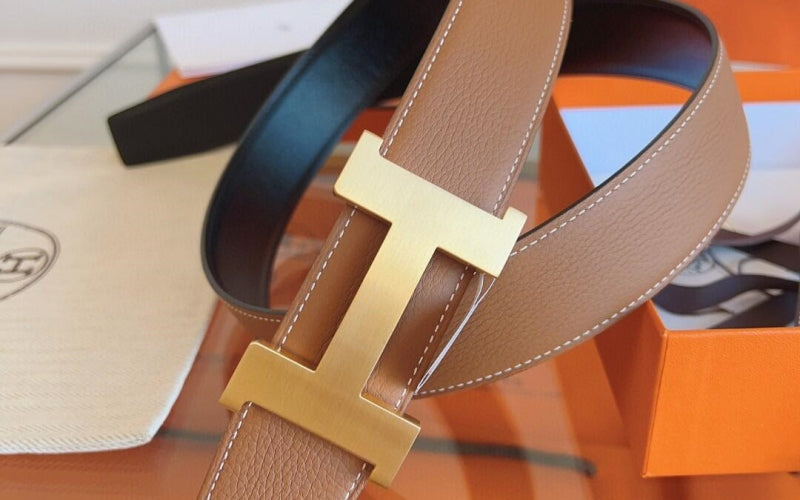
5. Buckle finish. A genuine H buckle has a sandblasted (matte-textured) back side. Counterfeits typically show a smooth, polished finish on both sides. If you're curious about what goes into authentic Hermès buckle materials, our guide on whether Hermès buckles are real gold covers the metallurgy in detail.
6. Leather quality. Authentic Hermès uses calfskin (Togo, Epsom, Box), alligator, or other premium hides. The leather should feel supple but structured — never plasticky or overly stiff. Knowing how to identify full-grain leather will sharpen your eye for material quality across all brands.
7. Packaging. Genuine belts ship in the signature orange box with a brown ribbon, a felt dust bag, and no printing inside the box lid. Missing or inconsistent packaging doesn't automatically mean fake (secondhand items may lack original packaging), but it warrants extra scrutiny.

Can You Verify a Hermès Belt Through the Brand?
Hermès does not offer a public serial-number lookup tool or online authentication service. The only way to get an official verification is to bring the belt into a Hermès boutique and ask a sales associate to inspect it. They can identify the date stamp, confirm the craftsman code, and assess the materials — though they won't issue a written certificate for items not purchased directly from them.
For secondhand purchases, third-party authentication services like Entrupy, LegitCheck, and Real Authentication use microscopic imaging and AI-assisted analysis to verify authenticity.
These services typically cost $10–$50 and can be worth every cent when you're spending upward of $800 on a belt. Considering why Hermès belts are so expensive, protecting that investment with proper authentication makes sense.

The Bottom Line
Hermès belts do not have serial numbers. They use blind stamps — a date letter and a craftsman identifier — pressed into the leather strap. To authenticate a Hermès belt, focus on stamp clarity, the "HERMÈS PARIS" deboss, cm-only sizing, hand-stitching quality, buckle finish, and leather feel. No single detail confirms authenticity; it's the combination that tells the full story. If you're shopping secondhand, invest in a professional authentication service before you buy.
Looking for a premium belt that proves its quality through craftsmanship rather than a logo? Browse BELTLEY's designer belt collection — handmade, backed by a 10-year warranty, and priced without the Brand Tax.
Frequently Asked Questions
Q: Do all Hermès leather goods have blind stamps?
Yes. Every authentic Hermès leather item — belts, bags, wallets, and small leather goods — receives a blind stamp during production. The stamp format varies by era, but the system has been in use since 1945.
Q: What does the letter stamp on my Hermès belt mean?
The letter indicates the year of manufacture. Hermès assigns one letter per year in a rotating cycle. For example, D = 2024 and K = 2025. The surrounding shape (circle, square, or none) tells you which era the stamp belongs to.
Q: Can a fake Hermès belt have a blind stamp?
Yes. High-quality counterfeits now replicate blind stamps, but the execution is almost always flawed — look for uneven spacing, overly thick lettering, or incorrect letter-year pairings. A stamp alone does not prove authenticity.
Q: How much does it cost to authenticate a Hermès belt?
Third-party authentication services typically charge between $10 and $50 per item. Bringing the belt to a Hermès boutique for inspection is free, though the store won't provide a written authentication certificate.
Q: Is there an app to check if my Hermès belt is real?
Several apps (Entrupy, LegitCheck, LegitApp) offer AI-assisted authentication using photos. They analyze stitching patterns, stamp details, and hardware finishes. Accuracy varies, so use them as a starting point — not a final verdict.
Q: Do Hermès belts come with an authenticity card?
Hermès does not include traditional authenticity cards with belts. If a seller shows you a printed "certificate of authenticity" card, that's actually a warning sign — counterfeits often include fake documentation that Hermès itself never issues.
%20instead.%0AThe%20date%20stamp%20is%20a%20single%20letter%20indicating%20the%20year%20...)