25 Different Types of Belts with Names and Pictures
TL;DR: Quick answer
There are more types of belts than most people can name. Ask someone and they'll say "dress belt, casual belt, western belt" and then trail off. But once you know the full vocabulary — plaque buckle, ratchet, obi, corset, double-layer — you can describe exactly what you're looking for, understand what you're buying, and make deliberate choices instead of guessing.
This guide covers 25 belt types with names, organized across five categories: material and leather type, buckle and fastening mechanism, width and silhouette, aesthetic style, and functional use. There's a master reference table at the end. Browse BELTLEY's full collection to see styles across all categories.

Master Reference Table
| Belt Name | Key Feature | Formality | Typical Width | Best Context |
|---|---|---|---|---|
| Full-Grain Leather | Top hide layer, develops patina | High | Any | Dress, smart casual, daily wear |
| Top-Grain Leather | Sanded surface, uniform look | High | Any | Dress, business |
| Genuine Leather | Split layers, polyurethane finish | Low | Any | Short-term casual |
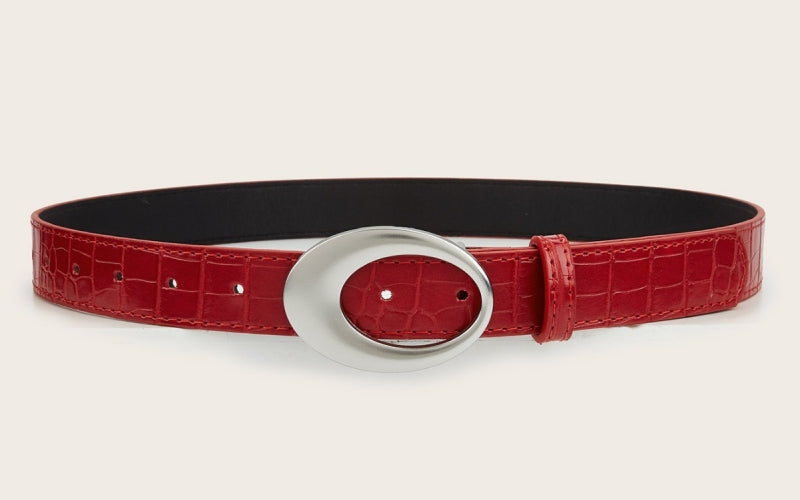
| Exotic Leather | Crocodile, alligator, python, elephant | High | Any | Statement, evening |
| Suede | Napped flesh side, soft texture | Medium | Any | Casual, autumn/winter |
| Vegan / Faux | Synthetic PU/PVC | Varies | Any | Casual, ethical choice |
| Single-Prong | One pin through holes | High | 1.25"–1.5" | Dress, casual |
| Double-Prong | Two pins, stronger hold | Medium | 1.38"–1.5" | Work, western, casual |
| Plaque / Plate | Hidden hook, smooth face | High | 1.25"–1.38" | Dress, designer |
| Ratchet / Track | Micro-adjust, no holes | High | 1.25"–1.38" | Business, travel |
| Box & Prong | Enclosed frame, sturdy | Medium | 1.38"–1.5" | Smart casual |
| O-Ring | Friction fold | Low | Varies | Fashion, women's |
| D-Ring | Double ring | Low | Varies | Utility, casual |
| Skinny Belt | Under 1" wide | Medium | Under 1" | Jeans, dresses |
| Wide Belt | 1.75"–3"+ | Medium | 1.75"–3"+ | Dresses, blazers |
| Corset / Cinch | Full midsection panel | Low–Medium | 4"–8" | Fashion, evening |
| Obi Belt | Sash-style, Japanese-inspired | Low–Medium | Wide | Fashion, editorial |
| Western Belt | Oversized buckle, tooled leather | Low | 1.5"+ | Denim, country, casual |
| Military / Tactical | Heavy-duty, utility hardware | Low | 1.5"–1.75" | Work, utility |
| Braided / Woven | Woven leather strips | Low | 1.25"–1.5" | Casual, summer |
| Reversible Belt | Two-color flip | Medium | 1.25"–1.38" | Travel, capsule wardrobe |
| Embossed Belt | Pressed exotic-look pattern | Medium | Any | Smart casual, affordable exotic |
| Studded Belt | Metal hardware along strap | Low | Varies | Casual, fashion |
| Rhinestone Belt | CZ or crystal stones | Low–Medium | Varies | Evening, events |
| Dress Belt | Slim, minimal, coordinating | High | 1.25"–1.38" | Suits, formal |
Part 1: Belt Types by Leather & Material
The leather is the foundation. Everything else — width, buckle, color — sits on top of the material decision. These names describe what the belt is made of.
1. Full-Grain Leather Belt
The premium standard. Full-grain uses the outermost layer of the hide — the densest, most durable part — without sanding or buffing. The natural grain texture and any marks from the animal's life remain visible. Over years of wear, full-grain leather develops a patina: a deepening of color and a subtle sheen at the stress points that makes every belt unique.

BELTLEY's full-grain leather belts are the backbone of the collection. If you want one belt that lasts a decade, this is the category. The 10-year warranty isn't marketing — it's confidence in the material. The leather industry's grading framework places full-grain at the top precisely because the original grain surface hasn't been sanded, buffed, or otherwise compromised.
Formality range: Formal to casual, depending on finish and buckle.
2. Top-Grain Leather Belt
One layer below full-grain. The surface has been lightly sanded and finished, removing the natural imperfections and producing a more uniform appearance. Less durable than full-grain over time (the dense surface layer has been removed), but still real leather. Common in mid-range belts that want a consistent, clean look.
Formality range: Formal to smart casual.

3. Genuine Leather Belt
A marketing term that technically means "real leather" — but in practice, genuine leather belts use the lower split layers of the hide, with a polyurethane coating to simulate the surface. They look like leather when new. They peel, crack, and delaminate with regular wear. The name sounds premium; the construction is not.
Formality range: Casual — and not for long.

4. Exotic Leather Belt
Exotic leather belts use hides from crocodile, alligator, elephant, python, ostrich, and other species — each with a visually distinct texture impossible to replicate in cowhide. The scale patterns of crocodile, the dimpled quill pattern of ostrich, the wide wrinkled grain of elephant: these textures carry their own presence.
All exotic leather must be sourced from CITES-compliant farms or managed populations — the international treaty governing trade in protected species. BELTLEY's exotic leather belt collection and crocodile and alligator belts come with full documentation. No documentation means unknown legal status — worth asking about before purchasing. The Leather Working Group sets the broader environmental and ethical standard for leather production that sits alongside CITES compliance.
Formality range: Smart casual to formal statement.

5. Suede Belt
Suede uses the flesh side of the hide — split and brushed to produce a soft, napped surface. Suede's texture comes from raising the fiber structure on the flesh side — which is why it handles moisture differently from grain leather. It reads softer and more casual than smooth grain leather, making it naturally suited to relaxed and transitional outfits: linen in summer, wool in autumn. Suede is more moisture-sensitive than smooth leather and benefits from a protector spray.
Formality range: Smart casual to casual.

6. Vegan / Faux Leather Belt
Synthetic belts made from PU (polyurethane) or PVC-coated fabric. Increasingly sophisticated in appearance, though not in durability. A quality PU belt can pass for leather visually; it won't pass for leather over a few years of regular use. Appropriate choice for buyers who avoid animal products. Not appropriate when longevity is the priority.
Formality range: Depends on finish; typically casual to smart casual.
Part 2: Belt Types by Buckle & Fastening Mechanism
The buckle name tells you how the belt attaches — a separate dimension from what the belt looks like.
7. Single-Prong Belt
The most common belt in the world. A single metal pin (prong) pivots on a center bar and passes through one of five to seven holes punched in the strap. Clean, reliable, and universally appropriate in dress and smart-casual contexts. The standard mechanism for dress belts.

8. Double-Prong Belt
Two prongs side by side, both passing through the strap holes simultaneously. A more secure hold than single-prong — useful on wide work belts and western belts where a single prong might flex under tension. Reads heavier and more casual.

9. Plaque / Plate Belt
A flat decorative plate on the front, with the strap threading through hidden channels on the reverse and locking into a concealed hook. The front face is entirely smooth — no visible prong.
This is the mechanism used by most designer belts (Hermès, Ferragamo, Gucci) and is the most formal-looking buckle type for dress contexts. BELTLEY's plaque buckle belts use a polished or brushed plate face with the mechanism completely hidden.

10. Ratchet / Track Belt
No holes. The inside of the strap carries a row of fine teeth; the buckle engages them with a spring-loaded mechanism, allowing micro-adjustment in 1/4-inch increments. The cleanest looking buckle type — indistinguishable from a plaque belt from the front — with the most precise fit. Increasingly popular for business dress and travel. BELTLEY's ratchet belts use a machined steel track, not plastic.

11. Box & Prong Belt
A variation of the single-prong where the frame is fully enclosed — front and back bars equally substantial — forming a solid box. The prong is often heavier gauge. Reads more deliberate and sturdy than a standard open frame, ideal for casual belts at the smart-casual end.

12. O-Ring Belt
A single continuous ring (circular or oval) through which the strap threads and folds back on itself. Friction holds the fold. No adjustment precision — fully casual mechanism. Common on fashion belts and women's waist-belt styling.

13. D-Ring Belt
Two D-shaped rings side by side. The strap threads through both and folds back through the first. Technically the most adjustable buckle type (not limited to punched holes). Originally utilitarian — military, tactical, workwear — now crosses into fashion on casual leather and fabric belts.
Part 3: Belt Types by Width & Silhouette
Width determines how a belt interacts with an outfit's silhouette. Different widths carry different dress-code meanings.
14. Standard / Classic Belt (1.25"–1.5" / 32–38mm)
The default width range for most men's and women's dress and casual belts.
Sits comfortably in standard belt loops, works across dress and casual contexts depending on leather and buckle, and doesn't require special styling consideration.
Most belts sold fall into this range.

15. Skinny / Slim Belt (Under 1" / Under 25mm)
Below an inch wide, the belt becomes a fashion accessory as much as a functional one.
Skinny belts work on high-waisted jeans, slim trousers, and worn over dresses or skirts at the natural waist.
A popular choice in women's styling. At this width, leather quality is immediately visible — there's no mass to hide behind.

16. Wide Statement Belt (1.75"–3"+ / 45mm+)
Wide belts define the waist and function as a design element. On women, a 2" leather belt over a dress or blazer reshapes the silhouette.
On men, wide belts typically signal western or workwear contexts. Above 3", the belt category transitions toward cinch and corset territory.

17. Corset / Cinch Belt
A wide leather panel — usually 4 to 8 inches — worn across the full midsection, from hip to just below the bust. Creates a pronounced hourglass silhouette. Primarily a women's style piece worn over dresses, blouses, and coats. Closes with hooks, lacing, or multiple buckles. Not a belt in the traditional sense — more of a structured waist accessory that uses leather belt construction.

18. Obi Belt
An obi is a wide sash-style belt borrowed from Japanese dress — traditionally worn with a kimono. Modern fashion obi belts are wide fabric or leather panels tied or fastened at the front, creating a high-waisted, structured look. Strictly a fashion belt; no functional strap or loops required.
Part 4: Belt Types by Aesthetic Style
These names describe the visual language and cultural vocabulary of the belt — separate from its mechanism or width.
19. Western Belt
Large decorative buckle (often 2.5" to 5" wide), tooled or embossed leather strap, sometimes with decorative stitching or concho embellishments.
Rooted in American ranching and rodeo culture — the oversized buckle originated as a competition trophy. Modern western belts range from restrained (slightly oversized buckle, clean strap) to full trophy-scale (heavily engraved plate, statement hardware).
Pairs with denim, country-adjacent styling, and fashion's recurring western revival cycles. GQ has covered the western belt's cyclical fashion revivals extensively — the current iteration trends more refined than the original rodeo trophy aesthetic.

20. Military / Tactical Belt
Wide (typically 1.5"–1.75"), heavy-duty, with a secure frame or plate buckle and often a D-ring or clip attachment point.
Made from thick leather, nylon, or rigger's webbing. Built for function — carrying weight, supporting a duty holster, surviving field conditions.
Not a fashion choice; a utility choice.

21. Braided / Woven Belt
Strips of leather woven or braided into a single strap. The texture is the visual interest — it reads handcrafted, casual, and warm in a way that a smooth strap cannot. BELTLEY's handwoven belts use full-grain leather strips rather than the cheap splits common in mass-produced braided belts (which fray and separate at the weave points). Permanent Style identifies hand-braided leather as one of the most underappreciated craft techniques in accessories — the quality gap between full-grain strip braiding and cheaply plaited split leather is immediately visible on close inspection. Best in casual, resort, and summer contexts.

22. Reversible Belt
One strap, two leather faces — typically black on one side, brown on the other — with a rotating plaque buckle.
One belt serves two wardrobe colors.
The rotating mechanism adds minimal hardware complexity in exchange for significant wardrobe efficiency. Popular for travel and capsule wardrobes.

23. Embossed Leather Belt
A cowhide strap pressed with a pattern — crocodile scale, python tile, ostrich quill, or geometric motifs — under heat and pressure. Produces the visual of exotic leather at a lower price point.
Quality embossing on full-grain cowhide holds its pattern for years; embossing on split or bonded leather fades at the edges and eventually cracks.
Look at the strap's back and edges to determine base leather quality.

24. Studded Belt
Metal hardware — pyramid studs, dome rivets, flat studs — set into the strap at regular intervals. Rooted in 1970s rock subculture; never fully out of fashion, currently cycling back into mainstream styling.
Works in casual, fashion-forward, and some evening contexts. Stud metal tone (silver vs. brass) should coordinate with other hardware.

25. Rhinestone / Crystal Belt
Faceted stones — cubic zirconia, crystal, or genuine gems — set into the buckle face or along the strap. BELTLEY's rhinestone buckle belts use jewelry-grade CZ with gold plating, which refracts light the way a gemstone does rather than the flat glimmer of plastic-set costume stones. Evening, event, and statement-casual contexts.

Part 5: Belt Types by Function & Use
Dress Belt
A slim (1.25"–1.38") smooth leather belt with a minimal buckle — single-prong frame, plaque, or ratchet — designed to coordinate with formal and business-formal outfits without drawing attention. Function: coordinates, doesn't dominate. The most used belt in any well-built wardrobe.
Casual Belt
Wider, heavier, and more relaxed than a dress belt. Often 1.5" wide, may have a box frame or statement buckle. Works with jeans, chinos, and weekend wear. Less rigidly defined than a dress belt — the "casual" label covers a wide range of materials, widths, and styles.
Work / Utility Belt
Built for function under physical load. Heavy full-grain leather or nylon/webbing, 1.5"–2" wide, with a sturdy frame or plate buckle designed to hold up under daily work stress. Used in trades, law enforcement, and any occupation requiring a belt that carries weight.
The Bottom Line
Every belt has a name, and every name carries meaning. A full-grain leather single-prong dress belt is a specific object with a specific purpose. So is an embossed reversible plaque belt, or a tooled double-prong western belt. Knowing the vocabulary means you can shop precisely, describe what you own, and understand why a belt does or doesn't work in a given context.
BELTLEY has been building handcrafted leather belts since 1999 — the collection spans formal dress belts through exotic leather statement pieces, all backed by a 10-year warranty and free worldwide shipping. Style guides from Esquire reinforce the same core principle: knowing the vocabulary of belt types is the foundation for dressing with intention. For the buckle side of this guide, see Types of Belt Buckles. For the full breakdown on what's trending right now, What Type of Belt Is In Style? covers the current moment.
Frequently Asked Questions
Q: What are the most common types of belts?
The most common types are the single-prong dress belt (slim leather strap with a frame buckle, used for formal and business contexts), the casual leather belt (wider strap, box frame buckle, used with jeans and chinos), and the plaque or ratchet belt (common in dress and smart-casual contexts). Beyond leather, braided, reversible, and western belts each occupy significant portions of the market.
Q: What is the difference between a dress belt and a casual belt?
A dress belt is narrow (1.25" to 1.38"), made from smooth full-grain or top-grain leather, and uses a minimal buckle — single-prong frame, plaque, or ratchet. A casual belt is typically wider (1.5"+), can use a variety of leathers and finishes, and pairs with jeans, chinos, and weekend wear. The dress belt coordinates without drawing attention; the casual belt has more latitude to express character.
Q: What is a ratchet belt?
A ratchet belt — also called a track belt or automatic belt — replaces the traditional hole-and-prong system with a toothed track on the inside of the strap and a spring-loaded buckle mechanism. It allows precise micro-adjustment in small increments instead of jumping between fixed hole positions. From the outside, it looks identical to a plaque buckle belt. Increasingly popular for business dress and travel.
Q: What is an exotic leather belt?
An exotic leather belt uses hides from non-bovine species — most commonly crocodile, alligator, python, elephant, or ostrich. Each has a visually distinct texture that smooth cowhide cannot replicate. Exotic leather belts must come from CITES-compliant sources (farms and managed populations registered under the international wildlife trade treaty). Always ask for provenance documentation before purchasing.
Q: What belt types are in style right now?
In 2026, the strongest belt trends include the western revival (oversized buckles, tooled leather), the skinny belt comeback (sub-1" straps on high-waisted pants and dresses), and continued growth in exotic leather for both men and women. The ratchet/track belt has steadily replaced the standard hole belt in business dress contexts. Statement rhinestone and animal-motif buckles remain strong in fashion-forward casual and evening styling.
Q: How many different types of belts are there?
Using just the major named categories — by material, buckle type, width, aesthetic, and function — there are at least 25 distinct belt types. When you account for variations within each category (different exotic leather species, different buckle face designs, different construction techniques), the number grows considerably. The table in this guide covers the 25 you're most likely to encounter or need to name.