Crocodile Belt for Golf — Country Club Style Guide
TL;DR
- A crocodile belt for golf should be slimmer (1.25" or 1.18"), not the 1.5" dress width.
- Best colors for country-club codes: cognac, navy, and white-cream — skip flashy gold or rhinestone buckles.
- Match your belt to your watch strap, not necessarily your shoes.
- Avoid glazed finishes near sunscreen — matte or semi-matte holds up better in the sun.
- Every BELTLEY crocodile belt is in stock and ships within 2-3 days, handcrafted to order.
Quick Facts
- Ideal width: 1.18"-1.25" (30-32mm)
- Top colors: cognac, navy, white-cream
- Buckle: polished or matte stainless — never rhinestone on the course
- Bermuda shorts: yes, with a 1.18" belt
- Etiquette: no metal-on-metal clinking near the green
- BELTLEY production: in stock, 2-3 day handcraft + ship worldwide
When a member walks past the pro shop at Pine Valley or Seminole, you can read his wardrobe in three seconds — collar, watch, belt. The belt is the line that quietly tells everyone whether he understands the dress code or just dressed for it. In our Connecticut workshop, we cut, skive, and hand-stitch crocodile belts for golfers who'd rather be mistaken for a member than a guest. Here's the country-club playbook for wearing a crocodile belt on the course — and how to carry it into the 19th hole without changing.

Course, Clubhouse, or 19th Hole?
One croc belt question, three venues:
| Your situation | Go with |
|---|---|
| On-course play | 1.18"–1.25" matte croc in cognac or navy — slim, sun-stable, swing-friendly. |
| Clubhouse lunch, collared casual | Same belt carries through — that's why the slimmer width wins over the 1.5" dress cut. |
| 19th-hole blazer evening | Espresso semi-matte with a quiet buckle — country-club code, fully satisfied. |
| Sunscreen-heavy summer rounds | Matte over glazed — sunscreen and high-gloss glaze are enemies; the guide below explains. |
Club-ready widths and colors in stock: BELTLEY's crocodile belts, 2–3 day shipping.
Why is a crocodile belt right for golf in the first place?
A crocodile belt works for golf because country-club codes reward quiet luxury — natural texture, restrained color, and obvious craftsmanship — while penalizing logo belts, woven plastics, and shiny dress leather. Crocodile reads as old-money confidence without screaming for attention, exactly the tone clubhouses prize.
Most "dress" belts are too formal for chinos and a polo, and most "casual" belts (canvas, braided cotton, ratchet plastics) look juvenile next to a Patek or a tailored quarter-zip. A handcrafted exotic leather belt sits in the sweet spot — refined enough for the dining room, rugged enough for 18 holes. The dominant menswear signal of the last two years has been texture over logos — a swing away from conspicuous consumption — and few textures speak louder (while saying less) than genuine crocodile.
What width should a country-club crocodile belt be?
For a country-club setting, a crocodile belt should be 1.18" (30mm) or 1.25" (32mm) wide — slimmer than a 1.5" dress belt. The narrower profile works with chinos, golf shorts, and Bermuda cuts without looking like office wear, and it keeps the belt line proportional to a slim modern polo.
The 1.5" width is reserved for suits and high-rise trousers. On the course, that width fights the lower-rise waistband on most performance chinos and makes the buckle look bulky against a stretch polo. Step down to 1.25" for traditional chinos and to 1.18" for Bermuda shorts or slimmer European-cut trousers. If you're still building your rotation, our men's belt collection is organized by width so you can shop by silhouette, not guesswork. For deeper sizing logic, our size guide walks through how width interacts with rise and loop width.

Which colors belong on a country-club course?
Cognac, navy, and white-cream are the three country-club-approved crocodile belt colors. Cognac is the all-day workhorse, navy reads sharper with white or stone trousers, and white-cream is a warm-weather signature — but it carries real maintenance risk near sunscreen and grass.
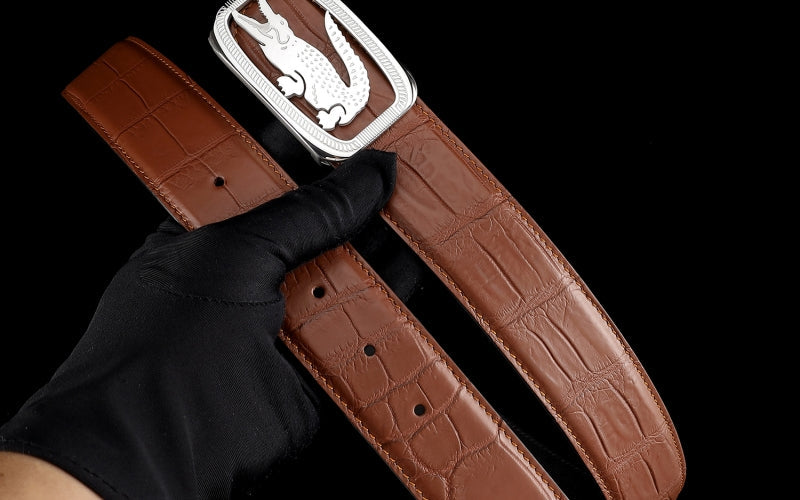
- Cognac crocodile — pairs with khaki, olive, stone, navy, and pale pink polos. The most forgiving color on the rack and the easiest to carry from the cart to dinner. Our cognac crocodile belt guide breaks down the exact shade range.
- Navy crocodile — quietly authoritative. Looks excellent with white trousers, light gray flannels, and seersucker. See our navy crocodile belt notes for buckle pairings.
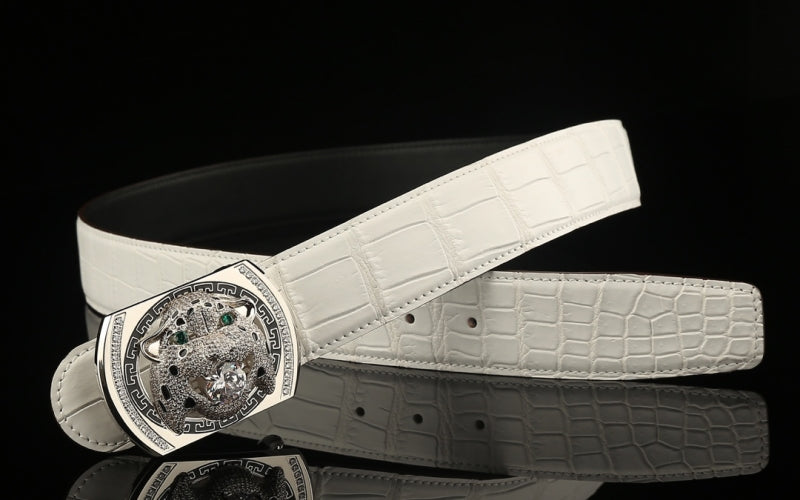
- White-cream crocodile — a club classic in Florida, the Hamptons, and Palm Springs. Beautiful, but vulnerable; review our white crocodile belt care brief before committing.
Avoid bright reds, oranges, and high-contrast two-tones at most traditional clubs — they're closer to nightclub than fairway.
What about the buckle — polished, matte, or decorative?
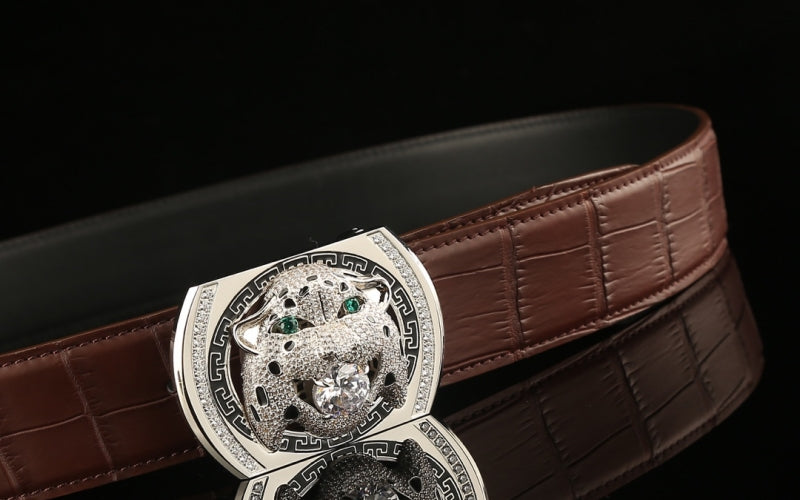
Choose a polished stainless or matte-brushed buckle in a plain rectangular or rounded shape. Country-club codes are deliberately understated, so rhinestone, oversized logo, animal-head, or high-shine gold buckles read as flashy and break the dress code at most traditional clubs.
We build every BELTLEY buckle from stainless steel — the same alloy used in dive watches and surgical tools — so it resists tarnishing from sweat and sunscreen. A simple plaque or box-and-prong buckle in brushed silver is the safest country-club bet.
If you prefer warm metal, go matte gold rather than mirror gold; it photographs and ages better. In the post-logo luxury goods shift, restraint is now the most expensive-looking signal in menswear.

How should I pair a crocodile belt with golf chinos, Bermuda shorts, and a 19th-hole blazer?
Treat the belt as a horizontal anchor: it should sit one shade darker than your trousers and echo the warmth of your watch strap. Cognac with stone chinos, navy with white Bermudas, and a richer brown with a hopsack blazer all work. The same 1.25" belt can carry you from tee box to dining room without a change.
A few specific pairings our customers reorder again and again:
- Stone chinos + white polo + cognac crocodile — the universal country-club uniform.
- Navy Bermuda shorts + white polo + navy crocodile (1.18") — sharp, summer-club-ready.
- Light gray trousers + cashmere quarter-zip + dark brown crocodile — early-fall member-guest tournament.
- Hopsack navy blazer + cream trousers + cognac crocodile — 19th-hole drinks and dinner.
For more outfit math, our crocodile belt outfit guide lays out twelve full looks with photos.
Key Takeaways (mid-post checkpoint)
- Width: 1.18"-1.25" only — never 1.5" on the course.
- Color: cognac, navy, or white-cream. Skip neon and two-tones.
- Buckle: plain stainless or matte gold; no rhinestone, no animal heads.
- Match: belt to watch strap first, shoes second.
- Finish: matte or semi-matte beats high-glaze in summer sun.
Do sweat, sun, and sunscreen actually damage a crocodile belt?
Yes — direct sunscreen contact and prolonged UV are the two biggest threats to any exotic leather belt, and they're worst on white-cream and high-glaze finishes. Sunscreen oils break down the surface glaze, while UV slowly fades dyed scales and stiffens the leather backing.
A few field rules from our workshop:
- Apply sunscreen 10 minutes before belting up. Let it absorb into skin so the waistband isn't sitting in wet SPF.
- Wipe the belt with a dry cotton cloth after the round. Salt and SPF residue should never sit overnight.
- Skip glazed finishes in summer. A high-shine glaze looks stunning indoors but turns dull and patchy after repeated sunscreen contact. Choose a semi-matte hand-buffed finish for a golf-first belt.
- Rotate. No leather belt — crocodile included — should be worn 18 holes a day, seven days a week. Our full leather care guide covers conditioning intervals.
White-cream is the most beautiful color on the rack and the most punishing to own. If you only have one country-club belt, start with cognac.
Should I match my belt to my shoes or my watch strap?
Match the watch strap first, the shoes second. On a golf course you're rarely wearing dress shoes — you're in spikeless saddles or sneakers — so the traditional belt-to-shoe rule breaks down. The watch is the consistent leather signal on your body, so anchor your belt to its strap tone.
If you wear a cognac alligator strap on the weekends, a cognac crocodile belt is the natural partner. A black rubber dive-watch strap pairs cleanly with a dark brown or navy crocodile belt. For deeper context, our belt-and-watch pairing notes walk through the logic across six common strap colors.
What's the etiquette around buckle noise on the green?
Modern country-club etiquette discourages any metal-on-metal sound near a putting green — that includes a heavy belt buckle clinking against a phone, club shaft, or zipper while a competitor is putting. Choose a flat plaque or rounded box buckle that sits flush against the body, and tuck your polo so nothing taps.
This is small, but members notice. A slim 1.18" belt with a flush plaque buckle is essentially silent. Oversized double-prong or heavy western buckles are not — save those for casual wear off-property.
The Bottom Line
A crocodile belt for golf isn't a costume — it's a quiet credential. Get the width right (1.18"-1.25"), the color right (cognac, navy, or cream), and the buckle restrained (brushed stainless or matte gold), and you'll move from first tee to clubhouse dinner without changing a thing. At BELTLEY, every crocodile belt is hand-cut, hand-stitched, and finished in our workshop, then shipped within 2-3 days — no Brand Tax, no waiting weeks, just a belt built to outlast the dress code. When you're ready, browse our crocodile belt collection and pick the one that earns its spot in your rotation.
Frequently Asked Questions
Q: Are crocodile belts allowed at country clubs? A: Yes — at virtually every traditional club, crocodile and alligator belts are welcome and often preferred over logo belts. The key is keeping the buckle understated; the leather itself is never the issue.
Q: Can I wear a crocodile belt with Bermuda shorts? A: Absolutely, and it's a country-club summer signature. Drop down to a 1.18" width and stick with cognac, navy, or stone-cream to keep the proportions and palette right for shorts.
Q: Is white crocodile belt practical for daily golf? A: It looks fantastic but is the highest-maintenance color. Sunscreen, grass stains, and UV will all show first on white. If you only own one golf-ready crocodile belt, start with cognac and add white as a second.
By the BELTLEY artisan team — handcrafting exotic leather belts since 1999.
Last updated: May 10, 2026.
,%20not%20the%201.5%22%20dress%20width.%0ABest%20colors%20for%20country-club%20codes:%20cognac,%20navy,%20and%20white-cream%20%E2%80%94%20skip%20flashy%20gold%20or%20rhinestone%20buc...)