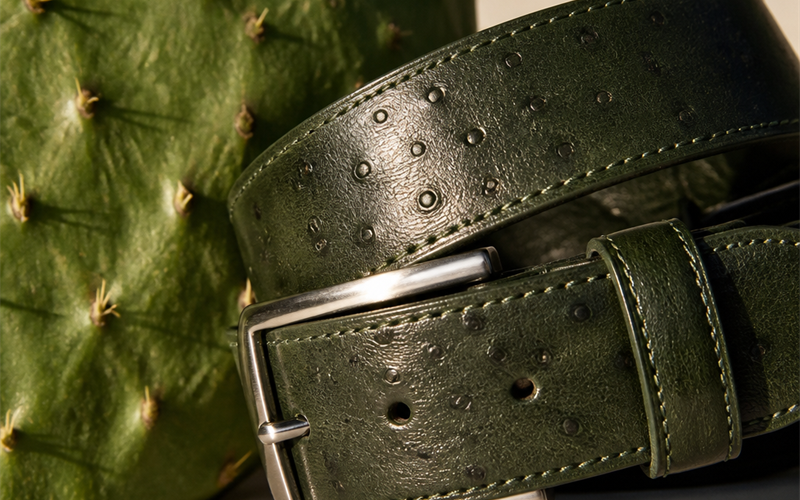
Cactus, Mushroom & Apple Leather Belts — Real or Marketing?
Quick answer: All three are real materials. None are pure plant. Cactus, mushroom, and apple leather all use plant or fungal fibers as the substrate, but almost all commercial versions include a polyurethane (PU) coating to function like leather. They're partially bio-based — better than full plastic, worse than the marketing suggests.
Last updated: May 2026 • By BELTLEY Editorial
TL;DR:
- All three exist. All three are sold in real belts (mostly by small brands).
- All three combine plant/fungus fibers with a polyurethane (PU) plastic coating.
- "Cactus leather" is roughly 80-90% plant; the rest is PU.
- Durability ranges from 1-3 years for most. Marketing often implies more.
- "Plant-based" ≠ "biodegradable" ≠ "long-lasting." Three different things.
You see a belt labeled "cactus leather" and your brain helpfully fills in: cactus = plant = green = ethical = win. The brand happily collects $89.
Here's what you're actually buying.
Plant Leather: Buy, Skip, or Wait?
The honest decision after the hype:
| Your situation | Go with |
|---|---|
| Strictly avoiding animal products | Cactus (Desserto-type) is the most mature option — accept the PU coating and 2–4 year lifespan. |
| Buying for sustainability | Check the PU percentage first — most "plant leather" is majority plastic with botanical filler. |
| Expecting leather-like aging | Wait — no current plant material develops patina; they only degrade. |
| Optimizing footprint per year of use | Veg-tanned full-grain still wins the math — 15–25 years of service from $58. |
The long-lifespan benchmark: BELTLEY's veg-tan full-grain belts.
What is cactus leather?
Cactus leather is made from the mature leaves (pads) of the nopal cactus, native to Mexico. The pads are harvested, dried, ground, and mixed with binders to form a leather-like sheet. The most well-known brand is Desserto, founded in Mexico in 2019. Their material is approximately 90% bio-based, with a polyurethane coating providing water resistance and durability.

Per Wikipedia's plant-based leather overview, cactus leather has "a tested durability of ten years" in optimal conditions. The official Desserto site is at desserto.com.mx for direct verification.
In real-world belt wear, ten-year durability assumes ideal conditions. Daily-wear results commonly fall in the 2-4 year range before visible cracking or coating wear.
Key stat: Cactus is one of the few crops on earth that requires no irrigation in its native climate — nopal grows on rainwater alone. That's the underlying environmental case for cactus leather.
What is mushroom leather?
Mushroom leather is made from the mycelium of fungi, typically grown on agricultural waste substrates. The mycelium forms a dense mat that can be harvested, compressed, and treated to mimic leather. Major commercial brands have included MuSkin (Italian, by Grado Zero Espace) and Mylo (US, by Bolt Threads — which scaled back production in 2023).
The advantage: mycelium grows in 2-3 weeks. The disadvantage: most commercial mushroom leather still needs a PU coating to handle daily wear without disintegrating.
For belt applications, mushroom leather has been more of a fashion statement (luxury runway pieces) than a daily-wear product. The high-volume durability remains unproven outside short product cycles.
What is apple leather?
Apple leather (often branded as AppleSkin or Mela) uses the pomace from apple juice production — the skin and core leftovers — as a fiber base. Combined with polyurethane and other binders, it forms a leather-substitute sheet. It's manufactured primarily by Frumat in Italy.
Apple leather is PETA-approved Vegan, USDA Biopreferred, and OEKO-TEX certified — per the Wikipedia plant-based leather summary. The bio-based content is typically around 50%, with the remainder being PU.
It's used in shoes, bags, accessories, and a small but growing number of belt products.
Plant-based leather — what's actually in it?
| Material | Plant/fungus content | Plastic content | Typical durability | Biodegradable? |
|---|---|---|---|---|
| Cactus leather (Desserto) | ~90% nopal cactus | ~10% PU | 2-4 yr (real-world) | Partially |
| Mushroom leather (mycelium) | ~70-90% mycelium | 10-30% PU | 1-3 yr | Partially |
| Apple leather (AppleSkin) | ~50% apple pomace | ~50% PU | 1-3 yr | Partially |
| Pineapple leather (Piñatex) | ~80% pineapple leaf | ~20% PLA + petroleum resin | 2-4 yr | No |
| PU vegan leather (no plant) | 0% | 100% petroleum | 1-3 yr | No |
| Full-grain animal leather | 100% animal | 0% | 15-25 yr | Yes (slowly) |
Source: composition data sourced from manufacturers and the Wikipedia plant-based leather article.

Is plant-based leather biodegradable?
Not fully. Almost every commercial plant-based leather uses a polyurethane (PU) coating that prevents complete biodegradation. The plant fibers underneath will degrade if separated from the coating — but in a discarded belt, the layers don't separate, so the whole product persists in landfills similar to plastic.
Piñatex, for example, is described as "non-biodegradable" on its own Wikipedia page despite being made primarily from pineapple leaf fiber. The PLA and petroleum-based resin coating prevents breakdown.
The marketing word is "bio-based." The misleading inference is "biodegradable." The two are not synonyms.
Are plant-based leather belts more sustainable than real leather?
It depends on lifespan, the same way every leather sustainability comparison does. A cactus leather belt that lasts 3 years has roughly half the production footprint of a cowhide belt — but if the cowhide belt lasts 20 years, the per-year-of-use math flips. Add the end-of-life problem (plant-based leathers don't biodegrade, leather does) and the picture gets messier.

See our full breakdown in carbon footprint of a leather belt vs a vegan belt and are vegan leather belts actually better for the environment.
Why do these materials need a PU coating?
The plant fibers alone don't behave like leather. They're not water-resistant. They tear under tension. They scuff easily. Polyurethane provides the physical properties — water resistance, scratch resistance, flexibility under stress — that make the material function as a belt.
Without PU, a pure cactus or apple "leather" belt would survive maybe one rainstorm and then look like a sad cracker. The plastic coating is what makes the product wearable. It's also what compromises the green claims.
Are there pure plant-fiber belts with no plastic?
A few exist, mostly from boutique sustainability-focused brands. They're usually woven canvas, organic cotton, or hemp belts with metal hardware. They're not "leather" in any sense — but they're often the lowest-footprint vegan option that lasts more than a year.
If you want to skip plastic entirely and skip animal leather, a quality canvas belt is more honest than a plant-based "leather" belt with a PU coating. See our are canvas belts good for men post.
How long does cactus or mushroom leather actually last in a belt?
Real-world durability varies widely by brand and construction. Most reports from buyers cluster in the 2-4 year range before visible cracking, peeling, or coating wear. Marketing claims of "10 years" assume light wear and ideal storage — not the daily commute and waistband flex a belt actually sees.

Compared to a $200 full-grain leather belt at 15-25 years, the per-year math heavily favors real leather. Compared to a $25 fast-fashion bonded leather belt at 1 year, cactus leather wins.
Why do brands market plant-based leather so heavily?
Two reasons. First, it's genuinely interesting innovation, and consumers respond to the story. Second, "plant-based" is a marketing premium that supports higher prices than ordinary PU vegan leather, despite the materials being chemically similar in their finished form.
The story is real. The premium is partly justified by genuine R&D and small-batch production. The implication that you're buying a biodegradable, long-lasting eco-product is usually marketing.
Should you buy a cactus, mushroom, or apple leather belt?
If you want to specifically support plant-based material development, yes — buying these products funds the R&D that may eventually produce truly biodegradable alternatives. If you want the lowest-footprint, longest-lasting belt option, no — a full-grain vegetable-tanned leather belt usually wins on both axes.

These materials are real innovations. They're just not the eco-miracle the labels imply yet.
The Bottom Line
Cactus, mushroom, and apple leather are real materials. They're partially bio-based. They're not biodegradable. They're not durable enough yet to beat quality animal leather on per-year-of-use sustainability math. The category is promising but oversold. If you want a 20-year belt with the lowest environmental impact per year of use, full-grain vegetable-tanned leather is still the answer.
BELTLEY's full-grain Tuscan vegetable-tanned belts are designed for 15-25 year lifespans — the same approach that's been quietly outperforming "innovation" categories for centuries. Browse the full-grain leather collection or read more on what is vegetable tanning.
Frequently Asked Questions
Q: Is cactus leather real leather?
No. Cactus leather is a plant-based vegan leather alternative made from nopal cactus pulp combined with polyurethane. It's not animal leather and uses different chemistry.
Q: How long does cactus leather last?
Real-world durability ranges from 2-4 years for daily-wear products. Manufacturer claims of "10 years" assume light wear and ideal conditions.
Q: Is mushroom leather biodegradable?
Mostly not. Commercial mushroom leather products typically use a polyurethane coating that prevents full biodegradation, even though the mycelium substrate is bio-based.
Q: Is apple leather sustainable?
It uses apple pomace waste from juice production, which is positive. The PU coating reduces the sustainability advantage. It's a "better than full plastic, worse than the marketing implies" middle position.
Q: Are plant-based leathers cruelty-free?
Yes — they involve no animal products. Whether they're more environmentally responsible than long-lived animal leather is a separate question.
Q: What's the most sustainable belt I can buy?
A long-lived full-grain vegetable-tanned leather belt from a reputable tannery, or a quality woven canvas belt — both beat plant-based vegan leathers on per-year-of-use math.


