Belts You Should NOT Wear on a Long-Haul Flight
Quick answer: Avoid stiff, tight, wide belts with bulky buckles on a long-haul flight. Sitting still for 8–14 hours makes your waist and legs swell, and a rigid belt cinched at one fixed hole digs in. The worst offenders are heavy plate buckles, thick double-layer belts, and anything you can't loosen on the fly.
Last updated: May 2026 • By BELTLEY Editorial
TL;DR:
- Your waist swells in-flight — a belt set tight at takeoff feels punishing by hour six.
- Skip stiff, wide, bulky-buckle belts. They press into your stomach when you slouch in a seat.
- Tight waistbands restrict circulation, which matters on flights over four hours.
- Best pick: a slim, soft, micro-adjustable belt (or one you can simply loosen one notch).
A 13-hour flight from New York to Hong Kong changes your body. Cabin pressure and hours of sitting cause fluid to pool in your legs and abdomen, so your waist can expand by an inch or more. The belt that fit perfectly at JFK becomes a tourniquet over the Pacific. The fix isn't going beltless — it's wearing the right belt. Below, we name the belts to leave in your bag, explain the comfort and health reasons, and tell you what to wear instead. If you're not sure how snug is too snug day-to-day, our guide on the side effects of wearing a tight belt is a useful primer.

Which belts should you avoid on a long flight?
Avoid three types: heavy plate-buckle belts, thick double-layer or stiff full-grain belts, and any belt with a bulky buckle that presses your abdomen when you lean back. These don't flex as your waist swells, and the hard buckle becomes a pressure point against a reclined seat.

The problem is rigidity. A stiff belt holds one shape. Your body doesn't. As you slouch, recline, and bloat over a long flight, an unyielding strap and a thick buckle have nowhere to go but into your stomach. A chunky plate or western buckle is the worst — it sits exactly where your seatbelt and waistband already compress you.
Why does a tight belt feel worse on a plane?
Because your circulation is already working against you. Sitting still for hours slows blood flow in your legs and lets fluid collect at your waist and ankles. A tight belt adds external pressure on top of that, squeezing veins that are already sluggish — so you feel bloated, achy, and pinched.

This isn't just discomfort. Prolonged immobility on long flights is a recognized risk factor for deep vein thrombosis, the blood clots that form when leg circulation stalls. The phenomenon is common enough to have earned the nickname "economy class syndrome." Tight waistbands and belts don't help — anything that constricts blood returning to your heart works against you on a long-haul leg.
Key stat: Cabin conditions and hours of sitting can swell your waistline by up to 1 inch (2.5 cm) on an ultra-long-haul flight — enough to turn a comfortable belt notch into a painful one.
What is the best belt to wear on a long-haul flight?
A slim, supple belt with easy adjustment. The ideal travel belt is narrow (1 to 1.25 inches), made of soft, broken-in leather, and either ratchet-style or easy to loosen a notch mid-flight. It holds your trousers without locking your waist into one fixed size.

Ratchet belts shine here. A ratchet (micro-adjust) belt clicks to roughly quarter-inch increments, so you can let it out one click when you swell and snug it back before landing. A soft braided belt also flexes naturally. The goal is a belt that moves with your body, not against it. For the basics of fit, our guide on how far a belt should extend past the buckle helps you dial in the right notch before you board.
Belt-by-belt: flight comfort ranked
| Belt type | Width | Flexibility | Long-haul verdict |
|---|---|---|---|
| Heavy plate-buckle belt | Wide | Rigid | Avoid — buckle digs in |
| Thick double-layer belt | Wide | Stiff | Avoid — no give |
| Standard full-grain dress belt | Medium | Moderate | OK if loosened a notch |
| Ratchet / micro-adjust belt | Slim | Adjustable | Best — fine-tune in seat |
| Soft braided belt | Slim | Flexible | Great — natural stretch |
How should you wear a belt during the flight itself?
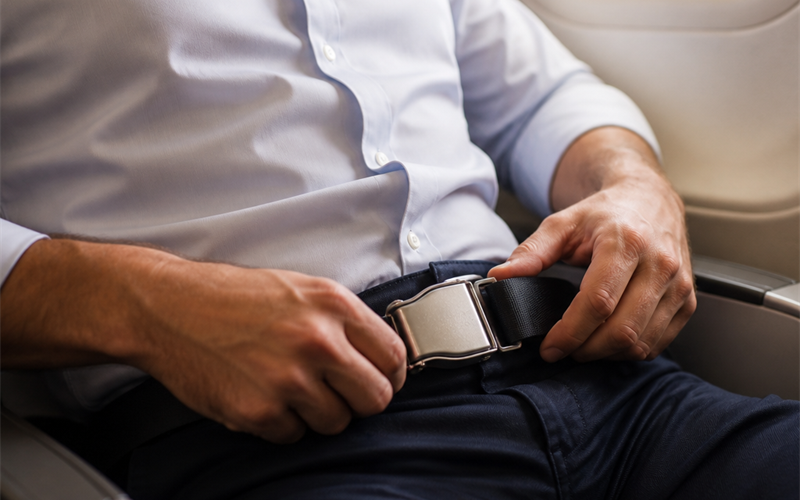
Loosen it. Once you're seated and the seatbelt sign is off, drop your belt by one notch — or unbuckle it entirely and re-snug before you stand. Combine that with aisle-seat leg movement and you protect both your comfort and your circulation.

Movement matters more than the belt alone. Health guidance for long flights centers on calf exercises, walking the aisle, and choosing an aisle seat so you get up easily. Your belt should support that, not fight it. A travel-friendly belt from our men's collection or women's collection in a soft, slim profile makes the loosen-and-move routine effortless.
The Bottom Line
The belt that fits you on the ground is not the belt your body wants at 38,000 feet. Long-haul flights swell your waist and slow your circulation, so stiff, wide, bulky-buckle belts turn into pressure points you'll regret by the second meal service. Pack those for the destination, not the seat. For the flight itself, wear something slim, soft, and adjustable — a ratchet belt or a broken-in braided one — and loosen a notch once you're cruising. At BELTLEY, we build belts to be lived in, including the 13-hour days, so choosing the right travel belt is half about quality leather and half about knowing when to give yourself an inch. Ready to travel more comfortably? Browse our casual and everyday belts built for real movement.
Frequently Asked Questions
Q: Is it bad to wear a belt on a long flight?
It's not dangerous on its own, but a tight belt can add to the circulation and swelling problems that come with sitting still for hours. The safe move is to wear a comfortable, adjustable belt and loosen it once you're seated.
Q: What kind of belt is most comfortable for flying?
A slim, soft belt that adjusts easily — a ratchet (micro-adjust) belt or a flexible braided belt. Both let you fine-tune the fit as your waist changes during the flight without leaving a pressure mark.
Q: Should I take my belt off completely on the plane?
You can, especially on ultra-long-haul flights. Many travelers unbuckle once seated for comfort. Just re-fasten it before you stand or land. Remember a metal buckle also has to come off at security screening.
Q: Do tight clothes really affect circulation on flights?
Yes. Tight waistbands and belts add pressure on veins that are already moving blood slowly because you're seated. Looser, flexible clothing helps your circulation stay closer to normal on long flights.