Are Off-White Belts Still in Style in 2026? The Ultimate Guide
TL;DR: Quick Answer
- Off-White belts aren't the accessory anymore, but they're not dead either — they've shifted from mainstream hype piece to niche streetwear staple with genuine cultural weight.
- The yellow industrial belt screams 2018 if you style it wrong. The black version still works in the right outfit.
- With Off-White now sold off by LVMH and resale prices down 40%, these belts are more about Virgil's legacy than flex value.

Let's be real for a second. If you bought an Off-White industrial belt between 2017 and 2020, you weren't alone. That bright yellow strap dangling past your knees was everywhere — music videos, street style roundups, Instagram flat lays, airport paparazzi shots. It was the accessory that said "I get fashion" without requiring you to explain anything.
But that was a few years ago. And fashion has a funny way of turning yesterday's must-have into today's "hmm, maybe not." So if you're wondering whether Off-White belts are still in style in 2026 — or if that industrial belt in your drawer is worth pulling out again — here's where things actually stand. (And if you're curious how the whole designer belt landscape has shifted, we've got a full breakdown.)

Is the Off-White Industrial Belt Still Cool?
It's complicated. The industrial belt isn't "cool" the way it was in 2018, when wearing one made you look like you had insider access to fashion's inner circle. That moment passed. But it hasn't crossed into embarrassing territory either — it's landed somewhere in between, as a recognizable piece of fashion history that still works if you know what you're doing.
Here's the thing most style guides won't tell you: the industrial belt aged the way band t-shirts age. Wear it like a costume and it looks try-hard. Wear it like it's just yours — something you've had for years because you genuinely like it — and it reads completely different. Farfetch called the industrial belt a "G.O.A.T" accessory for good reason. Some pieces transcend their hype cycle.
That said, the 2026 belt trend is moving hard toward leather-first, hardware-forward designs. Quiet luxury. Brushed metal buckles. Full-grain leather that looks better at year five than year one. The industrial belt's nylon webbing and plastic buckle sit outside that conversation entirely — which is either a problem or a feature, depending on your personal style.

What Happened to Off-White as a Brand?
You can't talk about the belt without talking about the brand, and the brand has been through a lot. Virgil Abloh — the founder, the creative engine, the reason Off-White existed in the way it did — passed away in November 2021. That loss changed everything.
LVMH, which had acquired a majority stake in Off-White, sold the brand to Bluestar Alliance in late 2024. That's a brand management company — not a fashion house, not a creative studio. The move signaled that LVMH couldn't sustain Off-White's cultural relevance without Virgil at the helm. According to Business of Fashion's reporting, the brand struggled against both the broader luxury slowdown and the fading streetwear cycle.
So when you wear an Off-White belt in 2026, you're wearing a brand in transition. For some people, that's a turnoff. For others — especially those who genuinely loved Virgil's vision — it's a reason to hold onto the piece even tighter.

How to Actually Style an Off-White Belt in 2026 (Without Looking Dated)
Okay, so you've got the belt. Maybe the yellow one, maybe the black one, maybe that red version you impulse-bought. Here's how to make it look intentional in 2026 rather than leftover from 2018.
The black industrial belt is your safest bet. It reads more like an interesting accessory choice and less like a billboard. Thread it through wide-leg trousers or cargo pants, let the tail hang, and keep the rest of your outfit neutral. According to Who What Wear's 2026 belt styling guide, belts worn with intention — meaning they're clearly a styling choice, not an afterthought — carry the most visual weight right now.
The yellow belt works, but only if you commit. Don't half-wear it. Cinch it over a long black coat. Double-wrap it over a blazer at the waist. The length is the whole point — High Snobiety's styling feature showed how the exaggerated drape creates a silhouette that no normal belt can replicate.
What to avoid: wearing it as your only statement piece with head-to-toe neutral basics. That was the 2018 formula — Off-White belt + all black + white sneakers. Everyone did it. Mix it into an outfit that already has personality, and it becomes a layer rather than a crutch.

Is an Off-White Belt Worth Buying in 2026?
Financially? Not really. StockX data shows a roughly 40% drop in resale prices since the peak in 2021. A belt that once resold for $250+ now moves in the $100-$150 range, and some colorways sit even lower. If you're buying for investment, this isn't it.
But "worth it" isn't always about resale value. If you genuinely like the aesthetic — the industrial hardware, the oversized webbing, the design language that Virgil built — then $150-$200 for the real thing is reasonable. It's a piece of fashion history from one of the most influential designers of the 21st century. That means something.
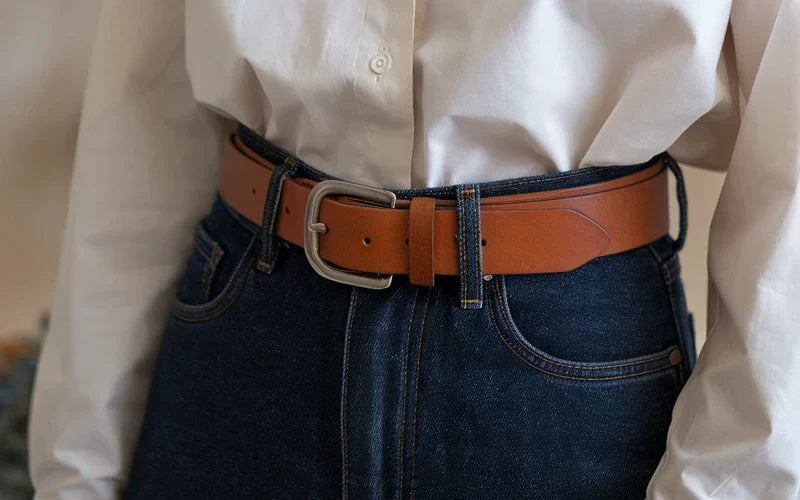
If your priority is a belt that feels premium — real leather, solid hardware, something that gets better with age — that's a different conversation. A handcrafted full-grain leather belt gives you materials that the Off-White industrial belt simply doesn't offer: no nylon webbing, no plastic components, no cracking or fraying after a couple years of wear.

What Are People Choosing Instead?
The streetwear-to-luxury pipeline that Off-White helped build has changed direction. In 2026, the buyers who used to grab industrial belts are now reaching for:
- Full-grain leather belts with architectural buckles — the brutalist belt trend favors heavy hardware and premium hides over branded nylon
- Exotic leather belts — a crocodile or alligator belt makes a louder statement through texture alone than any logo ever could
- Artisan-made pieces with hand-finished edges and brass or stainless steel hardware — the kind of belt you can't fake with a knockoff
At BELTLEY, we've watched this shift happen in real time. Our customers used to ask about designer logos. Now they ask about leather grade, tanning origin, and buckle metallurgy. That tells you everything about where fashion is heading. A unique handmade belt with 316L stainless steel hardware and a 10-year warranty doesn't need a yellow tag to get noticed.
The Bigger Picture
Virgil Abloh did something extraordinary with Off-White. He proved that a belt — literally a strip of industrial webbing with quotation marks printed on it — could carry cultural meaning. Could spark conversations. Could make people feel like they were part of something. That's rare, and it's worth respecting regardless of trend cycles.
But fashion also moves forward. The Off-White industrial belt belongs to a specific era of streetwear-meets-luxury that peaked in the late 2010s. Holding onto one because you love it? Great. Buying one in 2026 expecting it to land the same way it did in 2018? You'll be disappointed. The conversation has moved to materials, craftsmanship, and quiet confidence — things that don't need quotation marks to make a point.

The Bottom Line
Off-White belts are still in style in 2026, but in a much narrower lane. The black industrial belt works as a streetwear accent piece when styled with intention. The yellow belt is a nostalgic statement — wear it if it's genuinely your vibe, not because you think it's what you're supposed to wear. And if you're shopping for a new belt today, the smart money is on leather and hardware that will look better in five years, not worse.
Check out BELTLEY's designer belt collection for handcrafted options that skip the hype cycle entirely — full-grain leather, 316L stainless steel buckles, free worldwide shipping, and a 10-year warranty that means we actually stand behind what we make.
Frequently Asked Questions
Q: Are Off-White industrial belts played out?
Not exactly, but they've lost their mainstream momentum. The industrial belt works best as a deliberate streetwear styling choice in 2026 — not as a default "designer flex" accessory. The black version ages better than the yellow one in most outfits. If you already own one, keep it. If you're buying new, consider whether the aesthetic truly fits your wardrobe.
Q: How much is an Off-White belt worth now?
Retail prices sit around $150-$225 depending on the model. Resale values have dropped roughly 40% since 2021, with most pre-owned industrial belts selling for $80-$150 on StockX and eBay. Rare collaborations or unworn deadstock can command more, but standard colorways have softened significantly.
Q: Is Off-White still a luxury brand?
Off-White's positioning has shifted. After LVMH sold the brand to Bluestar Alliance in 2024, it moved from a luxury fashion house to a brand management portfolio. The products still carry premium pricing, but the creative direction and cultural cachet that Virgil Abloh built have been harder to maintain without him.
Q: What belt styles are replacing Off-White belts in 2026?
The 2026 belt trend favors full-grain leather with architectural hardware — brushed metal buckles, heavy-gauge brass, and structural silhouettes. Exotic leather belts and artisan-made pieces with hand-finished details have replaced logo-driven accessories as the go-to for style-conscious buyers.
Q: Can you still wear a yellow Off-White belt?
Yes, but commit to the look. Double-wrap it over a coat or blazer, use it as a waist-cinching layer over a dress, or thread it through wide-leg pants and let the tail hang. The yellow belt demands a styled outfit — throwing it on with basic jeans and a t-shirt reads as 2018 rather than 2026.