Are Alligator or Crocodile Leather Belts Durable? Lifespan & Strength Data
TL;DR: Quick Answer
- Yes — alligator and crocodile leather belts are among the most durable belts you can buy. With proper care, expect 20–25+ years of regular wear — roughly double the lifespan of premium full-grain cowhide.
- Alligator leather has a tensile strength of approximately 2,500 PSI, with an interlocking scale fiber structure that distributes stress more evenly than cowhide's parallel fibers.
- The main durability risk isn't the leather itself — it's improper care. Moisture, heat, and neglect shorten exotic leather lifespans dramatically.

You're considering spending $200–$500+ on an alligator or crocodile belt, and the obvious question is: will it actually last? The price only makes sense if the leather holds up significantly longer than a standard belt.
The good news is that the material science supports the investment. Both alligator and crocodile hides have physical properties — fiber density, scale structure, tensile strength — that make them genuinely superior to cowhide for long-term wear.
This guide covers the hard data behind exotic leather belt durability, how alligator and crocodile compare to each other and to cowhide, what causes these belts to fail, and how to maximize their lifespan.

How Long Do Alligator and Crocodile Belts Last?
A well-maintained alligator or crocodile belt lasts 20–25+ years of regular wear. That's two to three times longer than premium full-grain cowhide, which typically reaches 10–15 years under similar conditions.
The lifespan gap comes down to fiber structure. Reptilian hides have dense, interlocking collagen fibers arranged in a complex three-dimensional weave beneath the scales. Cowhide fibers run in more parallel, layered arrangements. The interlocking pattern in exotic leather distributes stress more evenly across the hide, reducing the localized fatigue that causes cowhide belts to crack at buckle holes and bend points. Research on crocodilian skin structure confirms that the dense dermal matrix is what gives these hides their exceptional resistance to tearing.
Here's how exotic leather belt lifespans compare to other grades:
| Leather Type | Expected Lifespan (Daily Wear) | With Proper Care + Rotation |
|---|---|---|
| Alligator | 15–20 years | 20–25+ years |
| Crocodile | 15–20 years | 20–25+ years |
| Elephant | 20–25 years | 25–30+ years |
| Full-grain cowhide (veg-tanned) | 10–15 years | 15–25 years |
| Full-grain cowhide (chrome-tanned) | 7–10 years | 10–15 years |
| Ostrich | 10–15 years | 15–20 years |
For a deeper breakdown of cowhide belt grades and their lifespans, see our guide on leather belt durability.

What Makes Alligator and Crocodile Leather So Strong?
Three physical properties give reptilian leather its strength advantage over cowhide: fiber density, scale architecture, and natural water resistance.
Fiber density. Alligator leather has a tensile strength of approximately 2,500 PSI — the force needed to tear the material apart. For context, premium full-grain cowhide typically measures 25+ MPa (~3,600 PSI) in controlled tensile testing, but that number drops significantly at stress points like buckle holes where fibers are cut. Alligator's interlocking fiber structure maintains more consistent strength across the entire hide, including around perforations.
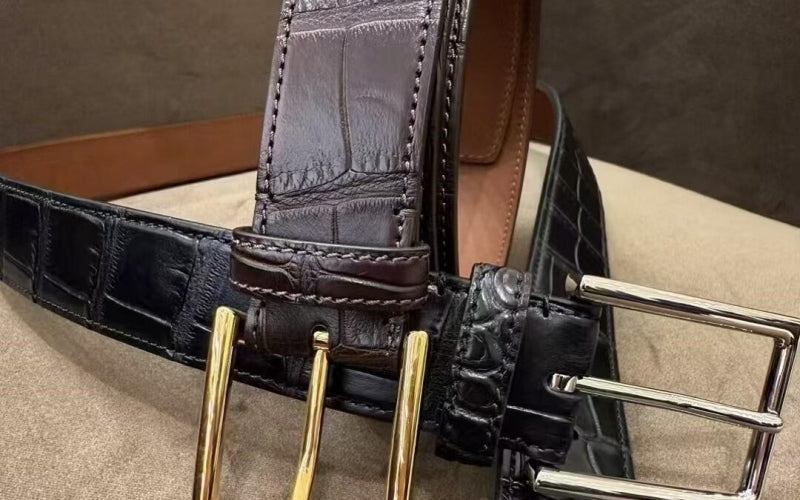
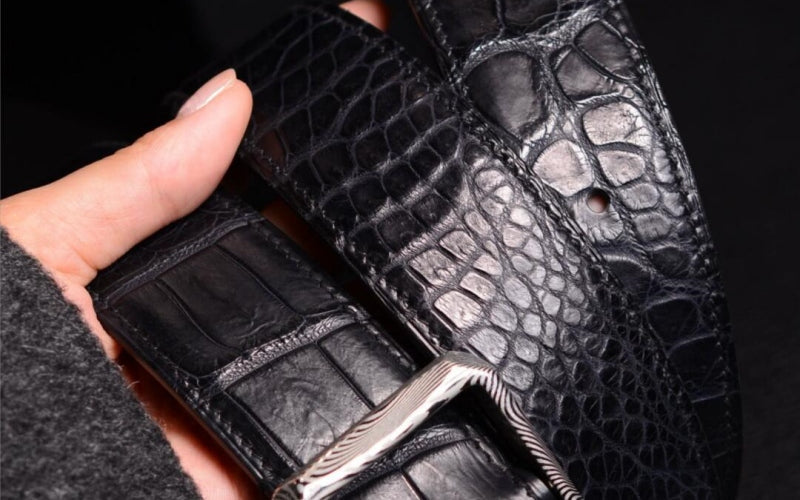
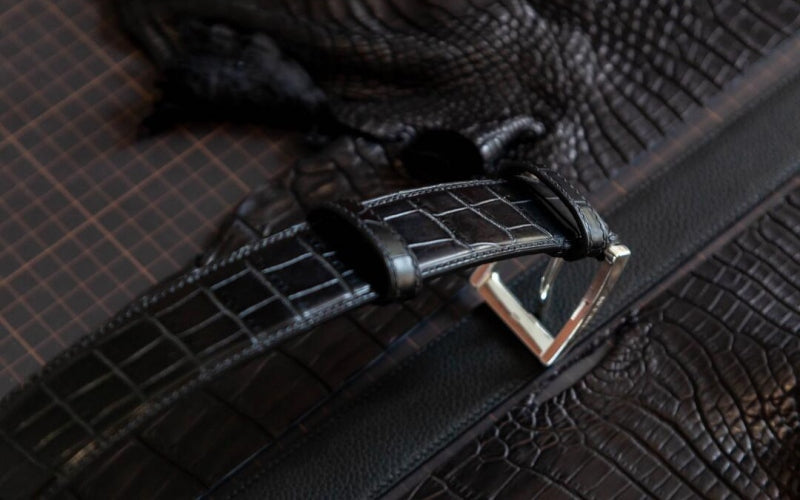
Scale architecture. The raised scales on alligator and crocodile hides aren't just decorative — they're structural. Each scale sits over a dense pad of collagen, and the scales overlap in a pattern that distributes impact and abrasion across a wider area rather than concentrating it at a single point. This is why exotic leather resists surface scratching better than smooth cowhide.
Natural water resistance. While not waterproof, alligator and crocodile hides are naturally more water-resistant than cowhide due to their tighter fiber density and the calcium deposits (osteoderms) embedded in the dermis. Water penetrates more slowly through exotic leather, giving you more time to dry it before damage occurs.

Is Alligator More Durable Than Crocodile?
The durability difference between alligator and crocodile is minimal — both are exceptional. Crocodile leather is slightly tougher and more rigid due to its less regular scale arrangement, while alligator offers better uniformity, flexibility, and a softer hand-feel.
In practical terms for belts, alligator's flexibility is actually an advantage. Belts undergo constant bending around the waist, and alligator's suppleness makes it less prone to cracking at flex points than stiffer crocodile. Crocodile's rigidity is better suited for items with less bending stress — handbags, watch straps, and wallets.
Here's the key difference breakdown:
| Property | Alligator | Crocodile |
|---|---|---|
| Scale pattern | Symmetrical, uniform | Irregular, varied |
| Flexibility | More supple | Stiffer |
| Crack resistance | Higher (better for belts) | Slightly lower at flex points |
| Abrasion resistance | Very high | Very high |
| Texture | Smoother, refined | More textured, rugged |
| Best for | Belts, dress accessories | Bags, structured items |
Both leathers are classified as premium exotic hides. For a full comparison beyond durability — including pricing, appearance, and sourcing — see our guide on alligator vs crocodile belts.

What Causes Alligator and Crocodile Belts to Fail?
Exotic leather belts rarely fail from the leather itself. The overwhelming majority of premature failures trace back to four preventable causes:
- Moisture damage. Despite natural water resistance, prolonged moisture exposure causes exotic leather fibers to swell and weaken. Sweat is the most common culprit — it contains salts and acids that degrade collagen over time. If your belt gets wet, dry it immediately with a soft cloth.
- Heat and UV exposure. Direct sunlight and heat sources dry out the natural oils in exotic leather, making it brittle. The calcium deposits in alligator scales are particularly susceptible to cracking when dehydrated.
- Improper conditioning. Standard leather conditioners formulated for cowhide can clog the scale patterns on exotic leather, trapping moisture underneath and accelerating deterioration. Always use exotic-specific conditioners.
- Hardware failure. A belt is only as strong as its weakest component. Cheap zinc-alloy buckles bend, corrode, and fail years before the exotic leather would. Quality hardware — like the 316L stainless steel buckles used in BELTLEY belts — ensures the hardware matches the leather's longevity.

How to Maximize Your Exotic Belt's Lifespan
Four practices will keep an alligator or crocodile belt in excellent condition for decades:
- Condition every 3–4 months with an exotic leather-specific cream. Products containing lanolin or mink oil work well for reptilian hides. Avoid wax-heavy products that seal scale edges. BELTLEY's leather care guide covers the step-by-step process for every exotic hide type.
- Rotate your belts. Even exotic leather benefits from rest between wearings. Rotating two belts prevents the same flex point from being stressed daily — the single most effective way to prevent buckle-hole cracking.
- Store flat or hanging in a cool, dry space. Never fold an exotic belt — folding creates a permanent crease that weakens the scale structure at the fold point. Keep away from direct sunlight and heat sources.
- Dry immediately if wet. Pat with a soft, lint-free cloth and allow to air-dry at room temperature. Never use a hair dryer or place near a heater — rapid drying causes the calcium in scales to contract and crack.
At BELTLEY, every alligator leather belt is handcrafted from full-thickness belly hide — the densest, most uniform section of the skin — paired with 316L stainless steel hardware and backed by a 10-year warranty. The leather will outlast the warranty by a wide margin if you follow these four steps.

The Bottom Line
Alligator and crocodile leather belts are genuinely durable — not just luxury marketing. The interlocking collagen fiber structure, scale architecture, and natural water resistance give exotic hides measurable advantages over cowhide in tensile strength, abrasion resistance, and longevity.
Expect 20–25+ years with proper care, compared to 10–15 for premium cowhide. The critical factor isn't the leather — it's what you do with it. Exotic-specific conditioning every 3–4 months, belt rotation, and proper storage protect your investment for decades. Pair that with quality hardware and construction, and an exotic belt becomes one of the most cost-effective accessories in your wardrobe on a per-year basis.
Browse BELTLEY's crocodile and alligator belt collection — handcrafted from full-thickness belly hides, fitted with 316L stainless steel buckles, and backed by a 10-year warranty.

Frequently Asked Questions
Q: Are alligator belts more durable than cowhide belts?
Yes — significantly. Alligator leather has interlocking collagen fibers that distribute stress more evenly than cowhide's parallel fiber structure. A quality alligator belt lasts 20–25+ years with care, compared to 10–15 years for premium full-grain cowhide. The exotic leather also resists surface scratching better due to its raised scale architecture.
Q: How do you maintain a crocodile leather belt?
Condition with an exotic leather-specific cream every 3–4 months. Avoid standard leather conditioners — they can clog scale patterns. Store flat or hanging in a cool, dry space away from direct sunlight. If the belt gets wet, dry it immediately with a soft cloth at room temperature. Never use heat to speed drying.
Q: Do alligator belts crack over time?
They can — but only from neglect, not normal wear. Cracking in exotic leather results from dehydration (lack of conditioning), heat exposure, or moisture damage. A properly conditioned and stored alligator belt maintains its flexibility and scale integrity for decades. The most common failure point is the buckle hole area, which belt rotation prevents.
Q: Is crocodile or alligator better for a belt?
Alligator is generally better for belts. Its greater flexibility and suppleness make it more resistant to cracking at the constant flex points a belt experiences around the waist. Crocodile is slightly tougher overall but stiffer — better suited for bags and structured accessories. Both last 20–25+ years with care. See our detailed alligator vs crocodile comparison for more.
Q: Why are alligator leather belts so expensive?
The cost reflects limited supply (CITES-regulated farming), labor-intensive tanning, and low yield — one alligator belly produces enough leather for approximately 2–3 belts. The resulting leather is also 2–3x more durable than cowhide, making the per-year cost competitive with premium cowhide belts. Our guide on why alligator leather is so expensive breaks down the full cost structure.
Q: Can you wear an alligator belt every day?
Yes — alligator leather handles daily wear well due to its high tensile strength and scratch resistance. However, rotating between two belts extends each belt's lifespan significantly by preventing same-spot fatigue. Daily wear without rotation may reduce lifespan from 25+ years to 15–20 years, which is still exceptional compared to any cowhide alternative.